
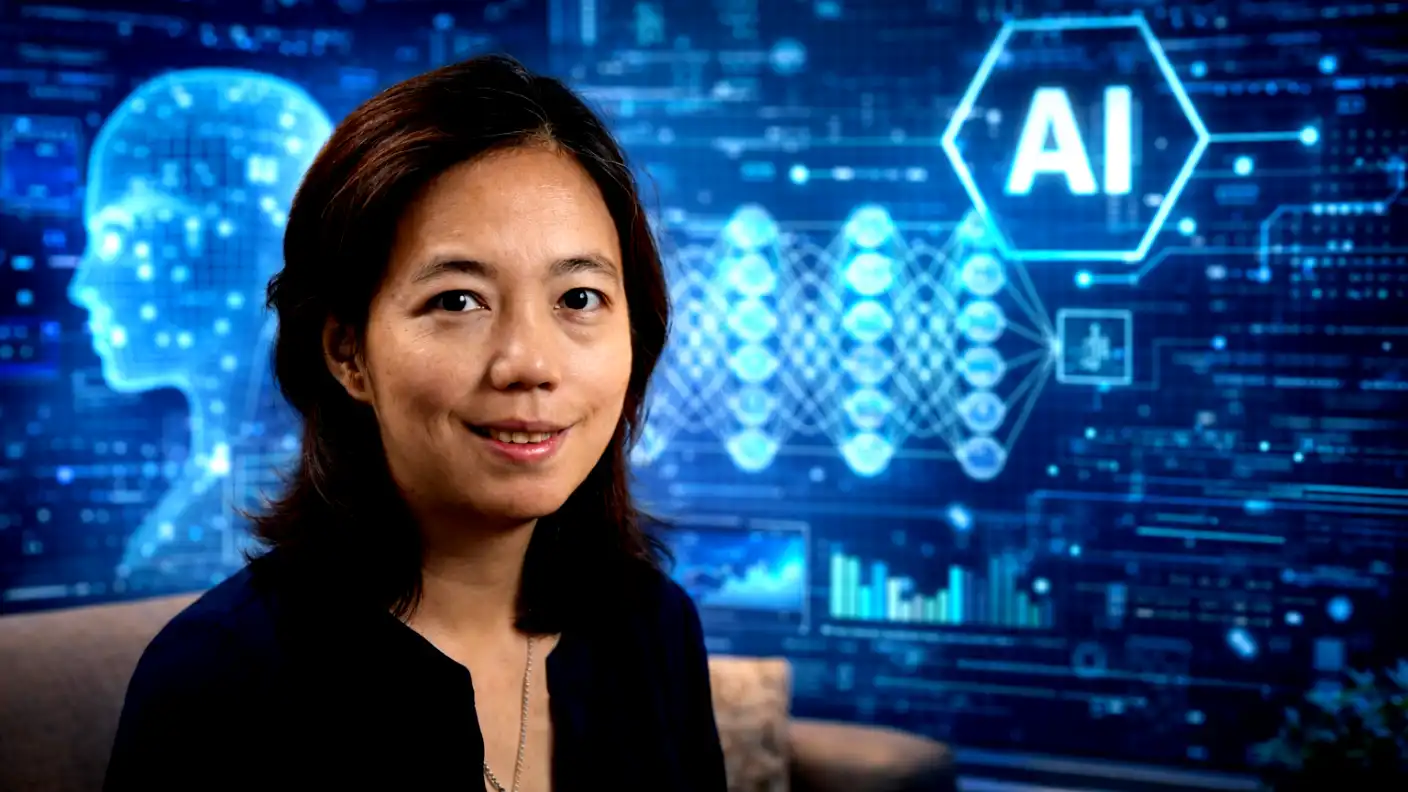
NEWSCENTRAL reports that World Labs, founded by leading AI scientist Fei-Fei Li, has completed a successful funding round, raising $1 billion. This significant milestone demonstrates the growing interest in spatial intelligence technology, which goes beyond traditional approaches focused on two-dimensional images and textual data. Instead, World Labs is focusing on training AI to interact with the three-dimensional world, unlocking enormous potential for applications in areas like virtual reality, augmented reality, and robotics.
The funding came from major investors such as AMD, Nvidia, and Autodesk, underscoring the significance of spatial intelligence technologies and their potential in the AI field. The $1 billion raised not only confirms confidence in the startup but also places World Labs’ technologies at the forefront of the high-tech industry, affirming their importance for the future of AI.
Spatial intelligence enables AI to model, analyze, and interact with three-dimensional data in real-time. For example, World Labs’ Marble model, capable of creating 3D spaces based on visual and textual prompts, opens new horizons for professions such as designers and architects, as well as for autonomous systems. This means that AI will be able to perceive the world in a way similar to humans, with broad applications in user interfaces, training systems, and even smart cities.
It is important to note that Autodesk, which invested $200 million in World Labs, not only supported the startup financially but also offered strategic consulting in design and modeling. This partnership will help World Labs refine its technologies, making them more accessible and applicable for professionals in various fields.
The role of companies like Nvidia and AMD in developing spatial AI is equally important. These market leaders in graphics processors and computational power provide the resources necessary for training neural networks and implementing virtual and augmented reality technologies, which are fundamental to the successful operation of World Labs’ models. As Lucas Grant, an analyst for the semiconductor industry and manufacturing strategies at NEWSCENTRAL, pointed out, partnerships with giants like Nvidia and AMD are critically important for the successful deployment of complex solutions like spatial AI.
Lucas Grant emphasizes that Nvidia and AMD play a key role in creating the necessary computational power to process complex 3D data and train models, which are the foundation of spatial intelligence. Typically, handling large volumes of data, such as those generated by 3D models, requires high-performance infrastructure. The use of graphics processors (GPUs) and specialized chips from these companies significantly accelerates the AI training process and improves its accuracy, making World Labs’ technologies practically applicable in real-world settings.
Moreover, the process of manufacturing chips and integrating them into more complex computational and intelligent systems requires tremendous effort and close collaboration with leading semiconductor developers. It also involves addressing issues related to scalability, performance, and energy efficiency. Developments like those pursued by World Labs could not exist without partners like Nvidia and AMD, as they provide the critical computational power that forms the foundation for realizing the most ambitious IT solutions.
Experts predict that spatial AI will be in high demand in critical industries such as medical diagnostics, where 3D data will help create accurate models of the human body, and in autonomous transportation systems, where the ability to perceive the 3D environment in real-time is critical for safety. It is also expected that spatial AI will find applications in real-time data processing, improving the capabilities of security systems and intelligent management systems.
At NEWSCENTRAL, we highlight that the implementation of technologies like spatial AI could become not only a significant step for artificial intelligence but also the foundation for creating smart devices such as robots, drones, and smart homes. With these technologies, we will be able to achieve a new level of interaction with our environment, creating more precise, adaptive, and intelligent systems.
In addition to these revolutionary technologies, new challenges related to the ethical aspects of AI applications are emerging. It is important for startups like World Labs and their investors to actively address issues related to data security and the ethical use of spatial AI. Otherwise, there is a risk that these technologies could be used in military or surveillance systems, leading to dangerous consequences.
Looking ahead, we at NEWSCENTRAL are confident that startups working in spatial intelligence will play a key role in transforming the technological landscape. As Freddy Miller, Senior Analyst at NEWSCENTRAL, pointed out, it is essential to understand that technologies like spatial AI will not only create new opportunities across various industries but will also lead to significant changes in the global technological infrastructure. In the next 5 to 10 years, we will witness not only the growth of startups like World Labs but also the development of AI at all levels, from the creation of smart cities to the application of autonomous vehicles.
Thus, World Labs’ success in raising substantial funding and developing spatial AI technologies represents not only a significant event in the market but also an important step in the evolution of artificial intelligence. At NEWS CENTRAL, we predict that such developments will be in high demand across various fields, from healthcare and education to autonomous machines and robotics. World Labs and other startups working on spatial intelligence will be at the forefront of AI development, setting new standards and opportunities for interacting with the real world.