
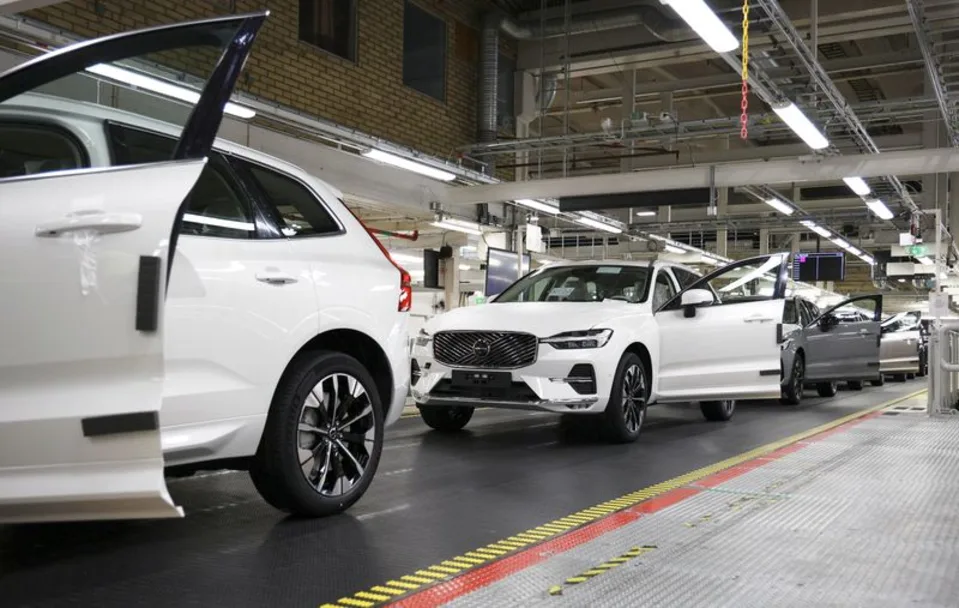
Volvo Cars reported a second-quarter 2026 operating profit of 826 million Swedish kronor on Friday – a dramatic reversal from an operating loss of 9.95 billion kronor in the year-earlier period, though that comparison is distorted by 11.4 billion kronor in impairment charges related to the EX90 and ES90 platform and 1.4 billion kronor in restructuring costs that burdened the prior-year quarter. Stripping out those one-offs, the underlying improvement is real but considerably more modest. Revenue fell 17% to 77.7 billion kronor from 93.9 billion kronor in Q2 2025, a decline partly explained by 4 billion kronor in one-off positive effects that benefited the prior-year comparison. The EBIT margin came in at 1.1%, up from negative 10.6%, while free cash flow deteriorated sharply to negative 5.2 billion kronor from positive 4.2 billion kronor a year earlier. Net income was 1.25 billion kronor, compared with a net loss of 7.51 billion kronor. NEWSCENTRAL reads the Q2 result as a company that has successfully executed a cost reduction program – delivering 5 billion kronor in full-year targeted savings six months ahead of schedule – but has not yet closed the gap between its operational improvement story and the revenue and cash flow performance required to sustain it.
The cost savings achievement is genuinely significant and provides the foundation for the second-half recovery the company is projecting. Selling expenses declined from 6.5 billion to 5.0 billion kronor. Administrative expenses fell from 3.1 billion to 2.24 billion kronor. Research and development expenses, elevated in the prior year by impairment charges, fell to 5.37 billion kronor from 12.9 billion kronor – though that comparison is heavily influenced by the non-recurring charges. Cost of sales declined from 80.9 billion to 64.59 billion kronor. The delivery of full-year targeted savings ahead of schedule, in an environment where revenue is contracting, suggests that management has achieved genuine structural cost reduction rather than simply deferred expenditure that will return in future quarters.
The China story underneath the headline numbers is where the most commercially difficult dynamics live. China, historically one of Volvo Cars’ most important markets, has become one of its most challenging. The competitive intensity from domestic Chinese electric vehicle manufacturers has compressed pricing and eroded market share for premium foreign brands, and Volvo has been unable to replicate in China the electrification momentum it has built in Europe. Fully electric car sales reached 25% of total Q2 volume globally, up from 21% a year earlier, and electrified cars including plug-in hybrids accounted for 52% of sales, up from 44%. Those figures reflect solid European performance. The company has flagged China sales mix and pricing effects as a primary explanation for lower Q2 revenues and profitability. Jessica Kline, Automotive Industry Analyst at NEWSCENTRAL, observes that Volvo’s China positioning illustrates a broader pattern affecting European premium automakers: the transition to electric vehicles, which was supposed to provide a technology refresh that would sustain brand premiums in the Chinese market, has instead created a more competitive environment where domestic Chinese EV brands offer comparable technology at lower prices, eroding the pricing power that Western brands previously commanded.
The EX60, Volvo’s new mid-sized electric SUV whose production began rolling off the Gothenburg assembly line in April, is the vehicle management is counting on to drive the second-half recovery it has projected. The EX60 targets the most commercially important SUV segment in Europe and positions Volvo alongside the fully electric offerings from BMW, Mercedes, and Audi that have been gaining momentum in the premium European market. The company’s expectation of significantly stronger sales in the second half of 2026 depends on the EX60’s reception in European dealerships and on the ability to convert the electrification momentum visible in the Q2 sales mix into actual revenue at pricing levels that sustain margin improvement.
NEWSCENTRAL places the EX60 launch in the context of a European premium EV market that is more competitive in mid-2026 than Volvo’s original product planning cycle anticipated, with BMW’s iX3, Audi’s Q6 e-tron, and Mercedes’s EQC all established in the segment and Chinese premium EV entrants including NIO’s European lineup adding further pricing pressure. The EX60’s commercial success will depend not only on the product’s own merits but on how the competitive pricing environment in Europe has evolved between when the car was designed and when it reaches dealerships at scale.
The negative free cash flow of 5.2 billion kronor is the financial metric that most demands attention alongside the profitability turnaround narrative. Positive operating income coexisting with sharply negative free cash flow indicates that the company is consuming cash at a rate that the operating profit does not offset, driven by working capital requirements, capital expenditure, and the cash costs of the restructuring program. A company that has returned to profitability on its income statement while burning cash at this rate cannot yet be described as financially stable, and the trajectory of free cash flow in Q3 and Q4 will be the most important variable in assessing whether the turnaround story is durably funded or whether it requires additional external capital. NEWS CENTRAL notes that investors watching this name through the second half should weight the cash flow data at least as heavily as the EBIT trajectory, because the two can diverge significantly before the full picture of Volvo’s financial health becomes clear.