
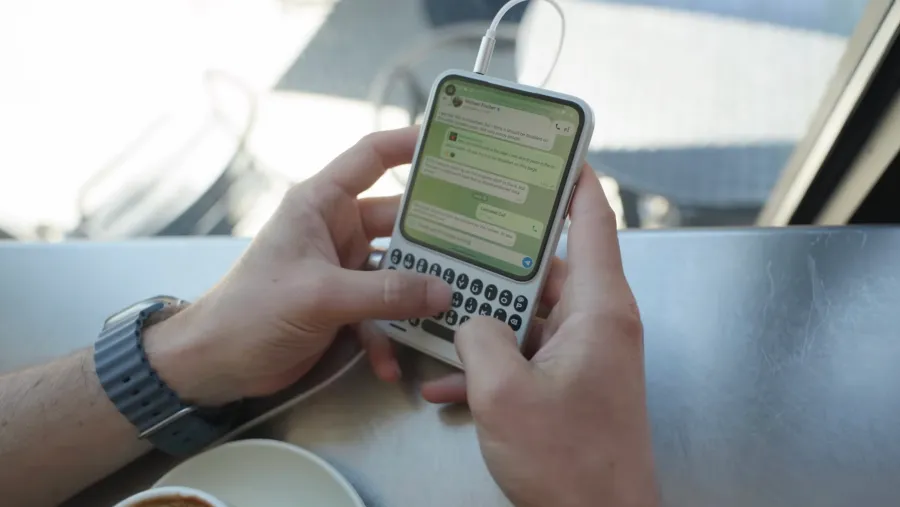
Clicks Technology released the first hands-on video of a working prototype of its Communicator smartphone on Tuesday, giving prospective buyers and the technology press their first real look at how the company’s BlackBerry-inspired physical keyboard device actually functions rather than simply appears. Introduced at the Consumer Electronics Show in January as a concept with physical presence but limited operational demonstration, the Communicator now appears in video as a fully operational device navigating its custom Android 16 interface, switching between messaging applications, browsing the web using the keyboard as a trackpad, and unlocking via a fingerprint sensor embedded in the spacebar. The device ships in Q4 2026 at a price of $499, with advance reservations available at $399. NEWSCENTRAL notes that the hands-on video accomplishes something the CES introduction could not: it demonstrates that the product resolves its central design tension – integrating a physical keyboard into a form factor that feels deliberate rather than retrofitted – at a level that justifies the delay between announcement and commercial availability.
The hardware specification surrounding the keyboard is competitive at the price point – and NEWSCENTRAL notes that these specifications address the exact compromises that caused earlier physical keyboard revival attempts to fail commercially – and addresses the concerns that have historically hobbled physical keyboard smartphones launched by competitors who compromised on performance to accommodate the mechanical constraints of the form factor. The Communicator pairs a 4.03-inch AMOLED display at 1,080 by 1,200 resolution with a MediaTek 5G processor and 8 gigabytes of RAM, a 4,000 mAh battery supporting both 18-watt wired and 15-watt wireless charging, a 50-megapixel primary camera with optical image stabilization, a 24-megapixel front camera, a 3.5-millimetre headphone jack, expandable microSD storage up to 2TB, NFC, and stereo front-facing speakers. The keyboard itself is approximately 30% larger than the keyboard featured on Clicks’ earlier iPhone keyboard case accessory, and the spacebar doubles as the fingerprint sensor for biometric authentication in a natural typing position. Android updates are committed through Android 20, with five years of security updates included.
The device’s software architecture is designed around communication rather than general-purpose smartphone use, which is both its central differentiation and its most significant commercial constraint. Clicks has partnered with Niagara Launcher to provide a vertical ribbon of favourite applications on the home screen – Gmail, Telegram, WhatsApp, Slack, Spotify – optimized for keyboard navigation without requiring users to lift their hands to the touchscreen for routine interactions. Upcoming features to be demonstrated in subsequent videos include a Signal Light on the side of the phone that can be customized with different colors and patterns to indicate message notifications from specific contacts, a Prompt Key for AI interactions, a Message Hub for unified messaging, and a hardware privacy kill switch. Liam Cortez, Visual Systems Analyst at NEWSCENTRAL, observes that the Signal Light feature represents one of the more genuinely novel notification paradigms in consumer hardware in years – a peripheral visual indicator that allows users to assess communication priority without activating the screen or unlocking the device, a capability that aligns directly with the growing consumer interest in reducing the compulsive screen-check behavior that constant notification banners and lock screen alerts have normalized.
Whether the nostalgia market for physical keyboards can sustain a commercially viable phone company is a question the Communicator’s CES reception has begun to answer but not yet resolved. Clicks reported at CES that it was processing orders every 6.5 seconds across both the Communicator reservation program and its existing keyboard case accessory products – a demand signal that is encouraging without being conclusive about the scale of the final market. The company’s founders include YouTuber Michael Fisher, whose consumer electronics coverage has built an audience specifically among the technology enthusiasts most likely to respond to a thoughtfully designed physical keyboard phone. That community credibility provides a marketing asset that comparable products from less community-embedded companies have typically lacked. For NEWS CENTRAL, the commercial test of the Communicator is less about whether a nostalgia market for physical keyboards exists – it clearly does – and more about whether Clicks can navigate the first-time phone manufacturer challenges of production quality, supply chain management, software support, and post-launch customer service at a price point that leaves no room for the quality concessions that derailed the BlackBerry KEYone and KEY2 in their own attempts to revive physical keyboard smartphones.