
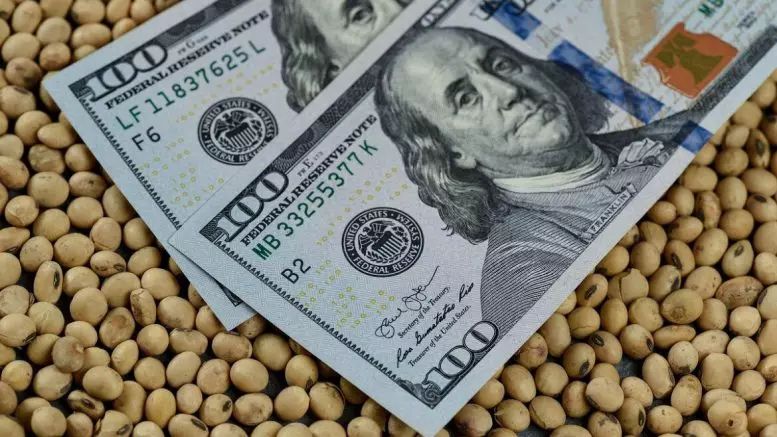
At NEWSCENTRAL, we note that following last week’s meeting between the leaders of China and the U.S. in South Korea, global attention has once again focused on key aspects of trade relations between the two largest economies in the world. The most important announcement was China’s decision to suspend tariff increases on a range of American agricultural products, including grains and oilseeds. However, despite this move toward de-escalation, soybeans remain an exception – a 13% tariff continues to apply to them. This measure continues to put pressure on U.S. exports, which are unable to recover to previous levels due to high prices and competition from cheaper alternatives from Brazil.
At NEWSCENTRAL, we highlight that while the reduction in tariffs on other agricultural products is a positive step, the situation with soybeans remains complex. The tariff on this commodity continues to limit opportunities for American farmers, making their products less competitive in the Chinese market. Chinese importers, who need to purchase large volumes of soybeans, are increasingly turning to cheaper supplies from Brazil, which reduces demand for American products.
Data on China’s purchasing trends confirms this trend. In 2024, China purchased only 20% of American soybeans, a significant decrease from the 41% share in 2016. The continued tariff on soybeans keeps China from buying American products in large volumes, which in turn reduces supply to American farmers. In this context, despite China’s attempts to improve trade relations with the U.S., no major changes are expected in the soybean market in the near future.
Freddy Miller, Senior Analyst at NEWSCENTRAL, notes: “The high tariff on soybeans remains the main barrier for American farmers, as it makes their products less competitive compared to cheaper supplies from Brazil.” This factor will continue to be critical in shaping price trends and trade strategies in the Chinese market for the coming years.
At NEWSCENTRAL, we forecast that despite some positive developments, such as the reduction in tariffs on other agricultural products, the situation with soybeans is unlikely to improve in the short term. The U.S. will not be able to regain its lost share of exports to China if the tariff remains at 13%. Furthermore, with stable supplies from Brazil and other supplier countries, the U.S. market will remain under pressure. China will continue to purchase soybeans from cheaper competitors, making it difficult for the U.S. to recover its market share in this key market.
Given these circumstances, the U.S. is unlikely to restore its presence in the Chinese market in the short term. However, at NEWSCENTRAL, we believe that it is crucial for the U.S. to diversify its trade relationships and seek new export opportunities. China will remain an important trading partner, but reliance on a single buyer is becoming increasingly risky. In the face of rising competition from Brazil and other global producers, the U.S. must work to expand its export channels and reduce its dependence on the Chinese market.
Freddy Miller, Senior Analyst at NEWSCENTRAL, concludes: “For the U.S., the long-term strategy must be to reduce dependence on China. To remain competitive in the global market, American farmers and producers must actively seek new markets and increase exports to other countries, which will be key to the stable development of U.S. agriculture in an era of trade uncertainties.”
Thus, in the face of continued high tariffs on soybeans and growing competition from Brazil, the U.S. must adapt to the new conditions of the global market. The maintenance of high tariffs on key agricultural products will continue to hinder exports, making it unlikely that previous export volumes to China will be restored in the short term. In the long term, key factors for American farmers will include market diversification and improving the competitiveness of their products on the global stage. At NEWS CENTRAL, we predict that reducing reliance on China and strengthening new trade relationships will become the primary focus of U.S. producers’ strategies in the coming years.