
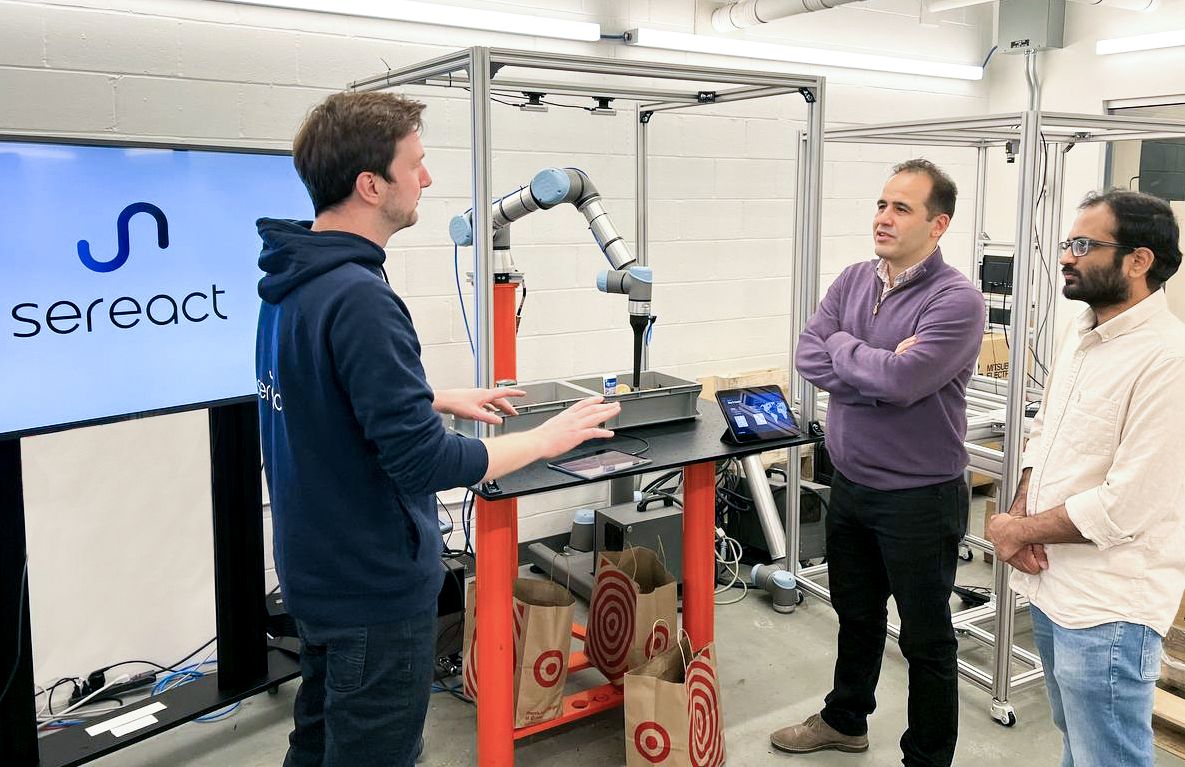
NEWSCENTRAL reports that Sereact, a company that recently raised $110 million in a Series B funding round, continues to strengthen its position in the field of robotic artificial intelligence. This strategic investment will not only enhance the development of their flagship product, the Cortex 2.0 robot, but will also enable the company to enter the U.S. market by opening an office in Boston and scaling its technology in one of the largest global robotics markets. Since its founding in 2021, Sereact has focused on creating AI systems that can adapt and learn in real-world conditions, rather than relying on theoretical models and lab tests.
The company claims that its approach is based on data collected during the operation of robots in real-world production and warehouse environments. This approach sharply contrasts with other market players, who train their systems on simulations. According to experts, the ability of Sereact’s system to learn from real data is the factor that makes its technology unique. Dr. Ralf Gulde, co-founder and CEO of the company, emphasized that the results speak for themselves: 200 installations, a billion order-picking operations, and one intervention for every 53,000 operations.
According to NEWSCENTRAL, amid the growing demand for automation, technologies like Sereact’s developments are capable of significantly enhancing the efficiency of logistics and manufacturing processes. Sereact robots do not simply follow a pre-set program; they are able to predict possible action trajectories depending on the situation. Cortex 2.0 analyzes its environment, generates several action options, and selects the most efficient one, which reduces errors and, consequently, the costs of corrections.
Unlike its competitors, who invest significant resources in creating simulated data, Sereact focuses on real-world operation. This allows the robot to learn in environments that cannot be reproduced in laboratory settings, making the system much more flexible and capable of handling complex tasks. A key part of the system is the robot’s ability to update its model in real-time based on data from both successful and failed operations, which enhances its efficiency.
It is also worth noting that Cortex 2.0 doesn’t just perform tasks it “thinks” before acting. This ability to predict the consequences of its actions allows the system to significantly reduce errors. The company is confident that this approach will make robotics safer and more predictable, particularly in tasks where precision is critical, such as when assembling or placing fragile objects. This is made possible by using a visual-linguistic-action model (VLA), which helps the robot predict the outcomes of interactions with objects before the action even begins.
According to Mark Tusher, co-founder and CTO of Sereact, their robot “dreams” in hidden space meaning it envisions possible trajectories, assesses their stability, risks, and efficiency, and then chooses the best course of action for completing a task. This method essentially overcomes the traditional “trial and error” model, making it more advanced and predictable.
Market forecasts for artificial intelligence and robotics, including those from NEWSCENTRAL analysts, confirm that Sereact occupies a key position in the market. This approach to creating robots that learn from real data, rather than simulations, puts the company a step ahead of its competitors and may make its solutions the standard for robotic systems in logistics and manufacturing. Freddy Miller, Senior Analyst at NEWSCENTRAL, noted that such technologies could significantly speed up automation processes in global warehouses and manufacturing facilities, leading to reduced operational costs and improved data handling.
Additionally, the new approach to computational resource planning deserves attention. Cortex 2.0 can adapt its behavior depending on the complexity of the task. In more complex situations, where mistakes could be costly, the robot spends more time on analysis and planning, which increases its efficiency. For less critical tasks, where mistakes are not as costly, the system optimizes its resource usage.
The scalability of the technology is also an important part of Sereact’s strategy. The company plans not only to develop robots but also to supply a universal model that can be integrated into various types of robots, significantly expanding the potential for partnerships and global distribution of the technology. This versatility makes the company attractive to a wide range of industries, from retail to warehouse automation.
As the results show, these approaches have a real practical effect. Leading investors in the company, including Headline, Bullhound Capital, and Felix Capital, are confident that Sereact will be able to scale its technology globally and secure a leading position in the market.
At NEWS CENTRAL, we are confident that Sereact’s technology will have a significant impact on robotics, creating a new standard for automation and efficient use of artificial intelligence. As the company’s results demonstrate, the use of real data and adaptive learning can greatly improve manufacturing processes, opening new opportunities for many sectors. We predict that such approaches to robot development will become increasingly in demand in the coming years, and Sereact will be one of the leaders shaping the future of the industry.