
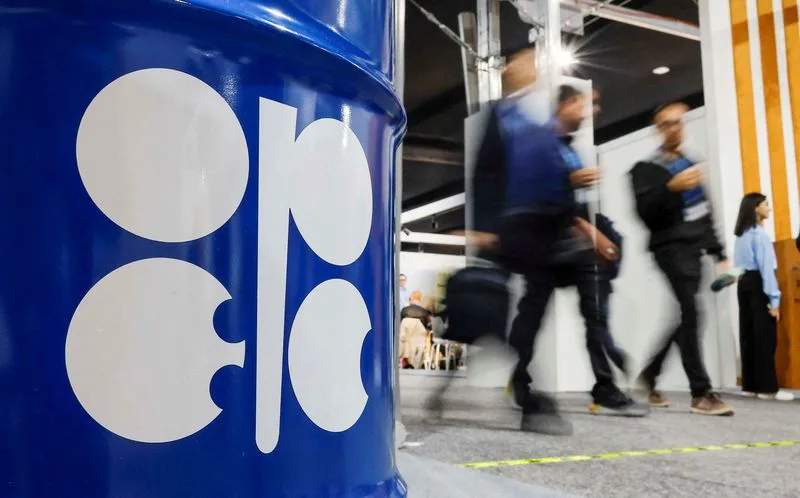
Seven members of the OPEC+ alliance announced on Sunday a fifth consecutive monthly production increase, agreeing to raise combined output by 188,000 barrels per day from August – continuing a phased rollback of the supply cuts originally implemented in 2023. The participating countries are Saudi Arabia, Russia, Iraq, Kuwait, Kazakhstan, Algeria, and Oman. The announcement lands in a context that makes the production increase largely theoretical: the U.S.-Israeli war on Iran has effectively closed the Strait of Hormuz to the tanker traffic that moves roughly one-fifth of the world’s oil and liquefied natural gas supply. Total OPEC+ production dropped to 33.13 million barrels per day in May, down from 42.77 million barrels per day in February. NEWSCENTRAL notes that the gap between what OPEC+ is announcing and what it is actually shipping encodes the central tension in global oil markets right now.
The mechanics of the Hormuz closure are creating compounding distortions across global energy markets that monthly production target announcements cannot address. Saudi Arabia, Kuwait, and Iraq – three of the seven countries participating in the August increase – ship the majority of their crude through the strait or through export infrastructure in the Gulf region that connects to it. With confirmed tanker transits dropping from approximately 130 daily crossings before the war to 38 as of July 2, meaningful production increases by those three countries cannot reach the market regardless of what their quota commitments say.
The geography-of-benefit analysis matters enormously for how the production rollback lands in practice, and NEWSCENTRAL places it at the center of any realistic market assessment: increases announced by Gulf producers are largely symbolic at present, while increases from non-Gulf members are real and arriving into a market already softened by demand destruction.
The countries best positioned to benefit from the production rollback are those whose export routes bypass the strait entirely: Russia, Kazakhstan, and Algeria all export primarily through pipelines and terminals unaffected by Hormuz closures. The UAE’s departure from OPEC+ in late April – to align capacity with production free from group constraints – adds a further complication: the alliance now manages a market framework from which one of the Middle East’s largest and most strategically flexible producers has removed itself.
Brent crude for September delivery stood around $72 per barrel at the time of the announcement, below the settlement price on the day before the Iran war began. That level reflects simultaneous supply and demand disruption: Gulf supply constrained by the closure, demand contracted as elevated consumer prices and economic uncertainty suppress energy consumption across major importing economies. Nathan Clark, Enterprise IT and Systems Architecture Analyst at NEWSCENTRAL, notes that the geopolitical complexity OPEC+ is navigating simultaneously – a major member effectively excluded from export markets by a conflict it did not initiate, a core member departing the alliance, and production targets that substantially overstate deliverable supply – represents the most structurally challenging operating environment the group has faced since the 2020 demand collapse.
Optimistic projections suggest Gulf oil production could rebound fully by the first quarter of 2027. More cautious assessments hold that infrastructure disruption, insurance market dislocation, and tanker operator risk aversion will maintain a structural premium on non-Gulf supplies well beyond any political ceasefire. Energy observers who described OPEC+’s August increase as a paper formality are empirically correct – the announcement changes documented output targets far more than it changes deliverable barrels.
The more commercially significant signal in Sunday’s announcement is not the 188,000-barrel figure but the alliance’s decision to continue announcing increases at all. It is a maintenance of market signaling and group cohesion under extraordinary pressure, at a moment when either could fracture in ways difficult to reverse. What NEWS CENTRAL assesses as the operative question for the remainder of 2026 is whether the pace of Hormuz recovery will be fast enough to convert these paper increases into physical barrels before the supply gap they were designed to close becomes structurally permanent.