
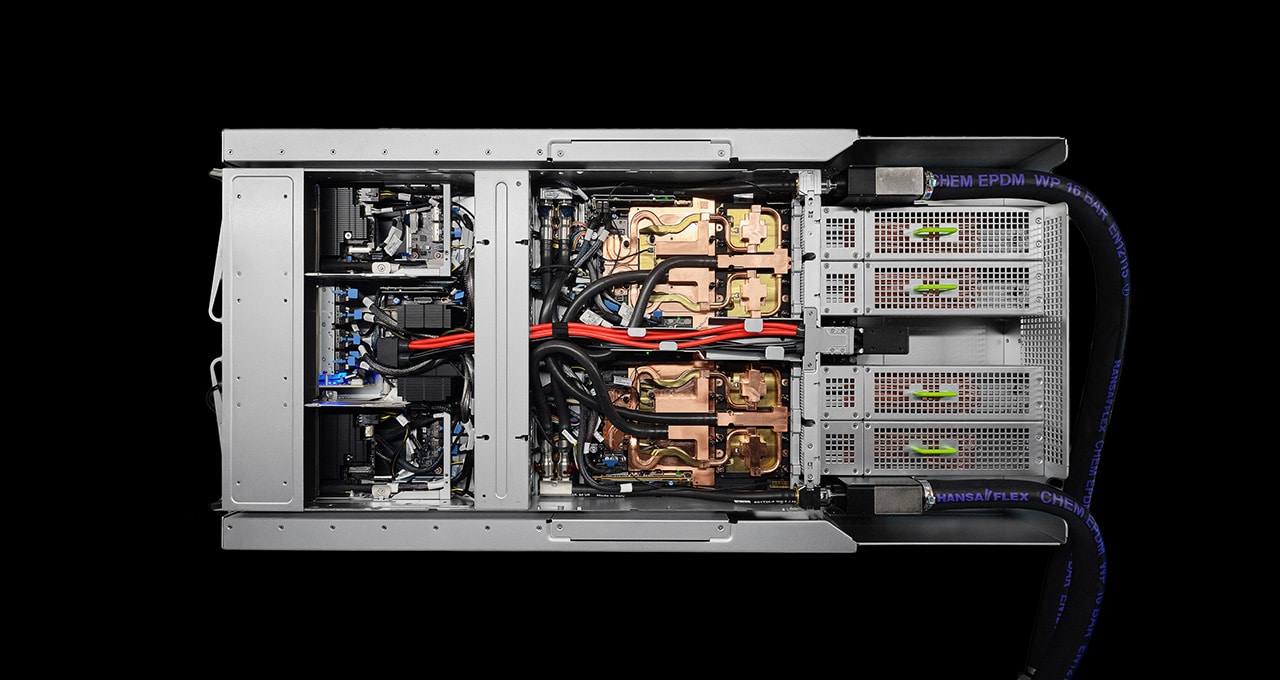
NEWSCENTRAL reports that data centers, which today support the operation of the internet, artificial intelligence, and global computing power, could undergo significant changes thanks to the latest technologies introduced by Nvidia. Investors were particularly intrigued by the recent presentation of the Vera Rubin chips, which could revolutionize not only data processing but also the cooling infrastructure of these powerful systems. Nvidia’s CEO, Jensen Huang, made waves when he announced that the new chips could operate at temperatures up to 45°C, causing concern on the stock markets and among cooling system manufacturers.
As we highlight at NEWSCENTRAL, this transformation in cooling technology, resulting from the arrival of Vera Rubin chips, promises to fundamentally change the entire industry landscape. This isn’t just another technological improvement it’s a step that could, in the future, lower the operating costs of data centers, making them more energy-efficient and environmentally friendly.
Nvidia’s new chips, which, according to Huang, could double performance compared to the current generation of Blackwell chips, while consuming significantly less energy for cooling, hold enormous potential. Unlike traditional water chillers, which have been used to cool such powerful systems, the Vera Rubin chips are designed to operate at temperatures up to 45°C, which is twice as high as the traditional operating temperature for previous-generation chips. This opens up possibilities for creating more compact and energy-efficient data centers that don’t require complex cooling systems.
In a market where every component is crucial, Nvidia’s innovations have already impacted the stock prices of companies involved in cooling system production. After Huang’s announcement, the stocks of major players such as Johnson Controls, Modine Manufacturing, and Trane saw significant declines, indicating how important it is for investors to monitor developments in technologies that could change the entire market. At NEWSCENTRAL, we see this as a troubling signal for companies that rely on traditional cooling systems, but we also recognize that they may have the opportunity to adapt to the new conditions.
Cooling technologies are an integral part of data center infrastructure, which consumes billions of liters of water and vast amounts of energy each year. The inability to use traditional water coolers could dramatically alter the plans of companies like Microsoft, which has announced its intention to expand its AI computing capacity by 80% next year. This will create additional challenges for cooling system suppliers, who will need new solutions that match the new type of equipment.
That said, it’s important to note that Nvidia’s new approach doesn’t completely eliminate the need for cooling systems. As Freddy Miller, Senior Analyst at NEWSCENTRAL, pointed out, the architecture of the Vera Rubin chips still requires efficient liquid cooling systems, which preserves a certain role for traditional technologies in this field. However, the cooling systems that will be developed to work with the new chips are expected to be much more efficient and less energy-intensive. This will create opportunities for companies willing to invest in the development of new, more sustainable solutions for data centers.
At NEWSCENTRAL, we forecast that the cooling industry will evolve toward more high-tech and energy-efficient solutions. There are already technologies, such as liquid cooling, that are ideally suited to work with new chips like Vera Rubin. This, in turn, creates new opportunities for companies specializing in cooling systems and could lead to growth in the sector.
The trends emerging on the horizon suggest that while traditional cooling systems will face some challenges, the long-term prospects of the market remain positive. Unlike older approaches, the new chips will significantly reduce energy and water consumption, making data centers more environmentally sustainable. At NEWSCENTRAL, we believe that companies that can adapt their offerings to the new conditions and meet the growing demand for energy-efficient solutions will have a competitive edge.
NEWS CENTRAL concludes that while short-term changes may lead to market volatility and stock price adjustments, in the long run, this will create opportunities for growth for companies that can adapt to the new conditions. We recommend that investors closely follow developments in cooling technologies and prepare for a future that will demand more energy-efficient and innovative solutions for data centers.