
Technological Leadership
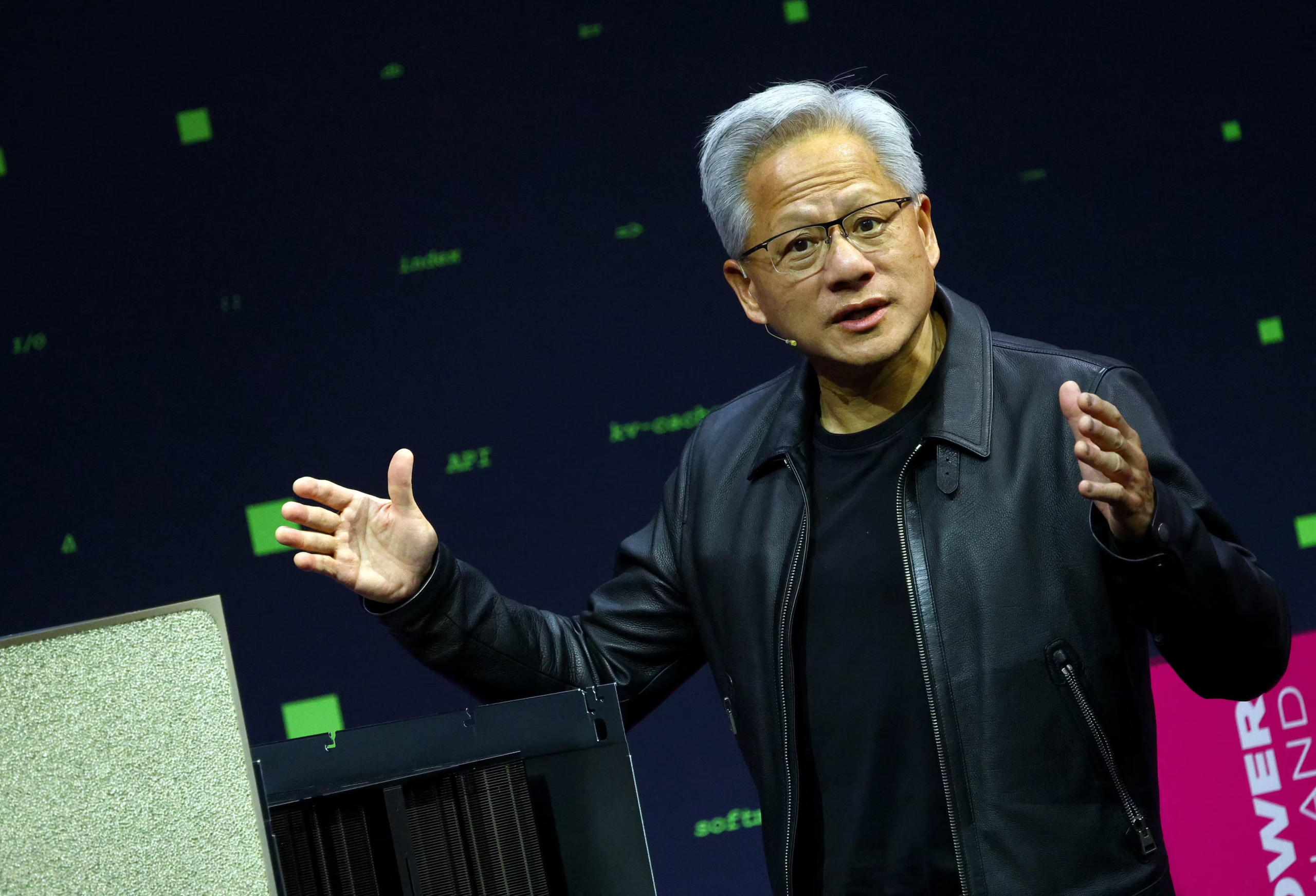
Nvidia, whose technologies have long been an integral part of the artificial intelligence (AI) and high-performance computing (HPC) industries, has encountered unexpectedly high demand for its latest line of Blackwell chips. At a recent event in Taiwan, the company’s CEO, Jensen Huang, stated that interest in these chips had exceeded expectations, creating significant pressure on the company’s production capabilities. Despite this, Nvidia has managed to meet the growing demand while actively ramping up production, relying on a key partner – Taiwan Semiconductor Manufacturing Company (TSMC).
At NEWSCENTRAL, we note that this surge in interest for Blackwell chips is no coincidence. It reflects not only the general trend of increasing computational power in AI but also Nvidia’s strategic success in developing more versatile solutions for high-performance computing. Unlike previous models, the Blackwell chips represent more complex platforms that integrate graphics and central processors, as well as networking components and switches, opening up new possibilities for scalable solutions.
Nvidia’s collaboration with TSMC, which remains a key supplier of wafers for these chips, continues to play a vital role in the company’s success. Huang emphasized that support from TSMC allows Nvidia not only to rapidly scale its production but also to confidently maintain its technological leadership. “Our success would be impossible without TSMC,” he noted, underscoring the importance of this partnership for Nvidia. It is worth mentioning that TSMC remains one of the few manufacturers capable of supplying the required volumes for such high-tech chips.
However, at NEWSCENTRAL, we highlight that the rising demand for Blackwell, coupled with the global semiconductor and memory shortage, poses a challenge for the company. Despite support from major memory producers like Samsung, SK Hynix, and Micron, component shortages remain an issue. This may complicate the timely fulfillment of orders, which in turn threatens the stability of production chains.
With the growing need for computational power, especially in the AI sector, Nvidia continues to strengthen its position as a key player in the high-performance computing market. The inclusion of both graphics and central processors, along with networking solutions in the Blackwell lineup, enhances its strategic advantage, enabling integration across a wide range of applications, from scientific computing to cloud platforms.
According to Freddy Miller, a senior analyst at NEWSCENTRAL, “The demand for Blackwell chips clearly underscores the increasing influence of AI technologies on the need for computational power. Nvidia demonstrates not only the ability to offer high-quality solutions but also to create an ecosystem where chips integrated into a broader context play a crucial role in realizing ambitious projects.” This opinion reflects Nvidia’s strategic approach to integrating its solutions across various high-performance computing segments.
Moreover, at NEWSCENTRAL, we observe that Nvidia continues to operate amidst growing geopolitical tensions. U.S. trade restrictions, which prohibit the export of certain chips to China, including Blackwell, present additional barriers for the company in one of the world’s largest markets. This factor continues to influence Nvidia’s strategic decisions, and while the company is actively seeking new markets, it must operate in an environment of uncertainty regarding potential new restrictions.
Considering all these factors, NEWSCENTRAL predicts that Nvidia will remain one of the leaders in AI and high-performance computing in the coming years. However, the company will need to address several challenges, including optimizing production chains, solving component shortages, and mitigating geopolitical risks. In the face of global changes in the semiconductor market and intensifying competition, Nvidia will strive not only to maintain but also to strengthen its position in these key segments.
In conclusion, we at NEWS CENTRAL note that Nvidia’s future depends on its ability to adapt to changing conditions. The continued growth in demand for Blackwell chips, as well as the importance of strategic partnerships with giants like TSMC and major memory producers, solidifies the company’s role as a significant player on the global high-performance computing stage. At the same time, geopolitical risks and the need to refine production processes may become critical factors determining Nvidia’s growth pace in 2025 and beyond.