
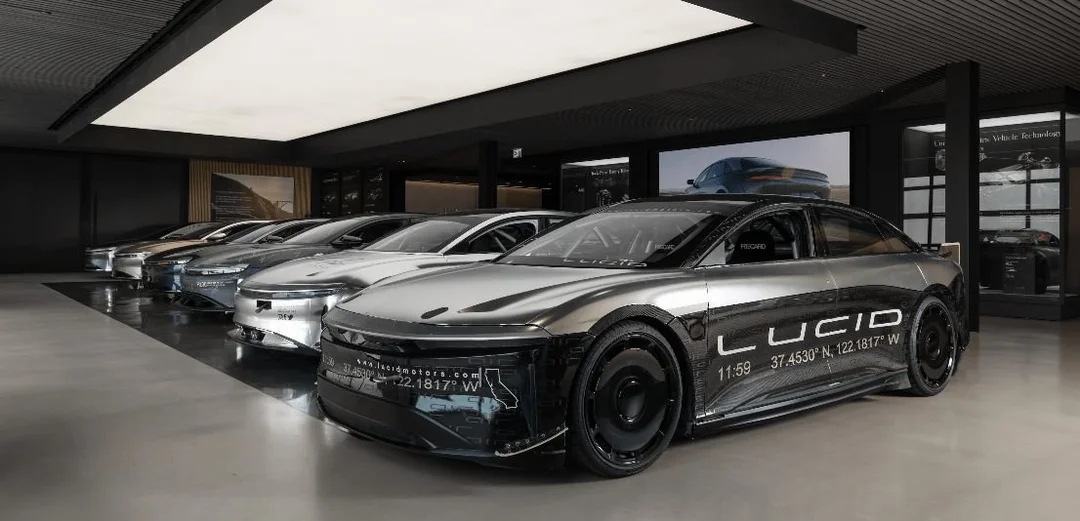
At NEWSCENTRAL, we see that Lucid Group’s recent results reflect a deep shift in the dynamics of the electric vehicle market. The company was able to demonstrate impressive revenue and delivery growth, which in itself is strong evidence of strengthening its brand in the premium EV segment. However, Lucid remains under pressure from significant operating losses, internal reporting adjustments, and slowed growth due to external factors, including changes in demand and supply chain challenges. This balance between commercial achievements and financial challenges shows how complex the path has become for EV manufacturers in current conditions.
In 2025, Lucid recorded significant revenue growth to approximately 1.35 billion dollars, reflecting an increase of more than 60 percent compared to the previous year. The quarterly revenue figure is particularly impressive at 522.7 million dollars in the fourth quarter, significantly exceeding market expectations. Total deliveries of Lucid Gravity SUV and Lucid Air reached 15,841 units for the year, a record result that indicates demand for Lucid products remains strong despite growing competition and a slowing premium EV market. At NEWSCENTRAL, we note that this growth demonstrates the company’s ability to expand its presence and strengthen its position in a segment where consumers are becoming increasingly selective and price-sensitive.
At the same time, Lucid faced a substantial operating loss. The company reported a net loss per share of 12.09 dollars for the entire 2025 year, and a quarterly loss of 3.62 dollars per share, which was worse than analysts’ forecasts. At NEWSCENTRAL, we believe such deep losses reflect a structural problem of negative margins, where production and operational costs significantly exceed revenues, creating a serious barrier to profitability.
An important point is that Lucid revised its production data: of the initially reported 18,378 vehicles, 538 units were excluded from the total because they did not pass final quality checks, and the actual production amounted to 17,840 vehicles in 2025. We at NEWSCENTRAL see this as a signal of the need to strengthen quality control systems and internal auditing, especially as the company increases production volumes.
In response to cost pressures, Lucid reduced its U.S. workforce by approximately 12 percent, mostly in corporate and administrative roles, while production staff remained intact. At NEWSCENTRAL, we consider such cost optimization measures rational in terms of accelerating operational efficiency, but it is important that they do not weaken the company’s key competitive advantages, including innovation and new product development.
Amid changes in demand structure, particularly after the cancellation of tax incentives that previously encouraged the purchase of expensive electric vehicles, Lucid is also adjusting its long-term plans. The company forecasts production of 25,000 to 27,000 vehicles in 2026, representing moderate growth compared to 2025 results but below the forecasts that expected more dynamic production expansion. At NEWSCENTRAL, we believe this moderate forecast reflects management’s realistic view amid uncertain demand, a complex macroeconomic environment, and persistent supply chain risks.
Lucid ended 2025 with cash and cash equivalents of about 4.6 billion dollars, providing a financial cushion for investments and operating expenses. However, free cash flow remained negative, and the company continues to generate cash burn, reinforcing the need to strengthen financial discipline and cost control. At NEWSCENTRAL, we believe that maintaining liquidity is important, but the company must also aim for more balanced capital spending to avoid excessive pressure on future profitability.
The market reacted to Lucid’s report with a decline in stock value, as investors expressed concern about high losses and a less aggressive production forecast. At NEWSCENTRAL, we see this reaction as reflecting not only the response to current results but also doubts about the company’s ability to quickly achieve sustainable profitability, especially given increasing competition from other EV manufacturers and market demand volatility.
Another important aspect is that Lucid is aiming to expand its international presence. The company has opened a new plant outside the U.S. and is actively working to increase exports, especially to European and Middle Eastern markets, where potential demand for premium electric vehicles remains high. At NEWSCENTRAL, we consider geographic market diversification a strategically important part of the plan to reduce dependence on a single region and expand the potential customer base.
The company is also taking steps toward the development of autonomous technologies, including robotaxi projects, which in the future could become an important source of revenue. These initiatives require significant investment and clear commercialization strategies to deliver the expected economic impact. At NEWSCENTRAL, we emphasize that success in this area could change Lucid’s long-term business profile, but it requires consistent effort and effective resource management.
Freddy Miller, Senior Analyst at NEWSCENTRAL, notes that Lucid is at a critical development point, where the company must strengthen operational discipline and optimize its cost structure while preserving its innovation potential and ability to launch products that will be in demand on the market.
At NEWSCENTRAL, we believe that Lucid demonstrates impressive steps in revenue growth and delivery expansion, but to achieve sustainable development, the company needs to strengthen margins and financial stability. Lucid must enhance operational control to manage expenses more effectively, continue work on more affordable models that can expand its customer base, and strengthen supply chains to reduce the risk of delays and higher costs. Successful commercialization of autonomous driving and robotaxi technologies could also play a key role in future revenue growth, but only with clear monetization plans.
We at NEWS CENTRAL predict that if Lucid can overcome current financial and operational constraints, it will have the opportunity not only to strengthen its position in the EV sector but also to build a sustainable business model capable of adapting to changing market conditions. Otherwise, the company risks maintaining high operating losses and uncertain prospects, which will limit its investment attractiveness and slow the path to profitable growth.