
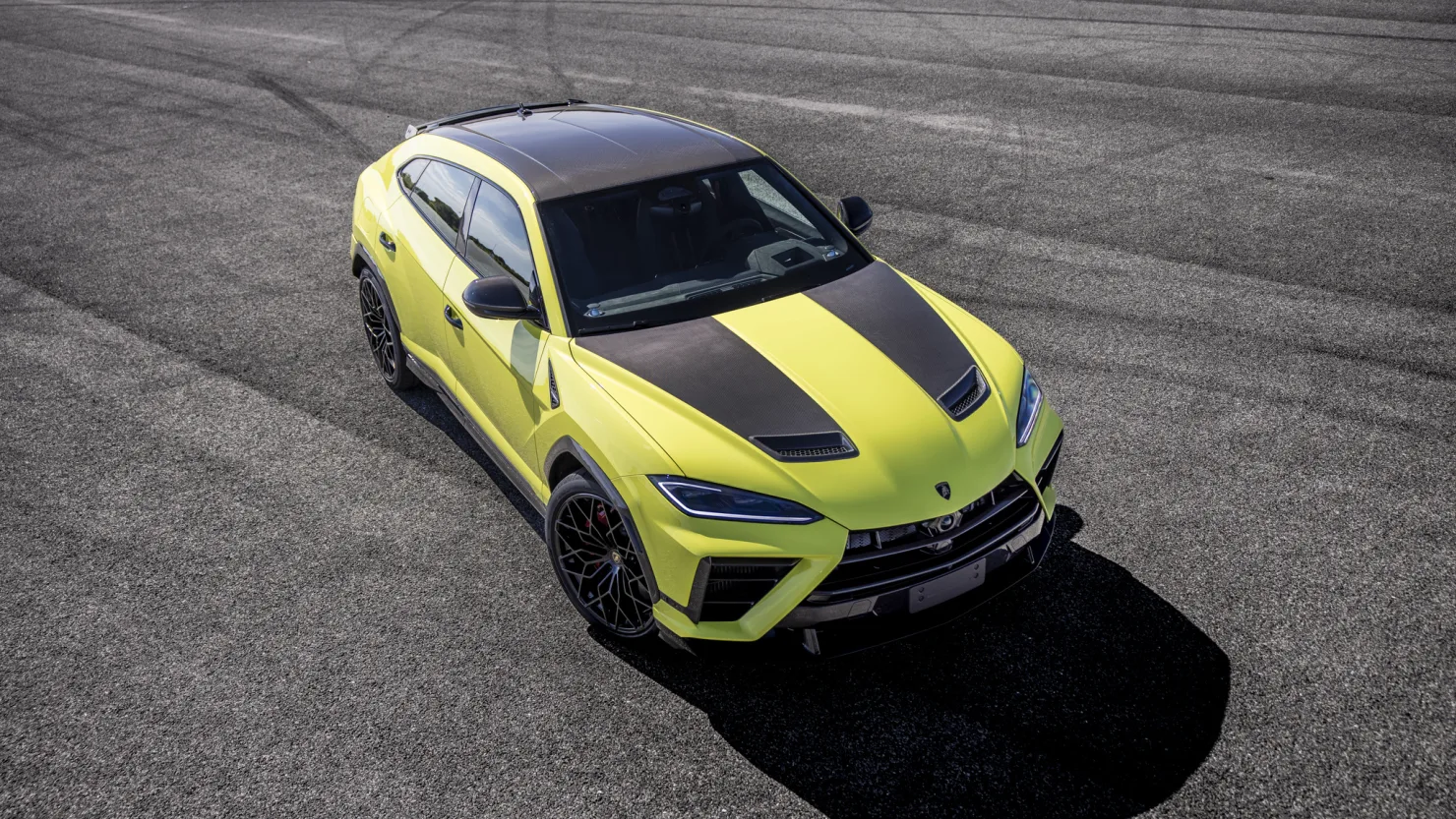
Lamborghini unveiled the Urus SE Performante on Wednesday, adding the highest-output model in the Super SUV nameplate’s history to a lineup that has now fully committed to plug-in hybrid power while its Italian supercar rival Ferrari was launching its first pure electric vehicle. The SE Performante’s powertrain pairs the Urus family’s established 4.0-litre twin-turbocharged V8 with a permanent-magnet electric motor to produce a combined output of 812 horsepower and 1,000 Newton-metres of torque – gains of 146 horsepower and 150 Newton-metres over the previous Performante model, which ran on a conventional internal combustion engine alone. Acceleration from standstill to 100 kilometres per hour takes 3.3 seconds; top speed reaches 312 kilometres per hour. An on-board 25.9 kWh lithium-ion battery, positioned beneath the load floor to maintain a low centre of gravity, supports more than 60 kilometres of pure electric range and doubles as ballast management for a vehicle whose mass would otherwise challenge the handling ambitions its Performante designation implies. NEWSCENTRAL reads the Urus SE Performante not as a compromise between performance and electrification but as a deliberate restatement of the hybrid thesis: that combining combustion and electric torque in a premium performance SUV produces a driving machine that either powertrain alone cannot match.
The decision to strip back the exterior bodywork to expose carbon fibre wherever structurally and aerodynamically appropriate – a choice NEWSCENTRAL considers a direct aesthetic statement that the SE Performante is primarily a performance vehicle that happens to accommodate passengers – gives the SE Performante a visual language more closely related to Lamborghini’s track-oriented models than to a vehicle that also accommodates five occupants and their luggage. The front and rear bumpers, hood, and surrounding aero components are all executed in exposed carbon fibre. Two rear spoilers, operating in combination, generate downforce that Lamborghini’s engineers have calibrated in conjunction with a new AURA dual-chamber air suspension system that the company says halves body roll during high-speed cornering and reduces vibration transmission to occupants by 25% compared with the previous generation Performante. The tension between those two objectives – producing a vehicle sharp enough to carry a Performante designation on the track while remaining comfortable enough to be used daily – is precisely the engineering challenge that distinguishes a credible performance SUV from a high-power vehicle that merely resembles one.
The commercial context for this reveal is one in which the Urus represents approximately 50% of Lamborghini’s total global sales annually, a dependency that gives the nameplate strategic significance well beyond its role as a product category extension. Total Lamborghini sales approached 11,000 vehicles last year, and the Urus SE Performante sits at the top of the pricing structure for the brand’s highest-volume model, with the standard Urus SE positioned at between $250,000 and $280,000 depending on specification – a ceiling that the Performante variant will extend further. Lamborghini CEO Stephan Winkelmann, who described the Urus SE Performante as taking the concept of the Super SUV to its peak, declined to confirm whether the brand would ever return to pure internal combustion models in the future, saying only that one should never say never. That formulation signals that the hybrid commitment is firm for the foreseeable product cycle without permanently closing a door that some segment of the brand’s customer base clearly wants left ajar. Jessica Kline, Automotive Industry Analyst at NEWSCENTRAL, observes that Lamborghini’s hybrid pivot strategy has allowed the company to simultaneously satisfy emissions-constrained markets and high-performance expectations at a price point where buyers have historically been willing to pay for whatever combination of capability the manufacturer determines is technically best, regardless of powertrain ideology.
The competitive context is one in which Lamborghini deliberately chose the hybrid path at the same moment Ferrari announced the Luce, its first fully electric production vehicle. That contrast is commercially and symbolically significant: two Italian supercar manufacturers whose heritage and customer bases substantially overlap have reached opposite conclusions about the most compelling powertrain architecture for the near-term future. Lamborghini has bet that its customers will respond better to a hybrid system that expands the performance envelope in measurable, tangible ways than to a pure electric alternative that eliminates the combustion experience entirely. Ferrari has bet that the most expensive segment of the EV market represents an opportunity that its brand equity can uniquely exploit. For NEWS CENTRAL, the SE Performante reveal is the moment that bet becomes fully concrete – the product exists, the performance numbers are real, and the question of whether Lamborghini’s hybrid thesis holds commercially will be answered in the order books that open ahead of the model’s arrival for U.S. customers later in 2026.