
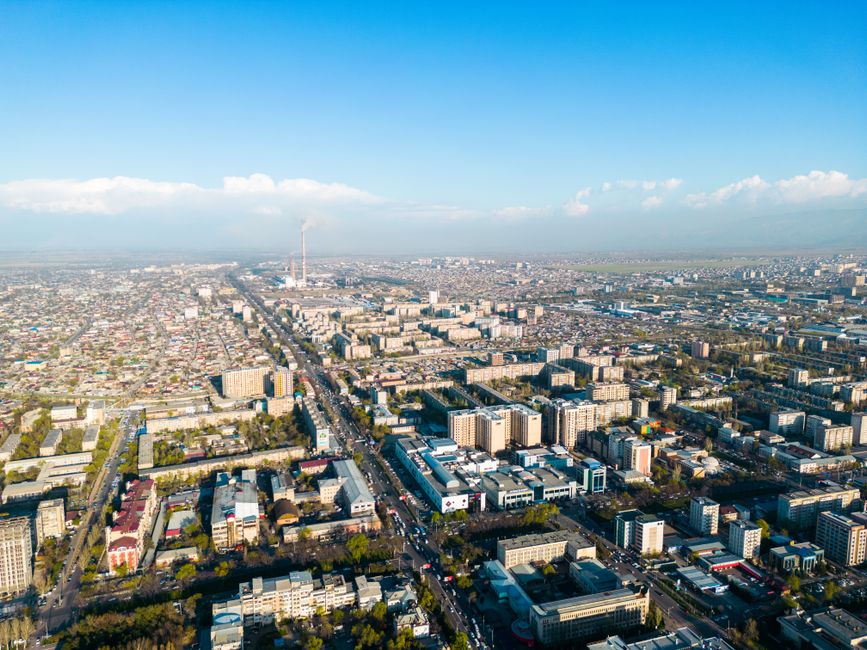
Kyrgyzstan recorded solid economic expansion in the first half of 2026, standing out as one of the more resilient performers among Central Asian economies at a time when the global economy continues to navigate elevated interest rates, persistent inflation in key markets, and slowing GDP growth across major trading blocs. The country’s performance offers a case study in how smaller frontier economies can sustain momentum even as the broader international environment tightens.
According to data released by Kyrgyzstan’s National Statistical Committee, the country’s GDP grew by approximately 8.3% in the first half of 2026 compared to the same period a year earlier. The expansion was broad-based, with contributions from industry, construction, trade, and services. Gold production, which historically plays an outsized role in Kyrgyz output figures, remained a significant driver, though growth in non-extractive sectors also showed meaningful acceleration – a signal that the economy is developing beyond its traditional commodity base.
The construction sector posted particularly strong results, supported by both public infrastructure investment and private development activity. Retail trade volumes expanded as consumer demand held up, partly reflecting remittance inflows from Kyrgyz workers abroad, primarily from Russia. Remittances have long served as a structural pillar of household income in Kyrgyzstan, and their continued flow helped sustain domestic consumption even as external conditions became more complex.
Industrial output also advanced, with manufacturing and energy production contributing to the headline figure. The services sector, including transport and logistics, benefited from Kyrgyzstan’s position along regional trade corridors that have gained relevance as global trade patterns shift in response to tariffs, sanctions regimes, and supply chain realignments. According to NEWSCENTRAL analysts, this geographic positioning has quietly become one of Kyrgyzstan’s more durable economic assets, attracting transit flows and re-export activity that add measurable value to national accounts.
The IMF and World Bank have both flagged Central Asia as a region of relative outperformance in recent years, partly due to elevated commodity revenues and strong remittance dynamics, and partly because several economies in the region have benefited from trade and financial rerouting linked to geopolitical shifts. Kyrgyzstan fits within this broader pattern, though its scale and structural vulnerabilities – including dependence on gold exports and external labor markets – mean that the growth story carries inherent risks.
Inflation remained a monitored variable. Consumer price growth moderated compared to the peaks seen in 2022 and 2023, when global inflationary pressures transmitted sharply into import-dependent economies like Kyrgyzstan. The country’s central bank has maintained a cautious monetary policy stance, keeping rates at levels designed to anchor expectations without choking credit growth. This approach mirrors the broader recalibration underway at major central banks globally, including the Federal Reserve, which has been navigating the tension between controlling inflation and avoiding a hard landing for the economy.
The external environment presents genuine headwinds. The Federal Reserve’s prolonged restrictive monetary policy cycle has strengthened the US dollar and tightened global financial conditions, raising borrowing costs for emerging and frontier markets. For Kyrgyzstan, which relies on external financing and is sensitive to shifts in the Russian economy – its primary remittance source – any deterioration in those conditions would feed through relatively quickly into household incomes and fiscal revenues.
Global trade dynamics add another layer of complexity. Escalating tariffs between major economies and the fragmentation of established supply chains create both risks and opportunities for smaller transit economies. Freddy Miller, senior analyst at NEWSCENTRAL, notes that Kyrgyzstan’s ability to capitalize on regional trade rerouting will depend heavily on whether the country can develop the logistics infrastructure and regulatory environment needed to handle higher volumes sustainably.
The World Bank’s projections for the broader Central Asian region remain cautiously optimistic for 2026, though they flag downside risks tied to commodity price volatility, geopolitical uncertainty, and the pace of monetary easing by major central banks. A sharper-than-expected global slowdown or a recession in key partner economies would compress remittance flows and reduce demand for Kyrgyz exports, particularly gold, which remains sensitive to Federal Reserve policy signals and real interest rate movements.
We at NEWSCENTRAL see this as a moment that tests the durability of Kyrgyzstan’s growth model. The first-half figures are genuinely strong and reflect real economic activity rather than statistical distortion. The challenge ahead lies in translating cyclical momentum into structural resilience – diversifying export revenues, deepening domestic financial markets, and reducing the economy’s sensitivity to external shocks that originate far beyond Bishkek’s control. If the government can sustain investment in infrastructure and institutional capacity while managing inflation and fiscal balances prudently, the second half of 2026 could consolidate rather than reverse the gains recorded so far.