
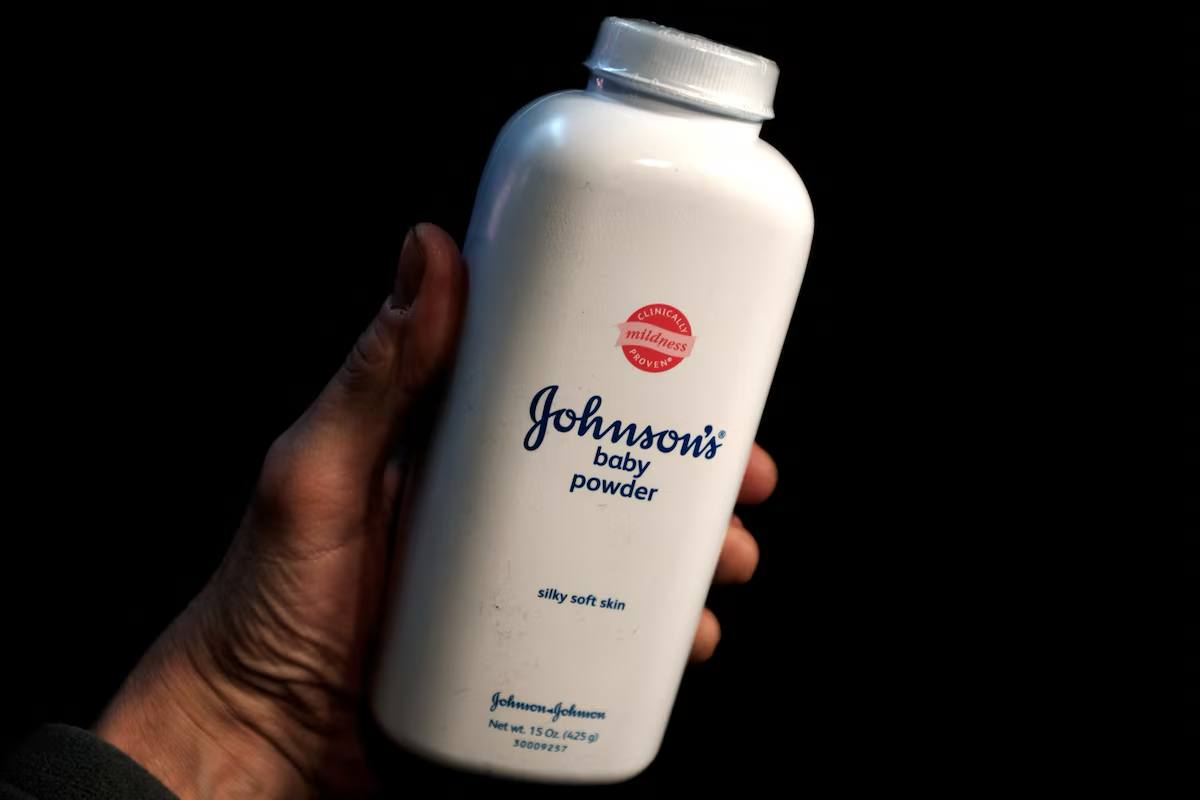
Johnson & Johnson announced on Monday that it has agreed to a $5.5 billion settlement covering approximately 69,000 cases consolidated in federal court in New Jersey and related cases in state court – totaling 99.75% of the remaining talc-related claims against the company. Plaintiffs’ law firms confirmed the agreement, describing it as a good resolution after a decade-long legal battle. The deal requires approval from the judge overseeing the federal litigation. When that approval arrives, it will close a chapter of litigation that has dominated J&J’s legal exposure for years, appeared as the most-discussed variable in virtually every analyst note covering the company, and suppressed the stock’s valuation multiple despite consistently strong operating results. NEWSCENTRAL marks Monday’s announcement as the most commercially consequential single day for J&J’s risk profile since the company discontinued talc-based baby powder sales in the United States.
The settlement’s timing was shaped by a specific and favorable legal event last week. A federal judge overseeing related proceedings cast significant doubt on individual plaintiffs’ ability to prove that talc specifically caused their ovarian cancer – a ruling that materially weakened the plaintiffs’ litigation position and created an incentive to settle at terms that J&J’s management could characterize as commercially rational rather than as a concession of legal liability.
J&J’s vice president of litigation described the talc claims as meritless and framed the settlement as being sought for closure. That framing is commercially standard for a major corporation settling litigation it believes it could ultimately win in court – the economic case for settling often rests not on liability assessment but on the certainty, cost, and management distraction avoided by resolution. For J&J specifically, the certainty value of closing 99.75% of remaining claims through a single agreement is substantial: every quarter that talc litigation persisted was a quarter in which investors applied an uncertain liability discount to a company that was otherwise posting record revenues and raising full-year guidance. Freddy Miller, Senior Analyst at NEWSCENTRAL, notes that the stock’s positive reaction – shares gained approximately 1% in a week when the broader market was under pressure from oil price concerns – reflects the market correctly identifying the settlement as a valuation re-rating event rather than a surprise cost, since the liability had been partially priced in for years.
The financial mechanics of a $5.5 billion settlement at this stage of J&J’s earnings trajectory are manageable without materially altering the company’s capital allocation picture. J&J reported full-year 2025 revenue of approximately $98 billion and guided to over $101 billion for 2026 – the first time in the company’s history that annual revenue would exceed $100 billion. Against that revenue base, a $5.5 billion settlement, likely structured as payments spread across several years rather than a single lump sum, represents a resolved liability whose predictable schedule is commercially preferable to the open-ended uncertainty of continued litigation with a potential jury award at an unknown date.
NEWSCENTRAL finds the failed Texas Two-Step history instructive as a commercial lesson: the faster and cheaper resolution mechanism that J&J attempted through subsidiary bankruptcy was blocked, and the conventional litigation path – while slower and more expensive – ultimately produced the comprehensive resolution that management wanted, without the reputational cost of the bankruptcy strategy.
The structural precedent that this settlement establishes for future mass tort litigation involving consumer product companies is worth noting. J&J’s earlier attempts to resolve the talc litigation through subsidiary bankruptcy filings – the so-called Texas Two-Step approach – were repeatedly blocked by federal courts that questioned whether a solvent company could legitimately use the bankruptcy system to channel mass tort liability. The settlement announced Monday reaches the same outcome – comprehensive resolution of consumer product liability claims – through conventional tort settlement rather than the bankruptcy pathway, demonstrating that the conventional mechanism, while slower and more expensive than the bankruptcy route, can ultimately achieve comparable coverage at comparable cost.
The remaining 0.25% of claims not covered by the settlement will continue in litigation. That residual group typically comprises claimants who have rejected the settlement terms for individual reasons – higher claimed damages, different factual circumstances, or a preference to pursue jury trial. J&J’s management has characterized that residual as manageable. Whether the 0.25% generates any material liability depends entirely on case-specific facts that are not representative of the broader litigation.
The talc chapter closing at J&J opens a cleaner view of a company that has been significantly transforming its business profile simultaneously. The spin-off of the Kenvue consumer health division in 2023, the continued growth of the Innovative Medicine pharmaceutical segment, and the MedTech division’s expansion into surgical robotics have produced a company whose financial profile is more consistently pharmaceutical in its margins and growth characteristics than the historical conglomerate structure suggested. NEWS CENTRAL treats the $5.5 billion settlement as the final accounting entry in J&J’s transition away from the consumer product liability exposure that defined its litigation profile for a decade – and the clearest signal yet that the company’s next chapter, built around Darzalex, Carvykti, and the surgical robotics pipeline, will be evaluated on operational execution rather than legal overhang.