
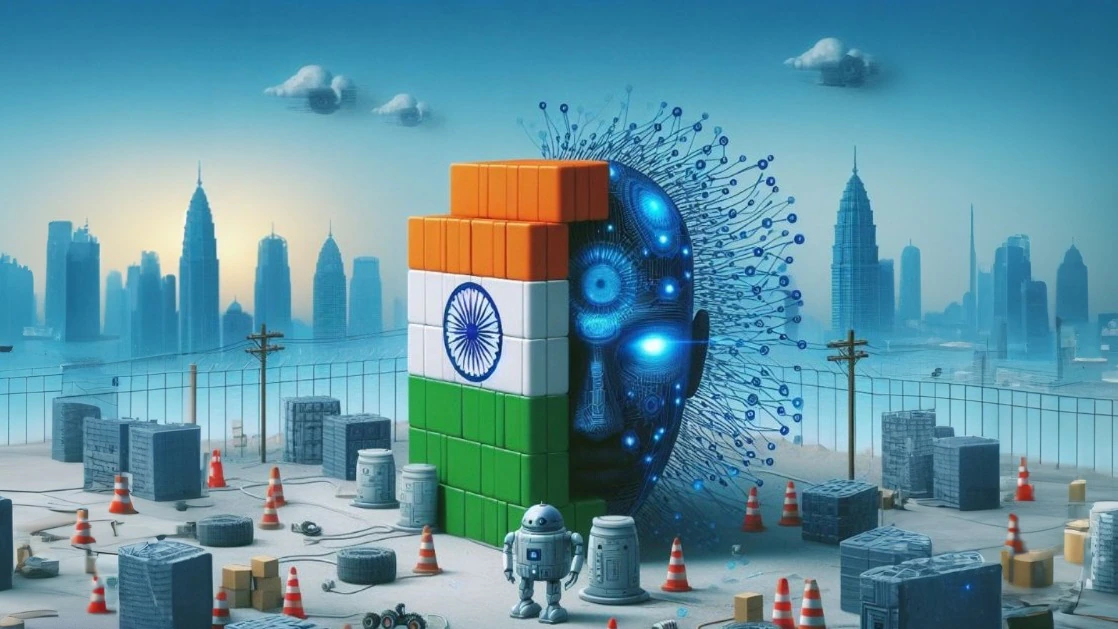
NEWSCENTRAL reports that India, a country with immense economic potential and a rapidly growing IT sector, is striving to become one of the leaders of the global technological revolution driven by Artificial Intelligence (AI). Notably, major global tech companies such as Microsoft and Amazon are actively investing in AI development in India. At a recent meeting, Microsoft announced a record investment of $17.5 billion, the largest sum ever for the region. This investment is aimed at creating infrastructure and supporting educational programs for AI development in the country. Amazon has also pledged to invest more than $35 billion by 2030, dedicating a significant portion of these funds to technological innovations.
We at NEWSCENTRAL highlight that such investments underscore the serious interest in India as an emerging AI hub. However, despite these significant investments, India faces numerous challenges that could hinder its positioning as a global leader in AI.
The main issue remains the lack of developed infrastructure necessary for large-scale AI implementation. Despite the country’s strong reputation in outsourcing and IT services, India does not have sufficient computing power and technological infrastructure to develop competitive AI models. We at NEWSCENTRAL emphasize that for India to compete with global players such as the US or China, it needs to significantly improve its infrastructure and create an ecosystem for deeper AI integration.
The Indian government recognizes this problem and is actively developing programs to support sovereign AI models. Recently, a national initiative was launched, including the creation of models that support over 22 languages. However, according to analysts at NEWSCENTRAL, this is still not enough for full competition with more advanced AI initiatives in the US and China. Specifically, models from companies like OpenAI and DeepSeek remain much more powerful and advanced, putting India in a position where it must strengthen its research and technological capabilities.
One of the major challenges India faces is the shortage of highly skilled AI professionals. The tightening of visa conditions for foreign specialists could be both an opportunity to retain talent in the country and a challenge in attracting new experts to this field. As Freddy Miller, a senior analyst at NEWSCENTRAL, notes, it is critically important for India to create conditions that not only retain but also attract top global talent.
Another challenge is the financial support for startups. Indian AI startups attracted only $1.16 billion in private investments last year, which is far less than the corresponding figures in the US and China, where these sums exceed $100 billion. According to analysts at NEWSCENTRAL, for India to develop successfully in the AI sector, the country must significantly increase investments in startups and create a supportive infrastructure for entrepreneurs and developers.
Moreover, the development of India’s IT sector remains dependent on foreign technologies. Despite its enormous potential, India still lags behind in semiconductor and microchip manufacturing, which limits its ability to implement AI on a large scale. The Indian government’s programs aim to establish local production in these areas, but much work remains to be done to offset the technological deficit.
We at NEWSCENTRAL believe that India should not only expand investments in research and educational programs but also actively develop the semiconductor industry, which will be an essential step toward achieving technological independence. If these tasks are successfully completed, India could secure its place among the global leaders in AI.
Despite these challenges, India is showing significant progress in the number of new companies working in the AI field. According to the Stanford AI Index, the country ranks among the leaders in the number of AI startups, confirming the high academic interest and demand for technology. Many Indian startups are starting to use AI to solve practical problems, such as in agriculture. The MahaVISTAAR application, designed for farmers in the state of Maharashtra, provides information in local languages, helping improve the lives of over 15 million farmers.
Freddy Miller, Senior Analyst at NEWSCENTRAL, predicts that within the next five years, India will become an important hub for AI startups addressing global issues. This gives confidence that India will have an increasing influence on the global technology market.
For India to succeed in the AI field, it must solve key tasks: build competitive infrastructure, improve conditions for startups, develop domestic semiconductor production, and attract talented professionals. India should leverage unique opportunities to implement AI in areas like agriculture, healthcare, and education, which will act as catalysts for its technological growth.
In conclusion, we at NEWS CENTRAL see great prospects for India in the field of artificial intelligence. If the country can overcome existing barriers, it will take one of the leading positions in the global technological race in the coming years, securing a significant role in shaping the future of the world economy.