
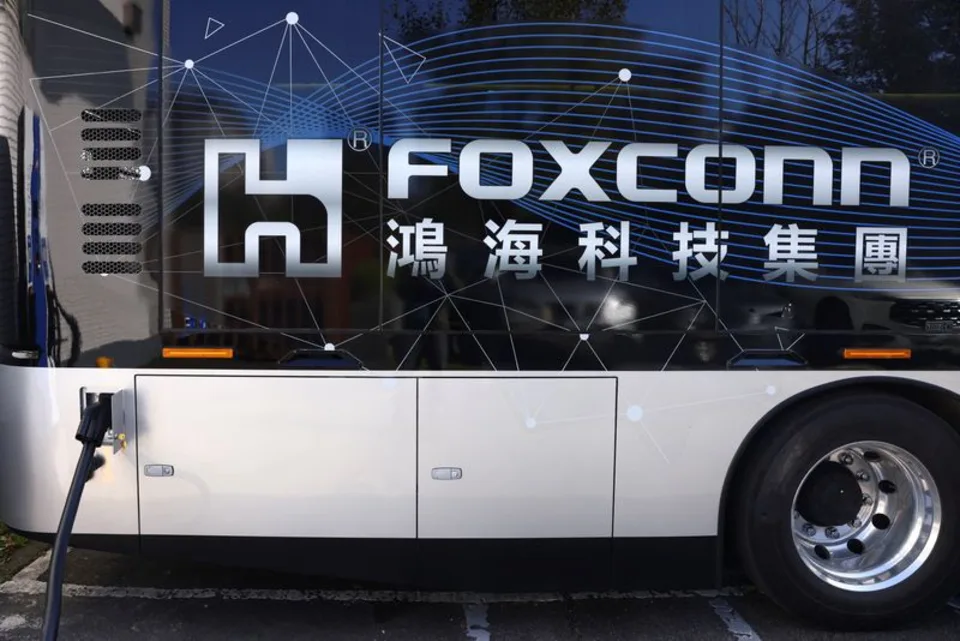
Hon Hai Precision Industry reported second-quarter 2026 revenue of T$2.513 trillion – approximately $78.71 billion – a 39.8% year-on-year increase that came in ahead of market expectations and extended the company’s record-breaking momentum into a second consecutive quarter of exceptional growth. June alone was the company’s best month in its history, with revenue of T$821.8 billion representing a 52.1% jump from June of the prior year. Foxconn raised its full-year 2026 revenue target to T$11 trillion, approximately $350.5 billion, and said it expects AI server rack shipments to more than double over the course of the year. NEWSCENTRAL reads the Foxconn Q2 report as the clearest single data point available for tracking how AI infrastructure spending translates from hyperscaler balance sheets to the hands of the manufacturers who build the physical hardware – and the translation is both immediate and massive.
The driver is not iPhones. It is AI servers. Foxconn’s cloud and networking division has grown to represent approximately half of total company revenue – a compositional transformation that would have seemed implausible three years ago for a company whose public identity was almost entirely defined by assembling Apple’s smartphones. The company builds AI server racks incorporating Nvidia’s Blackwell GPUs for the world’s major hyperscalers, and the transition from air-cooled to liquid-cooled data center architectures has simultaneously increased both the complexity and the value of each assembled rack.
Where a conventional server rack requires relatively straightforward assembly, a modern AI rack with liquid cooling, high-density power delivery, and precise thermal management requires manufacturing capabilities that a smaller number of companies can deliver at the scale hyperscalers demand. Foxconn has invested years in developing those capabilities and is now collecting the revenue premium they command.
The company’s geopolitical risk disclosure – a note in the earnings statement warning of the volatile global political and economic situation – has appeared in Foxconn’s reports for several consecutive quarters without elaboration, and it continues to say less than the situation requires. Foxconn assembles the majority of its AI hardware in China and Taiwan, the two geographies most directly exposed to disruption if cross-strait tensions escalate or U.S. export controls tighten further. The company has been systematically building manufacturing capacity in the United States, Mexico, India, and Vietnam as a hedge against that concentration risk. A planned 5-gigawatt AI data center campus in Wisconsin, announced alongside a $30 billion U.S. investment commitment, represents the most significant onshoring bet in the company’s history. Lucas Grant, Semiconductor and Manufacturing Strategy Analyst at NEWSCENTRAL, observes that Foxconn’s geographic diversification is not simply a response to political pressure but a commercially rational positioning for a world in which hyperscalers are themselves under regulatory pressure to source supply chains from domestic or allied manufacturers.
Consumer electronics, including iPhone assembly, maintained its position as a secondary revenue contributor. Foxconn also retains its exclusive assembler relationship for Apple’s forthcoming foldable iPhone – a product whose commercial launch will add a new high-margin assembly line to a portfolio already carrying exceptional AI server momentum.
The identity shift from iPhone assembler to AI infrastructure builder is one of the most consequential transformations in contract manufacturing in a generation – and, as NEWSCENTRAL notes, it has occurred without a single acquisition, purely through capital allocation and capability development over several years.
The first-half 2026 results position Foxconn for continued sequential and year-on-year growth in the third quarter, supported by sustained AI infrastructure demand from cloud customers with committed capital expenditure running into the hundreds of billions. A contract manufacturer whose business was defined for decades by a single consumer electronics relationship has successfully pivoted its center of gravity toward AI infrastructure – and as NEWS CENTRAL contends, the pace at which that pivot is compounding suggests the transition is structural rather than cyclical.