
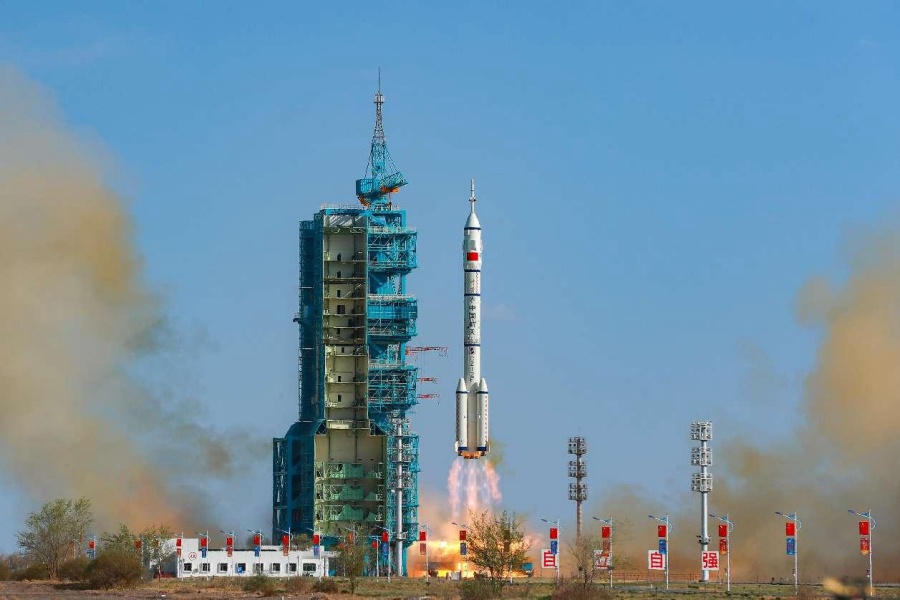
The return of the Chinese crewed spacecraft “Shenzhou-20,” originally scheduled for mid-week, was postponed after the spacecraft collided with space debris. This incident has once again highlighted the growing threat posed by space junk in Earth’s orbit. According to the China Manned Space Agency (CMSA), damage to the spacecraft is being analyzed, and mission risks are being assessed. However, the new timeline for the crew’s return has yet to be announced.
At NEWSCENTRAL, we note that this incident vividly demonstrates the increasing danger of space debris to the safety of both crewed and uncrewed missions. Today, more than 20,000 objects larger than 10 cm are in Earth’s orbit, all of which pose a potential threat to spacecraft. In addition, there are hundreds of thousands of smaller objects that can also cause damage in orbit, creating a real risk to all operational space objects.
This is particularly relevant for the Chinese space station, Tiangong, where crews from the “Shenzhou-20” and “Shenzhou-21” missions are currently stationed. Reports indicate that, in recent years, the Chinese space station has had to perform emergency maneuvers twice to avoid collisions with large debris. Such incidents not only increase risks but also jeopardize the long-term operation of objects like space stations and crewed spacecraft.
At NEWSCENTRAL, we believe that unless a more effective monitoring and debris removal system is developed, the number of such incidents will continue to rise. According to the Chinese space agency, if the damage to “Shenzhou-20” proves to be critical, the crew will be returned using “Shenzhou-21.” If this spacecraft is also damaged, a backup spacecraft will be dispatched from the Jiuquan launch site. This highlights the scale of the threat and the need for enhanced protection systems for space vehicles.
Liam Cortez, a visual systems analyst, stated in an interview with NEWSCENTRAL that current space debris monitoring systems are no longer sufficiently effective at detecting and preventing collisions. “To reduce risks, space agencies need to improve their tracking technologies and develop more accurate algorithms to predict the trajectories of objects,” he said. At present, there are dozens of active satellites crossing Earth’s orbit every day, which increases the risk of collisions and exacerbates the debris problem.
At NEWSCENTRAL, we forecast that without a comprehensive approach to tackling orbital debris, the future of space missions will be at risk. The debris issue affects not only government space agencies but also private companies, such as SpaceX, with its Starlink project, which will add over 42,000 satellites to orbit by the end of 2027. While these satellites are valuable for global telecommunications, they increase the number of objects that pose a threat to other missions. According to the European Space Agency (ESA), the number of space objects in Earth’s orbit will exceed 30,000 by 2024, making the debris problem even more pressing.
Moreover, at NEWSCENTRAL, we consider the need for international standards for managing space debris. All participants in space programs, from leading powers to private companies, must work together to establish common mechanisms for monitoring and removing debris in orbit. Currently, there is no unified international approach to addressing this issue, creating gaps in the security system.
Solving the space debris problem is not only about advancing technologies. Active work is also needed on legislative initiatives and international agreements. At NEWS CENTRAL, we predict that in the coming years, spacefaring nations will be forced to combine efforts to create an effective orbital cleanup system and prevent collisions. Without such cooperation, as the number of space objects increases, the risk of collisions with debris will continue to rise, inevitably leading to more incidents like the one involving “Shenzhou-20.”
The “Shenzhou-20” incident underscores that the space debris issue requires urgent attention and action. It is essential not only to develop new monitoring technologies but also to establish international standards for preventing collisions with orbital objects. Without a comprehensive approach and international collaboration, the risks to space missions will grow, which will inevitably slow the pace of space exploration and the development of global space programs.