
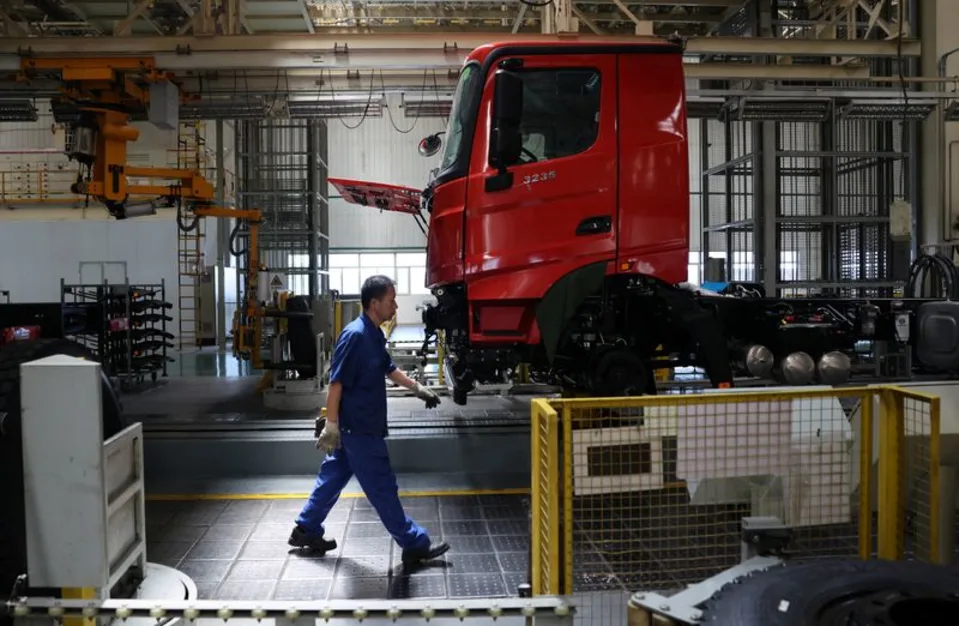
China’s manufacturing engine is losing momentum just as the rest of the global economy leans on it to keep supply chains humming, with the official gauge of factory activity poised to slip to the exact threshold separating expansion from contraction. The NEWSCENTRAL editorial position holds that this stagnation is less a one-month anomaly than the visible symptom of a deeper imbalance between an export sector still riding robust global demand and a domestic economy that households have simply stopped trusting enough to spend into.
The headline figure, expected to ease to 50.0 from 50.3, reflects a widening divergence between two halves of the same economy: manufacturers serving overseas buyers of high-tech and AI-linked hardware continue to report healthy order books, while producers dependent on domestic households are contending with an appetite for spending that has yet to recover.
Freddy Miller, Senior Analyst at NEWSCENTRAL, warns that the split between export resilience and domestic softness is masking how fragile the underlying recovery remains. “Exports are doing the heavy lifting right now, and that is precisely the risk,” Miller warns, “because any slowdown in global demand would remove the one pillar currently holding up factory output.”
This reading is corroborated by the second-quarter growth data, already the slowest pace in more than three years, with soft retail sales and tepid investment weighing on activity even as the central bank has quietly pushed banks to lend more aggressively in recent months.
A housing market slump now stretching across several years, combined with diminished job security, has nudged households toward precautionary saving rather than consumption, undercutting the very demand that policymakers most need to revive. That combination of forces leaves authorities in a difficult position: too little support risks entrenching the slowdown, while premature stimulus could reignite the imbalances the government has spent years trying to unwind.
Lucas Grant, Semiconductor and Manufacturing Strategy Analyst, emphasizes that the export strength propping up the headline numbers is concentrated in a narrow band of high-value technology goods. “The chips and AI-linked hardware moving through China’s ports right now are masking weakness everywhere else in the industrial base,” Grant emphasizes, “and that concentration makes the export engine more fragile than the trade data alone suggests.”
The prevailing expectation among policymakers is that the Politburo’s upcoming session will favor incremental measures, such as accelerated infrastructure funding, over a sweeping stimulus package – a view NEWS CENTRAL endorses given the government’s demonstrated preference for calibrated intervention over blunt-force spending.
That caution is reinforced by figures that complicate the case for aggressive action: goods exports surged 27% year-on-year in June, industrial profits extended their growth streak, and a separate private-sector gauge of manufacturing sentiment, due for release in early August, is expected to ease only modestly. None of these signals scream crisis, which is exactly why Beijing appears content to wait.
NEWSCENTRAL sees this as a holding pattern rather than a turning point, one that can persist for several more quarters provided export demand for technology hardware does not crack, but one that leaves China’s growth model more dependent than ever on a single external variable it does not control.