
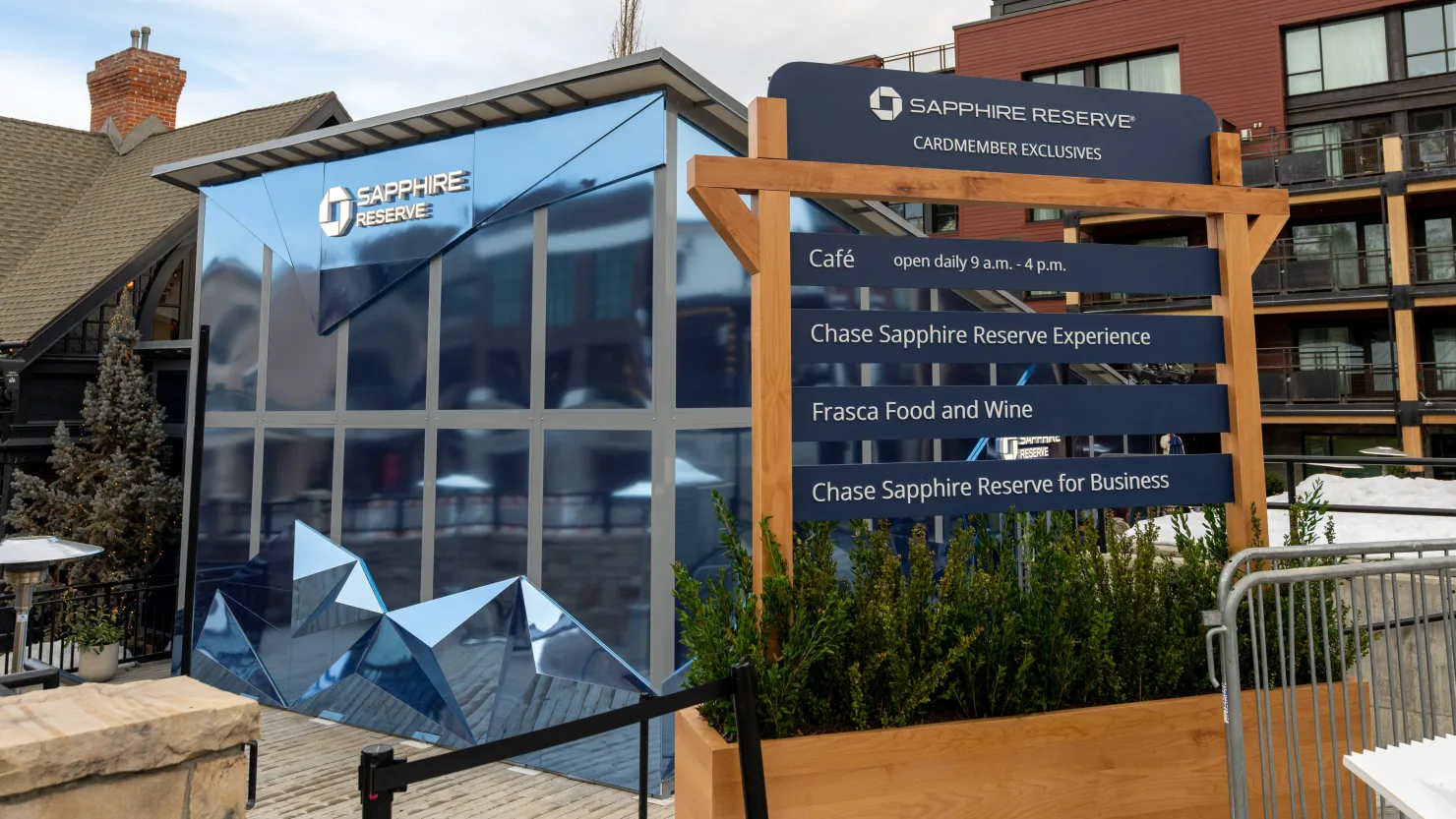
American Express and Chase have moved their premium-card rivalry well beyond the airport terminal, building air-conditioned retreats at Coachella, hosting athlete meet-and-greets at the Paris Olympics, and installing permanent branded lounges inside stadiums and arenas – a shift that lands just months after both companies raised the annual fees on their flagship travel cards, with the Amex Platinum now at $895 and the Chase Sapphire Reserve at $795. NEWSCENTRAL reads the expansion into festival and stadium hospitality as the two issuers’ answer to a specific commercial problem: once airport lounge access becomes table stakes across the premium card tier, differentiation has to happen somewhere the competitor’s card cannot simply copy overnight. Stadium partnerships and festival activations require multi-year rights negotiations, capital investment in purpose-built infrastructure, and brand relationships that take years to develop – none of which can be replicated in a single product cycle.
The economics behind the push are increasingly stark. Survey data shows cardholders paying more than $500 in annual fees spent an average of $3,200 a month between May 2025 and June 2026, up roughly 17% from the prior year, while holders of sub-$500-fee cards spent an average of $1,144 monthly, up only about 6% over the same period. The divergence is not incidental – and NEWSCENTRAL notes it reflects a K-shaped spending environment in which premium cardholders have continued to accelerate discretionary expenditure while mass-market holders have pulled back, creating a commercial case for doubling down on the high-fee tier rather than chasing the volume of the lower one. The cost structure of operating premium card programs – lounge networks, travel credits, concierge services, rewards redemption liabilities – requires the spending density that only the highest-fee cardholders generate.
Freddy Miller, Senior Analyst at NEWSCENTRAL, notes that the widening spending gap between premium and mass-market cardholders is itself a live readout of the K-shaped economy that has dominated 2026 consumer-spending commentary – affluent households continuing to spend freely while lower-income cardholders pull back, and issuers are now building entire hospitality strategies around leaning into that divergence rather than smoothing over it. The strategic implication is not merely that premium cards are more profitable than mass-market ones – that has been true for decades – but that the premium cardholder’s spending behaviour is accelerating away from the rest of the market at a pace that justifies ever-greater investment in differentiation. Every dollar Amex spends on a Barclays Center lounge is a bet that the cardholder who values that access is worth retaining at any reasonable cost.
American Express has built formal partnerships with more than 20 venues worldwide, eight of which already operate dedicated Amex lounges – including Hard Rock Stadium in Miami and London’s O2 Arena – with a new location set to open at Barclays Center in New York this year. The company has leaned into fandom-specific collaborations spanning musicians like Harry Styles and Olivia Rodrigo alongside the NFL and Formula 1, building a portfolio of cultural associations that positions the card as a passport to experiences the general public cannot easily access rather than simply a payment instrument with good travel benefits. Chase, for its part, is emphasising retention over acquisition: Laura Picciano, general manager of Chase Sapphire, has described the premium cardholder base as unusually engaged and loyal once won, making it a segment worth continued investment even at high activation cost per venue.
The strategic tell in this rivalry is less the lounges themselves than where the issuers are choosing to build them – and equally, where they are choosing not to. A stadium suite or a Coachella cooling tent only works as a differentiator if it feels authentic to the setting rather than a generic branded box dropped into a high-traffic venue, and both issuers appear to have internalised that lesson. The next phase of competition will be fought less on how many venues each company can add and more on how convincingly each experience fits the cultural context it is trying to occupy. What NEWS CENTRAL contends is that the winners of this phase will be determined not by infrastructure scale but by curation judgment: the ability to identify the events and communities where premium card access creates genuine desire rather than mere convenience, and to build partnerships that make that access feel earned by the cardholder rather than purchased by the issuer.