
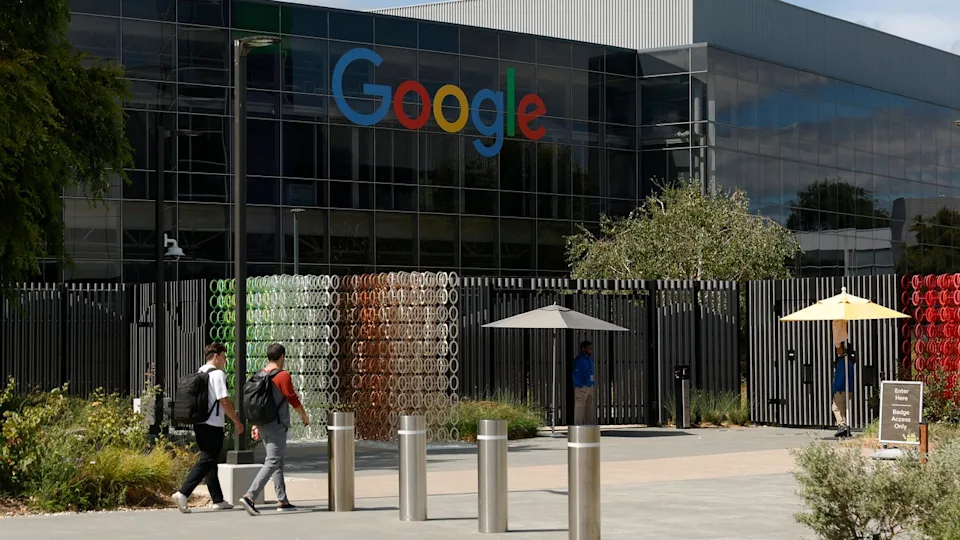
Alphabet shares rose approximately 4% on Monday as the company formally joined the Dow Jones Industrial Average, replacing Verizon Communications in a change S&P Dow Jones Indices first announced on June 23 and implemented before trading opened on June 29 – the index’s first compositional change since November 2024, when Nvidia and Sherwin-Williams replaced Intel and Dow Inc. The inclusion makes Alphabet the fifth member of the so-called Magnificent Seven mega-cap technology cohort to join the 130-year-old benchmark, following Nvidia, Amazon, Apple, and Microsoft, and gives the price-weighted index direct exposure to advertising, cloud computing, artificial intelligence, autonomous mobility through Waymo, healthcare technology, and media distribution – a portfolio breadth that S&P Dow Jones Indices cited explicitly as central to its inclusion case. The Dow closed above 52,000 for the first time in its history on the same session, with Alphabet’s gain among the largest single contributions to the index’s advance. We at NEWSCENTRAL consider the inclusion symbolically significant but practically modest in its immediate market impact – a recognition that arrived years after equity markets had already fully priced Alphabet’s transformation from a search advertising company into a diversified technology conglomerate.
The mechanics of the substitution illustrate a structural quirk of the Dow’s methodology that explains both why Verizon was removed and why the timing of Alphabet’s addition required a specific technical precondition. The Dow is a price-weighted index, meaning each constituent’s influence on the index level depends on its per-share price rather than its total market capitalization – a methodology that has persisted since the index’s creation in 1896 despite its well-documented analytical limitations. Verizon, trading around $44 per share, had been reduced to approximately 0.5% weighting in the index purely as a function of its low share price, regardless of the company’s continued operational scale as one of America’s largest wireless carriers with 146.8 million total wireless retail connections. Alphabet’s inclusion was only methodologically viable following the company’s 10-for-1 stock split, which brought its per-share price down to a level compatible with the Dow’s price-weighting framework; at its pre-split price, Alphabet shares would have dominated the index to a degree S&P Dow Jones Indices has historically avoided. Following the split-adjusted addition, Alphabet is expected to carry roughly 4% weighting in the Dow – approximately eight times the influence Verizon had been reduced to.
The market reaction to Dow inclusion announcements has historically been muted relative to the symbolic significance assigned to the change, and Monday’s session followed that established pattern: Nvidia fell 0.8% on the day it joined the Dow in 2024, and Amazon slipped 0.1% on its inclusion date, reflecting the comparatively modest scale of dedicated Dow-tracking capital relative to the S&P 500 and Nasdaq 100. The primary Dow-tracking vehicle, the SPDR Dow Jones Industrial Average ETF, manages approximately $45 billion in assets, dwarfed by the roughly $20 trillion tracking the S&P 500. Freddy Miller, Senior Analyst at NEWSCENTRAL, notes that the genuine significance of Dow inclusion is not the forced index-fund buying it generates but the narrative legitimacy it confers among a specific cohort of blue-chip-focused institutional investors and retail audiences who treat Dow membership as a marker of established, durable corporate significance – a signal that, for a company facing the specific investor anxieties Alphabet is currently navigating, arrives at a useful moment.
Those anxieties are concrete and have weighed on the stock through most of June despite the Dow-inclusion gain: Alphabet was tracking for its worst monthly performance since February 2022 heading into the final trading days of June, having posted losses in six of the preceding seven weeks – a sharp reversal from May, when the company briefly surpassed Nvidia to become the world’s most valuable company by market capitalization after-hours. Investor concerns center on a cluster of related AI execution questions: compute capacity shortages constraining Google Cloud’s ability to fully capture surging demand, the competitive pressure from lower-cost Chinese open-source AI models compressing the pricing power of frontier providers including Google’s own Gemini, a wave of high-profile DeepMind researcher departures to competitors including OpenAI and Anthropic, and reduced share buyback activity that some investors read as a signal of capital being redirected toward AI infrastructure spending at the expense of shareholder returns. Nathan Clark, Enterprise IT and Systems Architecture Analyst at NEWSCENTRAL, observes that Google Cloud’s first-quarter 2026 revenue of $20 billion, up 63% year-on-year with a 32.9% operating margin, represents genuinely strong underlying business performance that the stock’s June weakness has not fully credited – a disconnect between operating results and market sentiment that is becoming increasingly common across the AI infrastructure cohort as investors weigh near-term execution risk against demonstrated revenue growth.
For NEWS CENTRAL, the juxtaposition of Alphabet’s blue-chip validation through Dow inclusion and its simultaneous worst-month-in-two-years stock performance captures something important about where large-cap technology investing stands in mid-2026: institutional legitimacy and near-term investor confidence have become genuinely decoupled for companies whose AI infrastructure spending commitments are large enough to create real execution risk, even when those same companies possess businesses fundamentally strong enough to earn admission into the market’s most symbolically significant index. Alphabet’s challenge through the remainder of 2026 is not proving its strategic relevance – the Dow has now formally certified that – but converting its AI capital expenditure into the kind of visible, durable revenue growth that resolves the execution anxiety currently suppressing its valuation.