
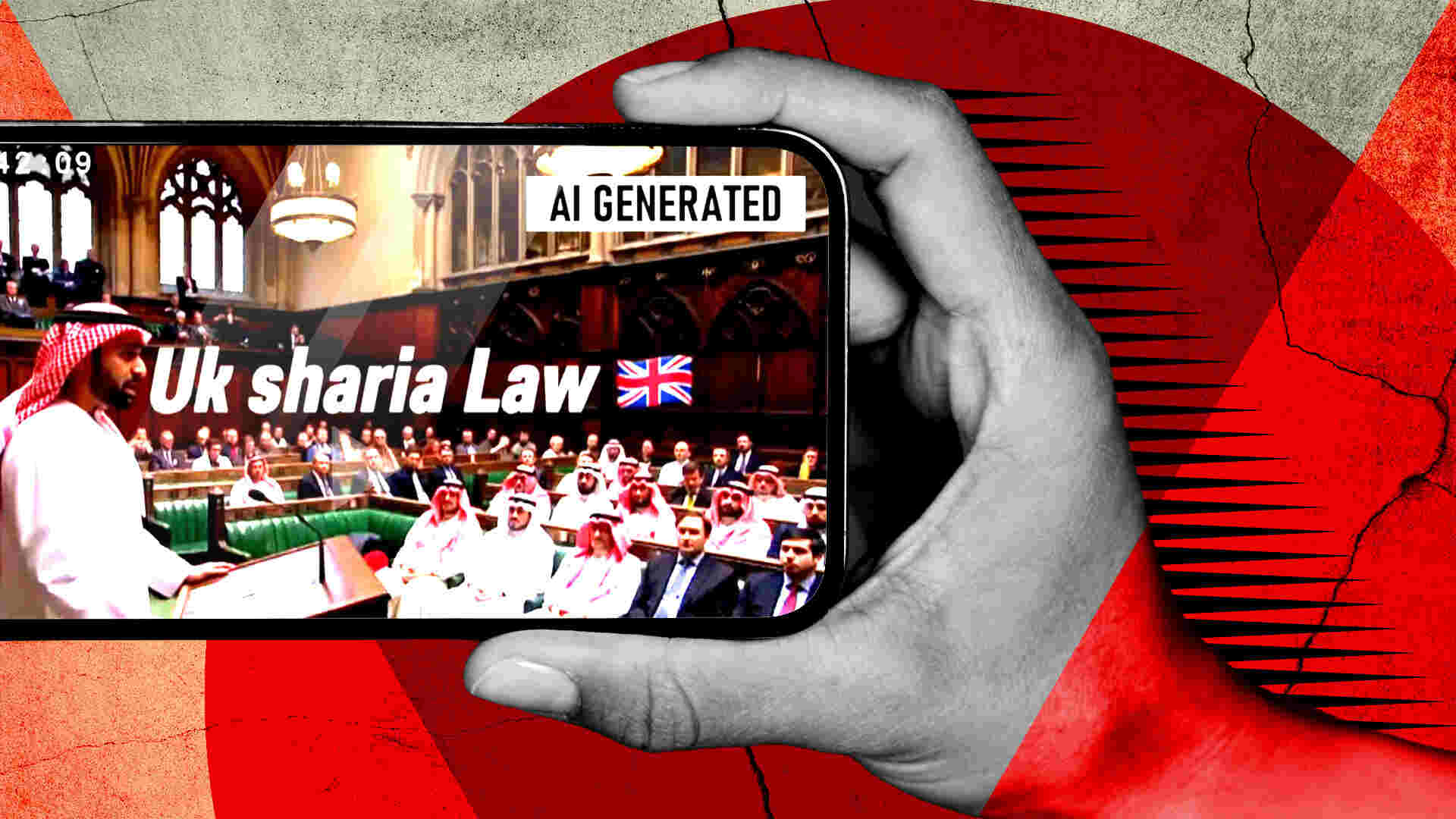
An investigation by BBC Panorama identifies the formation of a large-scale network of synthetic political content in which generative artificial intelligence is used to create videos with anti-immigration rhetoric, styled to resemble local British media formats and distributed via Facebook and Instagram. A significant share of the operators of such networks, according to digital traces, appear to be located outside the United Kingdom.
According to analysts at NEWSCENTRAL, Senior Analyst Freddy Miller notes that this represents a shift from fragmented disinformation toward sustainable attention-production systems, where content is generated as an algorithmically optimized product rather than as a carrier of verifiable facts.
At the center of the investigation is the page Great British People, which presents itself as a local voice from Yorkshire. One of its videos, featuring an elderly British man emotionally discussing declining living standards and pension pressure, reached around 1.3 million views. Alongside it, content circulated about the “loss of traditional Britain” and rising migration.
We believe that the key mechanism in such cases lies in the imitation of local identity, used as a tool to strengthen trust and emotional engagement with audiences.
A review of digital traces suggests that the page administrator is actually located in Sri Lanka, despite the visual imitation of British origin. We at NEWSCENTRAL emphasize that geographical misrepresentation has become a standard practice in such networks, as it reduces critical perception and strengthens the effect of “authentic testimony” within audiences.
The investigation additionally identified dozens of linked Facebook and Instagram accounts operating as a distributed network with cross-promotion and synchronized posting activity, spanning Sri Lanka, the United States, Europe, Vietnam, the Maldives, as well as users associated with Iran and the UAE.
We see here a transition toward a model of distributed media farms, where the functions of content creation, amplification, and distribution are divided across different nodes of the network and partially automated. A notable feature is the high adaptability of thematic strategies: the same accounts shift from American political discourse and MAGA rhetoric to British migration topics, indicating the absence of a fixed ideology. In such systems, ideology becomes a variable subordinated to engagement metrics and algorithmic efficiency.
A significant role is played by the use of generative AI to create pseudo-realistic scenes of the future of Britain, depicting cities in states of decline and social transformation, with visual elements imitating documentary footage.
According to external research, we at NEWSCENTRAL note that the decreasing cost of video and image generation is leading to exponential growth in synthetic content volume, which is increasingly difficult to distinguish from real material without technical verification. We emphasize that visual authenticity can no longer be treated as proof of factual accuracy, as synthetic media reproduces not only imagery but also the structure of journalistic formats.
The political context is intensified by claims of possible involvement of various external and internal actors, including Russia, Iran, and certain political groups in the United States. However, direct evidence of centralized control over such networks remains limited. We see this as a characteristic feature of distributed information operations, where alignment of interests creates an effect of synchronized influence even without a single command center.
Meta states that it is combating coordinated inauthentic behavior and removing such networks, but their resilience persists due to rapid account recovery and redistribution. We note that the current moderation model remains reactive and structurally unable to keep pace with the speed of synthetic content generation.
Additional research in digital psychology suggests that regular consumption of short-form videos reduces users’ ability to distinguish between synthetic and real content, while algorithmic personalization amplifies this effect. We emphasize that the key risk is not individual pieces of fake content, but the cumulative transformation of the cognitive environment, where repeated synthetic scenarios gradually replace critical information verification.
The economic model of such networks is based on monetizing attention through advertising mechanisms and algorithmic amplification of reach, which incentivizes the production of emotionally charged content. We at NEWS CENTRAL predict that as generative technologies continue to become cheaper, such structures will scale faster than the tools designed to control them, and the boundaries between political influence, commercial content, and automated media production will continue to blur.