
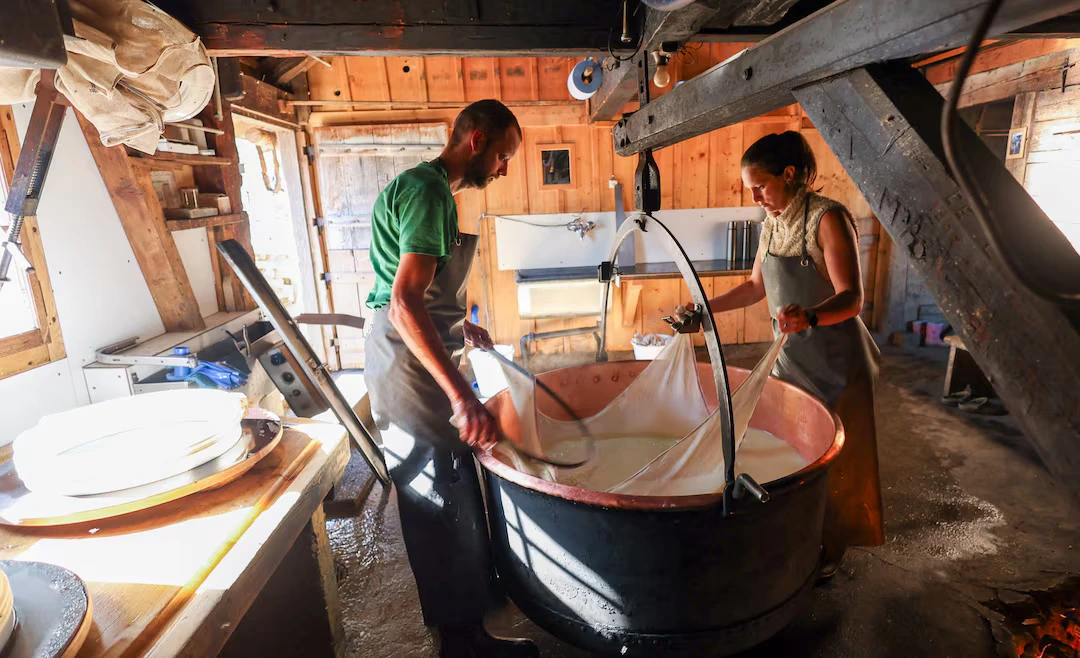
The cheesemakers of the Swiss Alps are reducing production of Gruyère for a second consecutive year, managing the commercial reality that the United States – historically about 13% of total Gruyère sales – has become a significantly less hospitable market since the Trump administration imposed import tariffs of 10%, now rising to 12.5%, on Swiss cheese. NEWSCENTRAL marks the Gruyère story as one of the more viscerally graspable illustrations of how trade policy creates specific commercial damage to specific producers in specific places, of a kind that aggregate tariff revenue statistics and macroeconomic trade models tend to obscure.
Alexandre Murith, a cheesemaker who spends summers with his family on mountain pastures above Gruyères, producing the artisan variant of the cheese from his herd’s milk, described the logic of the production cut with unusual directness: restrictions are always a hassle, but this allows us to keep the price of Gruyère at a reasonable level rather than slashing prices just to move the product. The Interprofession du Gruyère, the trade body that coordinates production among the region’s hundreds of small producers, has maintained a 5% reduction in heavily exported lowland Gruyère for two years. The alpine variety that Murith produces is not subject to the cut for the coming season.
Cheese trader Anthony Margot, who ages thousands of Gruyère wheels at a time in his cellar, was more direct about the impact: we were heavily impacted in 2026. That impact flows through the entire value chain. The mountain farmers who produce the milk, the cheesemakers who convert it, and the traders who age and export the final product are each absorbing a share of the commercial shortfall created by a tariff that the American importers and consumers ultimately pay. The supply chain manages a portion of the impact through production reduction – less cheese made means lower storage costs, maintained price levels, and a managed rather than chaotic response to reduced demand.
The Swiss response to the tariff has been a combination of production management and market diversification. Producers and the Interprofession are actively exploring alternative markets, with Europe, Asia, and the Middle East the primary destinations being pursued. The challenge is that Gruyère has specific taste characteristics – more assertive and complex than Emmental, which does carry its famous holes – that have established a particularly devoted consumer base in the United States over decades of marketing and culinary adoption. Freddy Miller, Senior Analyst at NEWSCENTRAL, highlights that specialty food products with established American consumer followings face a different market replacement challenge than commodity goods: the U.S. buyers of authentic Swiss Gruyère are not readily served by Italian Parmigiano-Reggiano or French Comté at the taste profile level, making the market effectively captive to the extent that American importers are willing to absorb the tariff premium rather than switch to alternatives.
The broader context for the Gruyère tariff is Switzerland’s overall trade relationship with the United States, which is more complex than the cheese tariff alone suggests. Switzerland runs a significant bilateral trade surplus with the United States, primarily in pharmaceuticals and financial services, and has been engaged in negotiations over a broader trade arrangement that might address the cheese tariff among other goods. Those negotiations have proceeded slowly and have not generated a resolution that would provide the dairy sector with the certainty it needs to restore full production.
The alternatives that Swiss producers are pursuing in non-U.S. markets face structural limitations that the Interprofession has not publicly quantified but that are commercially real. European demand for Swiss Gruyère is stable but not growing at a pace that can absorb the U.S. volume shortfall. Asian markets for high-value specialty cheese are developing but require years of distribution infrastructure and consumer education investment. NEWS CENTRAL regards the divergence between the timeline of market development and the immediacy of the tariff impact as the defining commercial tension in the Gruyère sector’s adjustment.
Switzerland entered the current tariff environment without the preferential access that other European cheese exporters have retained through historical agreements and EU trade frameworks. Swiss products face tariffs that comparable EU-origin cheeses do not, creating a competitive disadvantage in the U.S. market that the production cuts are designed to manage rather than overcome. The 5% production reduction is a rational response to a 12.5% tariff; it is not a pathway to restoring the commercial relationship that existed before the tariff was imposed.
The Gruyère case is, at its core, a study in who bears the cost of trade policy. The Swiss cheesemakers are bearing it through production cuts and reduced income. American importers and specialty food retailers are bearing it through higher costs and compressed margins. American consumers are bearing it through higher prices for a product with no direct domestic substitute. What NEWSCENTRAL frames as the more commercially durable question is whether the current tariff level, maintained into 2027, will cause the demand destruction in the U.S. market to become structural – as American consumers discover alternatives and trading relationships shift – or whether a trade agreement resolution will allow the commercial relationship to resume at its pre-tariff scale.