
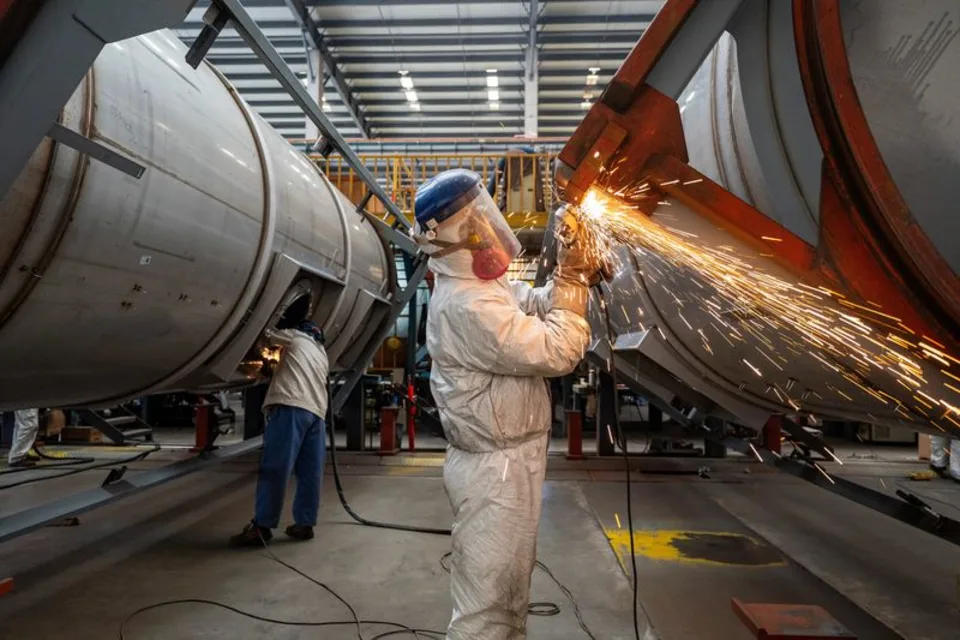
Industrial profits at China’s largest firms rose 15.1% in June year-on-year, the National Bureau of Statistics reported Monday – a double-digit gain that would be celebrated in most economies but that NEWSCENTRAL reads as the weakest performance this year, slowing from 21.1% in May and extending a two-month deceleration that has stripped some of the momentum from the profit recovery story that began 2026 so forcefully.
First-half profits rose 18.7%, marginally below the 18.8% pace recorded in the January-May period. The fractional slowing is more significant as a directional signal than as a magnitude – China’s industrial sector is still growing at roughly twice the rate it managed in 2025, when full-year profit growth was essentially flat.
The underlying driver of the deceleration is clear: energy prices. Producer prices dipped 0.3% month-on-month in June, the first decline since July 2025, as normalizing tanker flows through the Strait of Hormuz following temporary ceasefire negotiations pulled oil, refined-fuel, and petrochemical prices lower. Those categories had been among the strongest contributors to profit growth earlier in the year. Their retreat removed a tailwind that companies in adjacent sectors had been benefiting from, even if it partially reflects better supply conditions globally.
NEWSCENTRAL places the moderation of June industrial profits in a specific analytical context: the AI-driven boom in chip and equipment manufacturing, which drove triple-digit profit gains in earlier months, cannot sustain that pace indefinitely as a growing share of the investment cycle shifts from initial capacity build to production operations. June’s deceleration is consistent with that normalisation rather than with broader economic deterioration.
The structural imbalance beneath the profit numbers is the more commercially important story. Exports and industrial production have done the heavy lifting for China’s economy in 2026, while domestic consumption has remained soft and the property sector continues its prolonged contraction. Second-quarter GDP grew at its slowest pace in more than three years – a result that keeps pressure on policymakers to provide additional support even as Beijing’s traditional preference for targeted rather than broad-based stimulus limits the likely scale of any response.
The Politburo meeting scheduled for late July is the next key policy event. Investors are watching for signals on whether top leaders will upgrade their assessment of the economy’s needs or maintain the cautious easing posture that has characterized 2026. Expectations for a large stimulus package have been tempered by the resilience of exports and Beijing’s focus on curbing excess factory capacity, but the pace of profit growth moderation – two consecutive months of deceleration even as headline numbers remain positive – gives policymakers the data justification for additional targeted support if they choose to act. Freddy Miller, Senior Analyst at NEWSCENTRAL, notes that the profit data is internally stratified in ways the headline figure conceals: computer, communication, and electronic equipment manufacturing has led the sector with triple-digit profit growth in some monthly periods, while more traditional industries including mining and energy face a more mixed picture as commodity prices moderate.
The sectors that have contributed most to profit acceleration – AI-adjacent chip and equipment manufacturing – reflect a structural shift in China’s industrial base that is unlikely to reverse. The AI infrastructure buildout both domestically and as an export opportunity has transformed the profitability of technology-intensive manufacturing in ways that are durable regardless of the broader economic cycle.
The Politburo’s response to the June profit data will reveal how Beijing is balancing its competing policy objectives. A meeting that acknowledges the deceleration and signals targeted support for domestic consumption would be read as a constructive policy adjustment. One that maintains the current posture would suggest confidence that exports and industrial investment are sufficient to sustain the recovery without broader stimulus. NEWS CENTRAL tracks the outcome as one of the more commercially significant policy signals available for assessing China’s economic trajectory through year-end.