
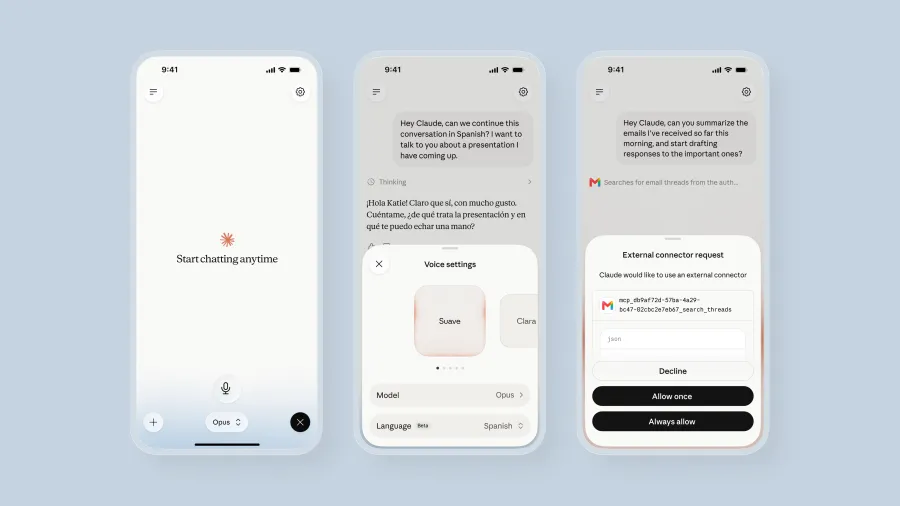
Anthropic announced on Thursday that Claude’s voice mode now supports its Opus and Sonnet models, replacing the Haiku-only configuration that had been in place since voice mode launched last year. NEWSCENTRAL reads the update as a deliberate competitive response to OpenAI’s conversational model rollout weeks earlier – and as an overdue correction to a product that was architecturally constrained to tasks that did not require the reasoning depth that paying subscribers expected. The change rolls out in beta across mobile, desktop, and web apps for all users immediately. For paid subscribers, voice mode now defaults to whatever model they last used in text chat, automatically applying that model’s fastest available version.
The practical significance of the change is greater than a simple model upgrade might suggest. Haiku is Anthropic’s smallest and fastest model, designed for low-latency responses to relatively simple queries. It handles quick lookups, basic questions, and tasks where speed matters more than depth. It is not well suited for the kinds of extended, context-sensitive conversations – talking through a pitch, working out a complex decision, brainstorming product strategy – that users increasingly want to have with their AI assistants.
Routing voice queries through Haiku was a product decision that prioritized latency over capability. Fast responses feel more natural in conversation than slow ones; the pause while a model generates a reply is more perceptible and more disruptive in voice than in text. The tradeoff worked for simple interactions and failed for complex ones. The new update resolves that by giving users the choice, rather than imposing a single model on all voice interactions.
NEWSCENTRAL notes that the cross-app integration distinguishes this update from a simple model upgrade in a commercially important way. A voice mode that can only answer questions is a voice search alternative. A voice mode that can execute actions in connected apps – drafting, scheduling, updating documents – is the beginning of a hands-free operating environment for knowledge work, which is the category that most AI assistant products are competing to define.
The cross-app integration that accompanies the model upgrade is commercially as important as the model choice itself. Claude’s voice mode can now act on connected Gmail, Google Calendar, Google Docs, Slack, Canva, and Notion accounts in the same way text chat does. A user can dictate a task – draft an email to this person, schedule a meeting, update this document – and have it executed without switching to a text interface.
Free plan users receive Haiku and single-app connectivity. Paid subscribers unlock Sonnet and Opus alongside multi-app access. Claude Fable 5, Anthropic’s most capable publicly available model, is not included in voice mode at this stage – a choice NEWSCENTRAL reads as a deliberate quality signal rather than a technical constraint: Anthropic is holding back its most capable model until the voice infrastructure can consistently match the standard Fable 5 users expect in text interactions.
The competitive context is direct. OpenAI rolled out a new family of conversational models and updated ChatGPT’s voice mode in the weeks preceding this announcement. The two companies are competing for the same use case: voice as the primary interface for complex, multi-step AI-assisted work rather than a secondary option for simple queries. The winner of that competition will be determined not by which model is more capable but by which voice experience handles the friction of real-world use – mid-conversation clarifications, background noise, ambiguous instructions, multi-step tasks that require context from earlier in the session.
The ten-language beta support that accompanies the update – English, French, German, Hindi, Indonesian, Italian, Japanese, Korean, Portuguese, and Spanish – extends the geography of the voice mode’s potential user base significantly. Claude’s voice feature still cannot detect a language switch autonomously; users must name the language they are about to speak. That limitation is a real constraint for multilingual users, and the lack of automatic language switching is a gap that Anthropic has acknowledged will require additional work. NEWS CENTRAL considers the voice interface the most consequential product frontier in consumer AI right now, and the companies that resolve the friction of hands-free complex task execution – not just voice-to-text, but genuinely agentic voice – will define the next interaction paradigm for AI assistants.