
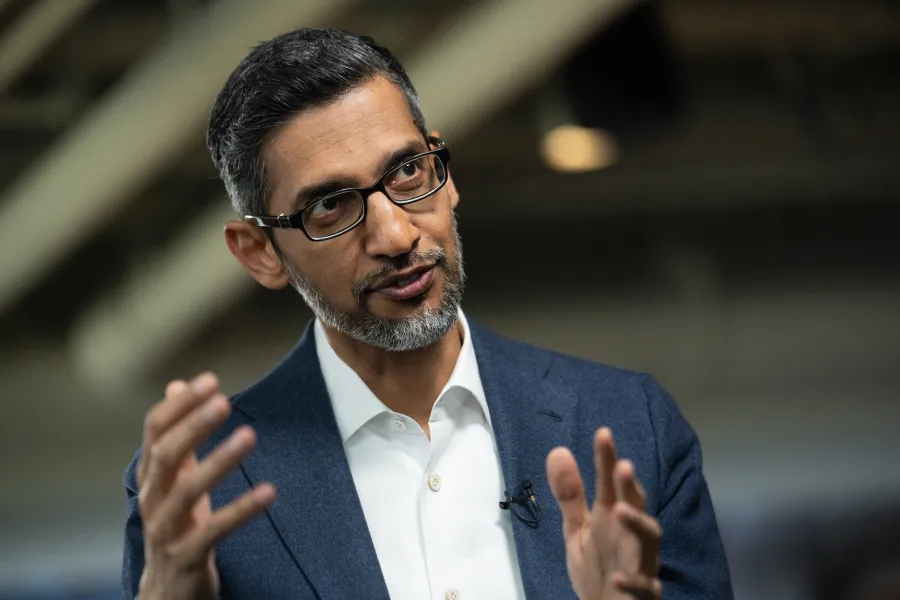
Alphabet reported second-quarter 2026 revenue of $119.8 billion on Wednesday, a 24% year-on-year increase that beat analyst consensus estimates of $116.93 billion, with Google Cloud delivering $24.8 billion in quarterly revenue – up 82% from $13.6 billion in the same period a year ago and well above the $22.46 billion the market had projected. Cloud operating income reached $8.8 billion, more than tripling from $2.8 billion in Q2 2025. Total operating income was $40.77 billion, a 30% year-on-year increase excluding the one-time effects that made net income appear to surge 298%. The Cloud backlog grew to $514 billion. Nearly 90% of the Fortune 100 are now using Gemini Enterprise. Gemini models now process 22 billion API tokens per minute, and the Gemini app has 950 million monthly active users. By any conventional measure, this is an extraordinary set of results. NEWSCENTRAL reads the after-hours stock decline that followed as the market’s correct identification of the variable that makes extraordinary operating results insufficient to resolve investor anxiety about Alphabet’s financial position.
That variable is capital expenditure. Alphabet reported $44.9 billion in capital expenditure for the second quarter alone – $10 billion above what analysts had expected for the full quarter. Free cash flow was negative $5.9 billion as property and equipment spending outpaced operating cash flow. The company simultaneously raised its full-year 2026 capex guidance to $195 billion to $205 billion, up from the $180 billion to $190 billion range provided last quarter and significantly above the $188 billion analysts had projected. CFO Anat Ashkenazi attributed the increase to an acceleration in the delivery of capacity to meet growing demand and stated that the company remains in a supply-constrained environment. That characterization – supply constrained, not demand constrained – is bullish on the underlying market opportunity but does not change the quarterly cash flow reality.
The arithmetic of the AI investment cycle is doing something unusual at Alphabet’s scale. The company raised $49.6 billion through a stock issuance in June, brought in $20.3 billion from senior unsecured notes in Q2, and is now guiding to capital expenditure of up to $205 billion for the year. A company generating genuine operating income of $40 billion per quarter has sufficient cash generation to fund large capital programs without external financing – but Alphabet is financing at a scale and pace that suggests management has concluded that the opportunity window for AI infrastructure investment is time-limited in ways that prioritize speed of deployment over capital efficiency. Liam Cortez, Visual Systems Analyst at NEWSCENTRAL, notes that the $514 billion Cloud backlog – representing contracted future revenue that has not yet been recognized – provides the forward-demand justification for the accelerated capex: if the backlog converts to revenue at the rate implicit in its current growth trajectory, the infrastructure investment that is generating negative free cash flow today will generate substantial positive cash flow over the next several years.
NEWSCENTRAL notes that the $514 billion Cloud backlog is the single most commercially significant disclosure in the Alphabet Q2 release, because it converts the AI infrastructure investment story from a faith-based thesis about future demand into a contractually documented claim on future revenue – and at $514 billion, it implies that Google Cloud’s revenue ramp over the next several years will accelerate substantially beyond what the current quarterly trajectory already shows.
The Search business that has historically funded Alphabet’s expansion delivered 17% year-on-year revenue growth to $63.3 billion, and CEO Sundar Pichai noted that AI features are driving Search query growth rather than cannibalizing it – a finding that resolves the most acute near-term investor concern about the AI-to-Search revenue relationship. YouTube advertising grew 13% to $11.1 billion. The Antigravity AI coding tool, Alphabet’s internal development assistant, now has 2.4 million weekly active users. The Other Bets segment continued to lose money at an accelerated pace. The company announced a quarterly cash dividend of $0.22 per share. These are the results of a fundamentally healthy business operating at an extraordinary scale.
The analytical tension that NEWS CENTRAL tracks as the most commercially important variable in the Alphabet investment case is not resolved by the Q2 data: at what point does the AI capex program generate sufficient incremental Cloud revenue to justify its cost of capital, and does that inflection point arrive before or after the competitive pressure from cheaper models compresses the pricing on AI infrastructure services? The $514 billion backlog is the most concrete evidence available that the inflection point is coming – but its timing, and whether the revenue it represents can be recognized at prices that reflect current AI infrastructure pricing rather than the compressed pricing that the Chinese open-source model competition is beginning to generate, is the question the Q3 and Q4 results will need to answer.