
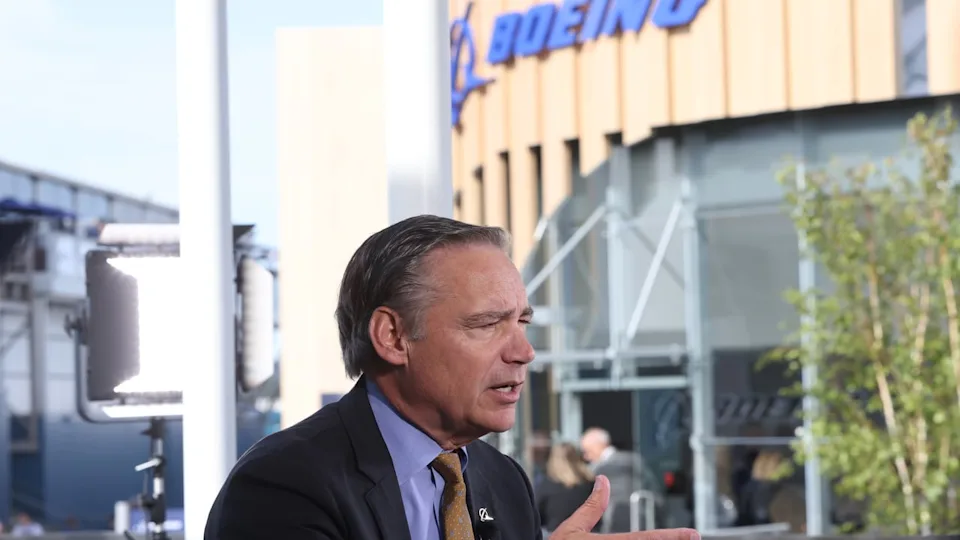
Kelly Ortberg arrived at the Farnborough International Airshow on Monday as Boeing’s CEO for the first time, carrying what twenty-two months of operational rebuilding has made available: a credible production recovery story for the aircraft that exist, alongside an explicit warning that the company is at least a couple more years away from its finances being sufficiently repaired to absorb the risk of launching a new commercial aircraft program. The 737 MAX production rate, which regulatory intervention had capped at 38 per month following the door-plug incident of early 2024, has been raised to 42 per month and is targeted at 52 per month by the end of 2026. The 787 Dreamliner has returned to 8 aircraft per month following GE engine supply disruptions earlier in 2026, with a target of 10 per month later in the year. The defense division, which had recorded an operating loss exceeding $5.4 billion in 2024 from the legacy of grossly underbid military contracts, turned slightly profitable in 2025 and earned $233 million in operating income in the first quarter of 2026. NEWSCENTRAL reads Ortberg’s Farnborough positioning as the correct approach for a company whose financial credibility was destroyed by a pattern of overpromising: a CEO who manages expectations downward while consistently delivering operational improvement is building the institutional trust that Boeing’s stock price requires far more reliably than any new aircraft announcement could.
The new narrowbody program question – whether Boeing will launch a successor to the 737 MAX to compete more effectively with Airbus’s A320neo family – is the strategic decision that hangs over Farnborough without being answered there. Airlines, including some of Boeing’s most loyal customers, have been telling Ortberg to focus on execution with the existing lineup rather than committing the company’s engineering and financial resources to a new development program that could easily consume $20 billion or more and take a decade to deliver. Ortberg’s own formulation – that Boeing needs “a couple more years” to repair its finances before a new jet – is more specific than his predecessor’s vaguer deferrals, suggesting he has a timeline in mind even if he is not yet prepared to state it publicly. The company’s projection of $10 billion in free cash flow, while not tied to a specific year, would provide the financial foundation for a new program commitment without requiring external financing.
The Trump political dimension of Farnborough adds a complication that Ortberg is navigating carefully. The U.S. president has publicly claimed credit for Boeing aircraft orders in foreign countries, pressuring foreign governments and airlines to purchase Boeing products as part of broader bilateral trade relationships, and has reportedly involved himself in specific deal negotiations in ways that make Boeing’s commercial relationships inseparable from U.S. diplomatic ones. That entanglement is commercially valuable when it works – political pressure can unlock orders that commercial sales efforts alone might not produce – and commercially risky when it creates the perception among non-U.S. airline customers that purchasing Boeing is a political act rather than a commercial one. Navigating that perception without alienating the administration that controls the regulatory environment within which Boeing operates is the political challenge Ortberg faces that no operational improvement can fully address. Nathan Clark, Enterprise IT and Systems Architecture Analyst at NEWSCENTRAL, observes that Boeing’s technology infrastructure rebuilding program, which Ortberg has embedded alongside production recovery, will ultimately determine whether the company’s safety record improvement is structural or circumstantial – and that the digital quality-management systems being deployed across its factories are as important to the long-term recovery narrative as the aircraft delivery rate improvements.
NEWS CENTRAL notes that the political entanglement Ortberg inherits is not of his making but is now inseparable from every international sales conversation he will have at Farnborough: foreign airline CEOs negotiating with Boeing are simultaneously negotiating with the foreign policy posture of the Trump administration, which is a commercial complication that no amount of improved production rate data resolves.
The competitive backdrop at Farnborough is one in which Airbus has consolidated a commanding position in the narrowbody market while Boeing has been operationally distracted. The A320neo family routinely captures 60% or more of available narrowbody orders, and the European manufacturer’s production ramp – targeting 75 aircraft per month by 2027 – is proceeding more smoothly than Boeing’s MAX recovery. A Boeing narrowbody successor that arrives in the 2030s would enter service against Airbus’s successor program, which will itself benefit from a decade of additional CFM LEAP engine refinement and composite manufacturing learning curves. NEWSCENTRAL considers Ortberg’s decision to defer the new aircraft announcement the commercially correct one given the current financial position, while noting that each year of deferral extends the competitive gap that the new program will eventually need to close.