
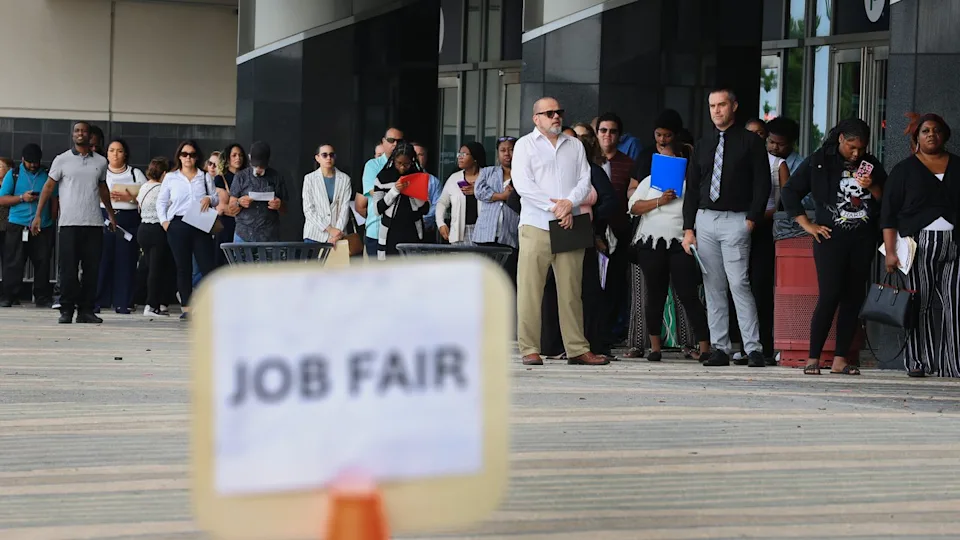
Initial unemployment claims for the week ended July 11 fell 8,000 to a seasonally adjusted 208,000, the Labor Department reported Thursday, coming in well below the consensus economist forecast of 217,000 and marking a continued retreat from the elevated levels recorded during the spring. Continuing claims, a proxy for ongoing unemployment, fell 16,000 to a seasonally adjusted 1.805 million during the week ended July 4. The Federal Reserve’s Beige Book, released Wednesday, noted that employment rose on balance in early July, with five districts showing modest, moderate, or solid gains and seven experiencing little to no change, while skilled workers remained hard to find across a range of fields including technicians and tradespeople. To NEWSCENTRAL, the jobless claims reading provides the clearest available near-term signal that the labor market has not materially deteriorated following the shock June payrolls report – but it does not yet tell us whether the conditions that produce 208,000 weekly claims can also produce the payroll growth that the broader economic trajectory requires.
The June payrolls context makes the July claims improvement meaningful rather than routine. The Bureau of Labor Statistics reported 57,000 net nonfarm payroll additions in June – sharply below the 115,000 consensus expectation – in a report that also revised down April and May by a combined 74,000 jobs, representing the most significant single-month downward revision pair in over two years. That result rattled economists who had been reading the labor market as one of the more resilient components of the 2026 economic environment. Weekly claims do not tell the same story as monthly payrolls, but they are available on a much shorter lag, and four consecutive weekly readings below 220,000 following a weak payrolls print provides meaningful evidence that the labor market has not entered the kind of deterioration that produces rising unemployment trends.
The slow-hire, slow-fire characterization that economists have applied to the current labor market environment is analytically useful but carries a specific ambiguity that the weekly claims data cannot fully resolve. Low firing, as measured by initial claims, is clearly present and has been since late 2022. Slow hiring, as measured by payrolls, job openings, and quit rates, has become more visible in recent quarters as companies that were aggressively hiring during the 2020-2022 growth surge have maintained headcount without adding, rather than actively reducing. The distinction matters for the inflation and rate outlook: a labor market where workers are not being displaced generates less income volatility and therefore less consumption pressure, but it also does not generate the productivity gains that come from labor market churn, as workers move from lower-productivity to higher-productivity roles. Nathan Clark, Enterprise IT and Systems Architecture Analyst at NEWSCENTRAL, observes that the AI-driven hiring freeze dynamic – companies maintaining existing headcounts while deploying AI tools that increase output per worker rather than hiring additional staff – is structurally consistent with the slow-hire pattern visible in the data, and that distinguishing AI-driven productivity from economic weakness in the payroll statistics is becoming a methodological challenge that the standard labor market indicators were not designed to address.
The Federal Reserve’s position on the claims data is part of a broader assessment of whether the economic conditions are consistent with maintaining rates at current levels through the September meeting or whether a deteriorating labor market would justify a preemptive cut. Chair Kevin Warsh’s documented hawkish posture on inflation has signaled that the Fed is more likely to tolerate labor market softness than to risk an inflation resurgence by cutting prematurely. The June payrolls miss created some pressure on that position; Thursday’s claims reading reduces it. The net signal heading into the July 28 payrolls release – the next major labor market data point before the September meeting – is one of a labor market that is soft but not deteriorating, which is consistent with the Fed’s patience on rate cuts.
The California and Michigan dynamics visible in the unadjusted claims data are worth specific attention. California posted a surge of more than 8,000 new claims, and Michigan and Missouri both saw notable increases of approximately 4,400 and 5,900 respectively, with the Michigan and Missouri moves attributed to automotive sector maintenance shutdowns and retooling. General Motors and Ford have both canceled some summer shutdowns at assembly plants, however, which reduces the expected drag from automotive sector seasonality. California’s claims surge reflects the state’s technology sector layoff activity, which has been concentrated among mid-level engineering and product roles at companies citing AI efficiency as the primary driver of workforce reduction.
NEWSCENTRAL places the Thursday claims data within the broader context of what has been an unusually difficult-to-read labor market in 2026. The AI-driven productivity improvement story and the AI-driven layoff story are both simultaneously true, and the standard labor market statistics – which were not designed to distinguish between those two dynamics – are generating readings that are ambiguous in ways that make the conventional tools of labor market analysis less reliable than they have been in previous cycles.
The trajectory into the second half of 2026 is one where multiple economic factors are simultaneously exerting pressure on labor demand: AI-driven efficiency investment reducing incremental hiring at technology companies, tariff-related cost uncertainty reducing business investment in hire-intensive activities, and elevated mortgage rates constraining the housing sector that historically generates significant ancillary employment. Against that background, 208,000 weekly claims is a data point that is better than the downside scenarios the June payrolls report had made plausible. What NEWS CENTRAL assesses as the more important variable is whether the July payrolls report, due July 28, confirms that June was an aberration or validates the interpretation that the labor market’s underlying hiring momentum has genuinely slowed below the level required to maintain stable unemployment through the second half.