
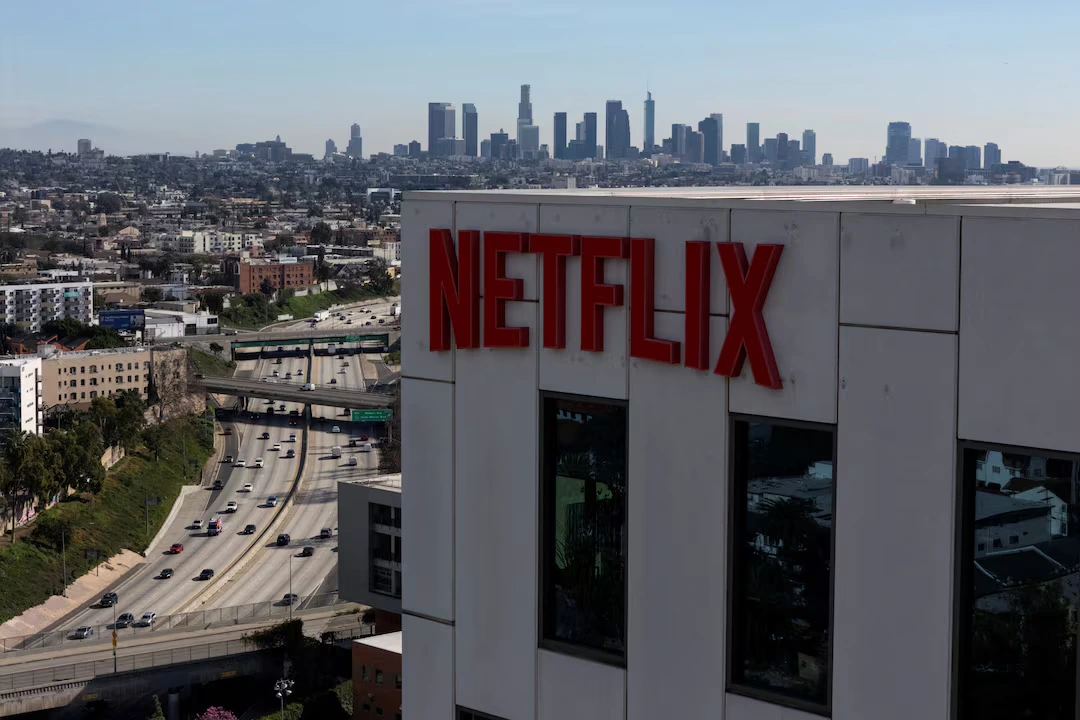
Netflix reports its second-quarter 2026 results on Thursday, July 16, with the company’s shares under sustained pressure that has produced more than a 40% decline over the trailing twelve months despite first-quarter results that were operationally strong by conventional metrics. Q1 revenue grew 16% year-on-year to $12.25 billion; operating income grew 18% to $4 billion; operating margin was 32.3%. Management reiterated full-year 2026 revenue guidance of $50.7 billion to $51.7 billion with operating margin of 31.5%. The guidance for Q2 called for revenue of $12.574 billion, operating income of $4.105 billion, operating margin of 32.6%, and diluted EPS of $0.78. NEWSCENTRAL considers the performance against that Q2 guidance the most important data point in Thursday’s release, because it will determine whether the margin compression visible in Q2 guidance relative to Q1 actuals was a one-quarter effect or the beginning of a trend that the advertising business must outgrow faster than management has previously acknowledged.
The World Cup effect has been the dominant near-term narrative surrounding Netflix’s Q2 results, but its analytical significance requires calibration. The tournament began June 11, affecting only the final 20 days of the Q2 period. The most commercially significant matches – the U.S. round of 16 against Belgium drawing 30 million viewers, the subsequent quarterfinals and semifinals – fall entirely in Q3. Netflix’s TV viewership share fell to 7.8% in April, its lowest since May 2025, reflecting competition for audience time that predates the World Cup and extends beyond it to YouTube’s continued gains in watch time. The engagement question the market is focused on is structural rather than event-specific: whether Netflix’s content strategy, subscriber base, and engagement metrics are sufficient to sustain premium advertising rates as the company attempts to double its advertising revenue to approximately $3 billion in 2026.
The advertising business is where Thursday’s results carry the most meaningful forward-looking information. In Q1, the ad-supported tier accounted for more than 60% of sign-ups in countries where advertising plans are available, and the advertiser count grew 70% year-on-year to more than 4,000 clients. Management’s Q2 forecast for advertising revenue of approximately $705.8 million would represent roughly 25% of the company’s $3 billion full-year advertising target, implying a significant acceleration in the second half. Live sports rights have been the primary mechanism for attracting premium advertising commitments: the World Baseball Classic’s 31.4 million viewers in Japan generated the platform’s most-watched program in that country and drove the largest single sign-up day ever for Japanese Netflix, demonstrating concretely how live events convert audience reach into subscriber acquisition in ways that scripted content cannot replicate on the same timeline. Freddy Miller, Senior Analyst at NEWSCENTRAL, argues that the advertising revenue trajectory is the cleanest available signal of whether Netflix is successfully navigating the transition from subscription-only to a dual-revenue model – and that the Q2 read on advertiser pricing and fill rates will be more analytically useful than the subscriber count, which management has increasingly de-emphasized as a primary growth metric.
The live content pipeline for the second half of 2026 is where NEWSCENTRAL sees the clearest near-term test of whether the advertising business can achieve the acceleration its full-year target implies. Netflix has an expanded NFL slate beginning Week 1, the FIFA Women’s World Cup beginning in 2027 but with build-up coverage, and a series of major live events that it is using to prove the case for event-driven advertising pricing power. Whether premium advertisers pay meaningfully more per impression for live event inventory than for scripted content – and whether that pricing holds as supply of Netflix live events increases – will determine whether the advertising revenue target is achievable or aspirational.
The strategic moves Netflix has been exploring – adding live television channels, bundling subscription streaming services from other providers, pursuing World Cup rights for 2030 and 2034 – collectively describe a company expanding the definition of what Netflix is rather than optimizing what it has already built. Adding live channels would put Netflix in competition with cable and satellite providers rather than just other streaming services. Bundling third-party services would position Netflix as a distribution platform rather than purely a content producer. Pursuing $1.5 to $2 billion World Cup rights would make Netflix a major sports broadcaster for the first time. Each of these expansions addresses the engagement and retention question from a different direction, but all of them carry execution complexity and cost that the current valuation does not fully credit as potential upside.
The engagement concern that has driven Netflix’s share decline is not primarily about whether subscribers cancel their subscriptions. First-quarter cancellation data showed no deterioration. The concern is whether subscribers who are paying increasingly for the service – Netflix has raised prices multiple times in its major markets – are watching enough to justify the subscription cost relative to alternatives that cost less and compete effectively for watch time. A subscriber who is on the ad-supported tier, watching less than 10 hours per month, and intermittently considering cancellation is worth considerably less to Netflix’s advertising business than one who watches 30 hours per month across ad-supported and subscription tiers. The distinction between subscriber count and engagement depth is why management stopped reporting subscriber counts as a primary metric – and why the advertising revenue number is now the more honest proxy for the health of the business.
Thursday’s Q2 results will either confirm that Netflix’s advertising flywheel is building momentum faster than the engagement headwinds are suppressing it, or they will deepen the investor uncertainty that has pushed the stock to twelve-month lows. The binary nature of that outcome reflects how much analytical weight a single quarterly report carries when the market is genuinely uncertain about which direction the business is heading. As NEWS CENTRAL assesses Netflix’s current position, the company’s strongest argument for its multiple is a version of the advertising business that roughly doubles in revenue while the content strategy continues to attract the incremental live and event programming that generates the engagement spikes its subscriber base needs to maintain the habitual usage patterns on which premium advertising rates depend. Whether that argument is validated in Thursday’s numbers, or deferred to the second half, will set the tone for how investors approach the stock through the remainder of 2026.