
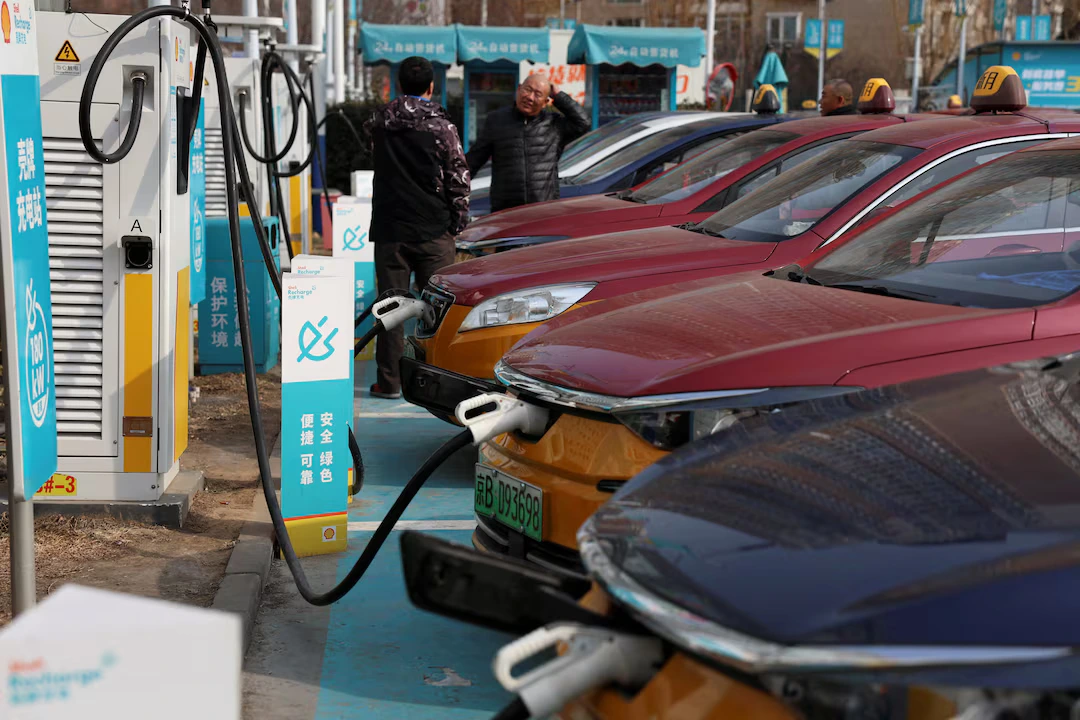
China’s oil imports fell 41% in June year-on-year, a reduction that has freed significant supply into a global market already stressed by the Strait of Hormuz disruptions caused by the U.S.-Israeli war on Iran. The mechanism behind that reduction is not a deliberate policy intervention or a demand collapse – it is a transportation shift that is happening organically and rapidly across Chinese cities: electric taxis and ride-hailing services are booming as falling fares and rising gasoline prices combine to redirect commuters away from private petrol vehicles and toward shared electric mobility. In May alone, Chinese ride-hailing and taxi services completed 3.05 billion trips – a 6% increase from the same period the prior year, a gain that accumulated entirely since the Iran war began affecting global energy markets in late February. NEWSCENTRAL reads this not as a policy success story but as the emergent outcome of several unrelated trends – labor market weakness, cheap electric vehicles, and geopolitical energy shocks – converging in a way that China’s transportation infrastructure happened to be positioned to absorb.
The mechanism driving the boom is counterintuitive: fares are falling even as demand rises. A flood of new drivers entering the ride-hailing market in search of employment during a sluggish economy has created an oversupply of drivers competing for passengers, pushing fares down by 10% to 15% in some markets. That fare compression is simultaneously compressing incomes for existing drivers and making taxi and rideshare travel competitively priced against private petrol car journeys as gasoline prices rise. The result is a behavioral shift: consumers whose household budgets are being squeezed by higher fuel costs choose to leave their cars at home and take an electric taxi instead, reducing petrol consumption further. The cycle is self-reinforcing within the current conditions: higher oil prices increase the economic appeal of electric mobility, which increases electric taxi usage, which increases driver competition, which lowers fares, which attracts more passengers.
The infrastructure enabling this shift has been building for years. Half of China’s 1.3 million taxis are now electric, with several cities approaching full electrification of their taxi fleets. Chinese electric vehicle manufacturers including BYD have produced affordable EVs at price points that make taxi fleet electrification economically viable for operators and accessible for individuals entering the ride-hailing market. Charging infrastructure has been deployed at a scale that makes electric range anxiety a minor operational concern for taxi drivers in major urban centers. The cumulative investment in this infrastructure was made on commercial rather than geopolitical grounds, but it has produced a structural energy demand buffer that no policy intervention could have assembled on a short timeline. Jessica Kline, Automotive Industry Analyst at NEWSCENTRAL, observes that China’s electric taxi fleet represents the largest deployed fleet-scale real-world test of electric commercial transportation in history, and the 6% year-on-year trip growth since February validates the infrastructure’s ability to absorb demand surges in ways that the academic models of EV adoption had projected but not yet observed at this scale.
The global energy market implications of China’s reduced oil imports are significant because they run counter to the directional effect that a Strait of Hormuz disruption would normally produce. In previous geopolitical oil shocks, China’s demand has added to global price pressure; in the current episode, China’s structural shift toward electric mobility has partially offset the supply reduction caused by the Hormuz disruptions by compressing demand simultaneously. That dynamic has contributed to keeping global oil prices softer than the Hormuz closure alone would suggest – Brent crude has remained in the low-to-mid $70 range rather than spiking toward the $90 or $100 levels that previous comparable supply disruptions produced. The partial market equilibration has benefited every oil-importing economy globally, though it has also limited the price signal that would normally accelerate the shift toward energy independence in other major importing countries.
The labor market dimension of the electric taxi boom is one that NEWSCENTRAL considers as analytically important as the energy dimension, though it has received less attention in coverage of the Hormuz disruption. The flood of new ride-hailing drivers entering the market amid labor market weakness reflects a structural surplus of workers displaced from manufacturing, logistics, and retail jobs who are finding the barriers to entry in ride-hailing sufficiently low to justify the switch. That dynamic compresses fares and incomes for existing drivers while expanding system capacity – a distributional outcome that is beneficial for passengers and for China’s aggregate energy demand trajectory, but painful for the millions of professional drivers whose livelihoods are being squeezed by the same oversupply dynamic that is expanding the electric fleet.
Chinese social media has captured the consumer dimension of this transition in real time. Since gasoline prices began rising in March, hundreds of posts have described how travel by cab or rideshare has become cheaper than driving personally for the same distance. That shift in relative cost – which was always theoretically possible as EV adoption progressed but has now become practically visible to ordinary consumers – is accelerating behavioral changes that analysts project to be durable rather than temporarily driven by the current oil price level. Greenpeace projects that 90% of taxi and ridesharing mileage in China will be electric by 2035. Whether that projection accounts for the current adoption acceleration or was made before it remains to be tested against updated data.
The strategic significance that NEWS CENTRAL places on the current China electric taxi data is specific: it demonstrates that the energy security benefits of EV fleet adoption manifest at a geopolitically relevant scale much faster than most scenarios had anticipated, and that the mechanism is demand-driven consumer behavior rather than government mandate. A country whose urban transportation fleet is predominantly electric does not respond to oil price shocks in the same way as one where combustion engines dominate – and China appears to be crossing that threshold significantly ahead of the timelines that energy market participants had been using to model Chinese oil demand through the 2030s.