
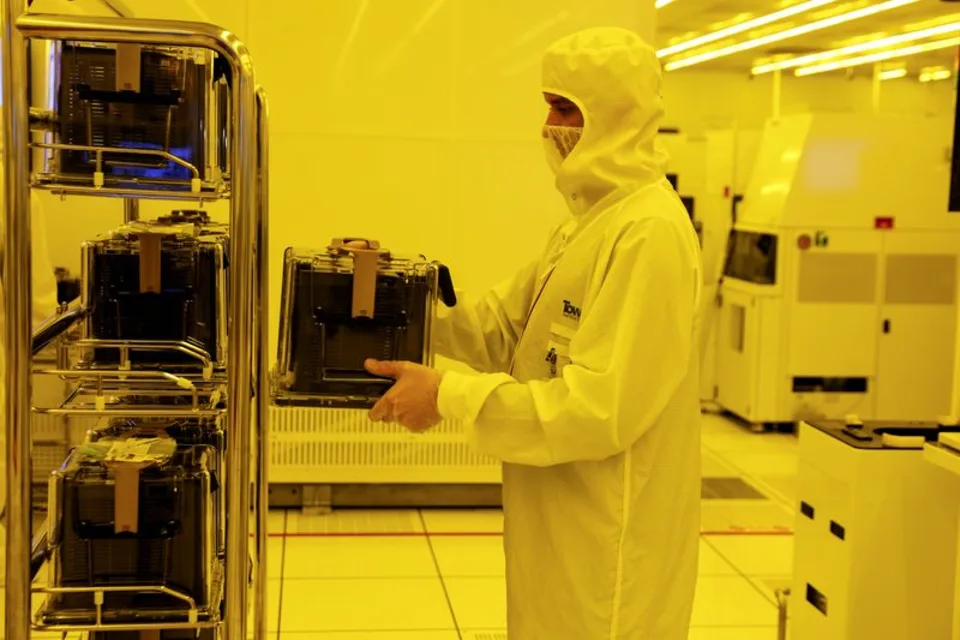
Tower Semiconductor, the Israeli specialty foundry whose silicon photonics technology has made it the primary producer of the optical interconnects that link AI chips inside data centers, announced on Tuesday a $3 billion dual-track manufacturing expansion in Japan – its largest single capital commitment in company history – that will more than double its silicon photonics production capacity by the end of 2027. The Japanese government is co-funding the program with $1 billion in grants, reflecting the strategic importance Japan has assigned to building domestic capability in a technology that sits at the intersection of semiconductor manufacturing, optical physics, and AI infrastructure. Tower’s U.S.-listed shares rose more than 18% in pre-market trading. The company simultaneously raised its 2028 revenue target from $2.8 billion to $3.6 billion and its 2028 net profit target from $750 million to $1.2 billion. Over 70% of the planned new capacity is already committed through customer contracts extending to 2028, including $1.3 billion in silicon photonics contracts for 2027 and $290 million in customer prepayments already in hand. We at NEWSCENTRAL consider the customer prepayment figure the most analytically useful data point in the announcement: companies do not put $290 million on deposit for manufacturing capacity that they are uncertain they will use.
The dual-track structure of the expansion reflects a deliberate sequencing of capital risk. The first phase converts Tower’s Arai facility in Japan – previously Fab 6 – from its current manufacturing configuration to a 300-millimeter silicon photonics production site, with commercial operations expected in the fourth quarter of 2027. This conversion of existing infrastructure is lower in execution risk and faster in timeline than a greenfield build, and it allows Tower to begin generating silicon photonics revenue from the new capacity before the more capital-intensive second phase is complete. The second phase involves constructing an entirely new 300-millimeter semiconductor fabrication facility adjacent to the company’s existing Fab 7 site in Uozu. CEO Russell Ellwanger described the second track as providing the path for continued growth far beyond 2028, suggesting management views the current demand cycle for silicon photonics as extending well into the next decade.
Tower’s existing position in the silicon photonics market is the commercial foundation that makes this expansion credible rather than aspirational. The company is already the primary supplier of silicon photonics transceivers for 1.6T optical interconnect platforms, the current leading-edge specification for AI data center networking. Its customer base includes the hyperscalers and networking equipment manufacturers who are driving the transition from copper to optical interconnects inside AI data centers. Silicon photonics enables the movement of data between AI processors using light rather than electrical signals, achieving the throughput and power efficiency that the interconnect demands of large-scale AI training and inference cannot be met through conventional copper. The technology was commercially viable for some time before AI infrastructure demand made it genuinely urgent. Lucas Grant, Semiconductor and Manufacturing Strategy Analyst at NEWSCENTRAL, notes that Tower’s first-mover position in commercial silicon photonics production has given it the customer relationships and process know-how that justify the $1.3 billion in contracted 2027 revenue that underpins the expansion economics – a competitive moat that new entrants into the market, including UMC whose Singapore expansion was announced on the same day, will find difficult to close quickly regardless of their capital commitments.
Japan’s decision to back this expansion with $1 billion in government grants places it within a broader national semiconductor strategy that has accelerated significantly since Japan’s inclusion in the U.S.-led export control framework for advanced semiconductor technology to China. Japan’s own strategic interest in silicon photonics is grounded in the technology’s importance for data communications infrastructure, defense electronics, and the next generation of industrial automation systems where optical sensing and data transmission are becoming standard. The $1 billion grant is net of which Tower’s $3 billion investment reflects approximately $2 billion in private capital – a ratio that is consistent with the support frameworks Japan has applied to other semiconductor manufacturing investments including TSMC’s Kumamoto facility and Kioxia’s flash memory expansion.
The financial guidance revision that accompanied the expansion announcement confirms that Tower’s management views the silicon photonics buildout as transformational for the company’s long-term earnings profile rather than as a capital allocation cycle to be managed conservatively. Moving the 2028 net profit target from $750 million to $1.2 billion – a 60% increase – while simultaneously raising the 2026 capital expenditure guidance to $920 million reflects a deliberate decision to deploy capital aggressively at the moment of peak competitive advantage. Tower’s pre-announcement consensus analyst price target was $276.75 with a Buy rating. The stock’s 18% pre-market move reflects institutional investors pricing in that the expansion economics are credible and the customer commitment already in place is sufficient to de-risk the investment case.
The Japan government’s role as a $1 billion co-investor in Tower’s expansion adds a dimension that purely commercial analysis understates. Japan’s semiconductor strategy has become explicitly geopolitical in its orientation: the government is investing in domestic production capability for technologies it has designated as strategically important, and it is selecting foreign companies to anchor those capabilities rather than waiting for domestic champions to emerge. Tower’s invitation to lead this expansion – described by CEO Ellwanger as the Government of Japan having selected Tower to lead the expansion of these strategically important technologies – is a significant institutional endorsement that validates the company’s technology position in a way that customer revenue alone cannot. NEWS CENTRAL considers that governmental validation as important for attracting future Japanese institutional capital and customer relationships as the manufacturing capacity itself.
NEWSCENTRAL tracks the Tower Semiconductor-UMC dynamic as a defining competitive race in one of the most commercially consequential supply chain segments of the current AI infrastructure cycle. Two companies – one Israeli with Japan-based manufacturing, one Taiwanese with Singapore-based production – are simultaneously scaling silicon photonics capacity to serve a demand that neither can currently satisfy in full. The commercial winners of that race will be those that bring qualified production capacity online fastest, with the process consistency and customer qualification track record that major hyperscalers require before embedding a new supplier into their AI rack designs. Tower’s head start in customer relationships and its $290 million in prepayments suggest it currently holds that advantage. Whether UMC’s Singapore expansion and Tower’s Japan buildout together provide sufficient supply to normalize silicon photonics pricing or whether demand continues to outpace supply through 2028 is the market structure question that will determine how much of the captured value flows to producers versus buyers.