
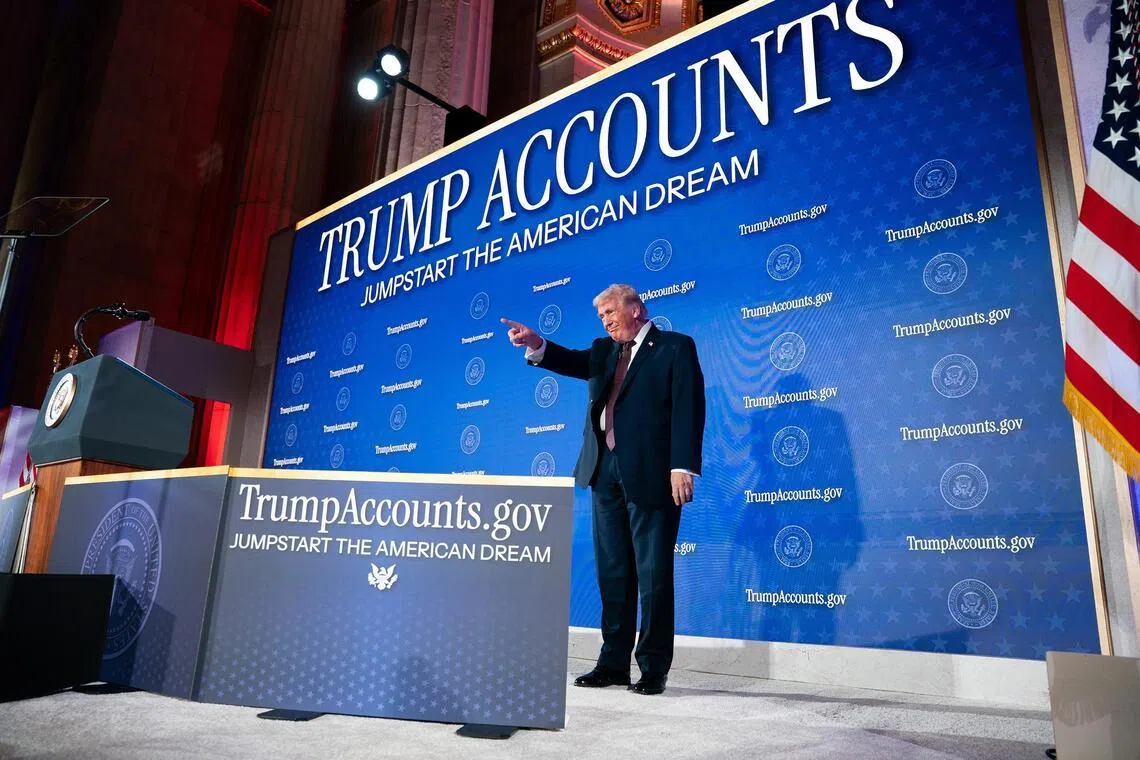
Trump Accounts – the tax-deferred investment vehicles for children created by the One Big Beautiful Bill Act – officially launched on July 4, the 250th anniversary of the United States, with more than 6 million children already registered and 1.4 million of those eligible for the federal government’s $1,000 seed deposit. The accounts, formally known as 530A accounts after the Internal Revenue Code section that defines them, allow any eligible child under 18 to receive contributions from family members, employers, and third parties up to an annual limit of $5,000, invested exclusively in low-cost index funds tracking broad U.S. stock market indices with expense ratios no higher than 0.1%. Managed by Bank of New York Mellon through an app developed with Robinhood, the accounts convert to traditional IRAs when the beneficiary turns 18. NEWSCENTRAL reads this initiative as a genuinely novel policy experiment in democratizing equity ownership – and simultaneously as a structural design that will widen rather than narrow the wealth gap it claims to address.
The universal elements of the program are real and meaningful. The $1,000 government seed deposit for children born between 2025 and 2028 is unconditional and available regardless of family income. The Michael and Susan Dell Foundation’s commitment of $6.25 billion will add $250 for each of approximately 25 million children aged 10 and under. A growing roster of major employers – JPMorgan Chase, Goldman Sachs, Morgan Stanley, BlackRock, Intel, Micron Technology, Robinhood, Comcast, and Chipotle among them – have pledged to match the $1,000 federal contribution for their employees’ children.
The structural inequality embedded in the design, however, is visible in the numbers. A family capable of contributing the maximum $5,000 annually can build an estimated $150,000 nest egg by the time the child turns 30. A child from a low-income family receiving only the $1,000 government seed deposit will accumulate approximately $2,500 over the same period, based on historical S&P 500 returns. The $148,000 gap between those two outcomes is not a rounding error – it is a reflection of the program’s architecture, which provides identical starting deposits to children from vastly different economic circumstances and then allows the market to compound the initial difference in family contribution capacity into a multigenerational wealth divide.
NEWSCENTRAL notes that the program’s design choice to give equal seed funding to children from unequal starting points is a political decision, not an economic one – and one that previous comparable proposals, including several Democratic baby bond initiatives, resolved differently by scaling the public contribution to family income.
The accounts are also less tax-advantaged than traditional Roth IRAs for children with earned income, since withdrawals from Trump Accounts are taxed as ordinary income rather than at capital gains rates. Freddy Miller, Senior Analyst at NEWSCENTRAL, observes that the equity criticism of Trump Accounts is not that they are unhelpful to low-income families – the $1,000 seed deposit genuinely is helpful – but that the program as designed captures much of its political symbolism from universal participation while concentrating the majority of its financial benefit among families who need it least.
The corporate participation dimension of the launch has been the most commercially revealing element of its rollout. Banks, technology companies, and consumer brands have lined up to offer employer match programs, turning Trump Accounts into a workforce benefits competition that mirrors the employer 401(k) match arms race of previous decades. The institutions that have committed matching programs include companies whose own business models benefit directly from broader equity market participation: Robinhood built its business around retail investing; BlackRock is the world’s largest asset manager; Charles Schwab’s revenue is directly correlated with assets under management.
The bipartisan concept underlying the initiative – decades of baby bonds proposals from economists and lawmakers on both sides – has produced a vehicle that is more politically durable than many of its predecessors precisely because it aligns private financial sector incentives with public policy objectives. The accounts were known variously as Invest America accounts and MAGA accounts before settling on their current name. Whatever the politics of the branding, the commercial infrastructure assembled around the launch is more substantial than most comparable government savings initiatives have ever attracted.
The policy question Trump Accounts will ultimately answer is whether universal equity account access, in the absence of meaningful universal contribution support, produces shared prosperity or a more precisely quantified version of the inequality it was designed to reduce. That answer will take decades to arrive. The July 4 launch is only the opening entry – and as we in NEWS CENTRAL contend, the most important number to track over the coming years is not total enrollment but the distribution of annual contributions across income levels, which will determine whether the program’s commercial infrastructure serves its stated social purpose or merely expands the asset base of those already accumulating capital.