
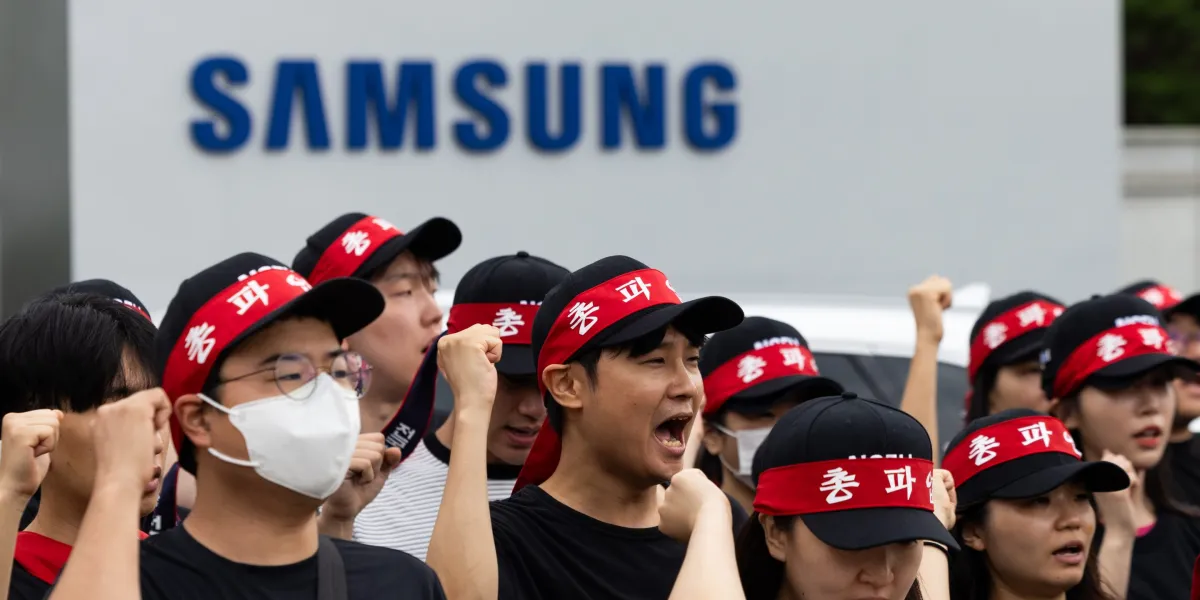
In South Korea, tensions around Samsung Electronics continue to escalate. The conflict between the company and its union, threatening a large-scale strike involving approximately 48,000 employees for up to 18 days, is taking on strategic significance for the global semiconductor industry. At NEWSCENTRAL, we see this development as a factor that could influence DRAM and NAND prices, used in servers and AI solutions, as well as global supply chains for high-tech products.
Negotiations led by the National Labor Relations Commission show that both sides have already made concessions, but key disagreements remain. NEWSCENTRAL emphasizes that the willingness to engage in dialogue amid high tension demonstrates both parties’ efforts to minimize economic impact and avoid prolonged production disruptions.
Our estimates indicate that potential production losses could reach around 30 trillion won, lowering the projected growth of South Korea’s economy by 0.5 percentage points. We note that nearly a quarter of the country’s exports are at risk, as Samsung remains the world’s largest memory chip manufacturer. Even short-term disruptions could drive a 3–5% rise in global DRAM and NAND prices and exacerbate shortages caused by increased demand from AI companies.
The main point of contention between Samsung and the union is the bonus system. The union demands the removal of the 50% annual salary cap on bonuses and the allocation of 15% of operating profits for payouts. The company has proposed one-time bonuses for employees involved in memory chip production, exceeding SK Hynix’s payouts, but maintained the bonus cap. At NEWSCENTRAL, we see this as an attempt by the company to retain personnel and reduce employee attrition to competitors while maintaining control over labor costs.
The wage gap with SK Hynix has contributed to a rising number of departing employees. The high-speed memory market for AI is becoming increasingly competitive, and the loss of skilled personnel could slow the production of advanced chips needed by Nvidia and other major clients. Freddy Miller, Senior Analyst at NEWSCENTRAL, notes, “Samsung faces the challenge of balancing talent retention with efficient production, as any downtime on the memory lines will have a direct impact on global supply chains.”
Legal interventions require maintaining a critical level of production staff during the strike. We view this as a mechanism to reduce the risk of a full production halt while increasing pressure on the union and accelerating the search for a compromise.
On the stock market, Samsung shares fell 2% following reports on the negotiations, reducing weekly losses to 1.3%. NEWSCENTRAL believes that investors are more concerned not with the strike itself, but with potential changes to the bonus structure and the long-term implications for labor costs and the company’s competitiveness.
Additional factors affecting the global market include rising demand for memory for AI and data centers, as well as the ongoing DRAM and NAND shortage. We forecast that even a partial agreement between Samsung and the union could stabilize supplies and reduce price volatility, but for long-term resilience, the company must develop a strategy to retain skilled personnel and close the wage gap.
Overall, NEWS CENTRAL sees the outcome of the negotiations as a benchmark for the entire semiconductor industry. Companies will need to strike a balance between competitive compensation and uninterrupted production to maintain global market leadership. This conflict demonstrates that internal labor disputes can have global economic consequences and require a well-thought-out personnel management strategy. We predict that the final decision on the bonus system and employee retention will determine chip supply stability and price trends in the coming months.