
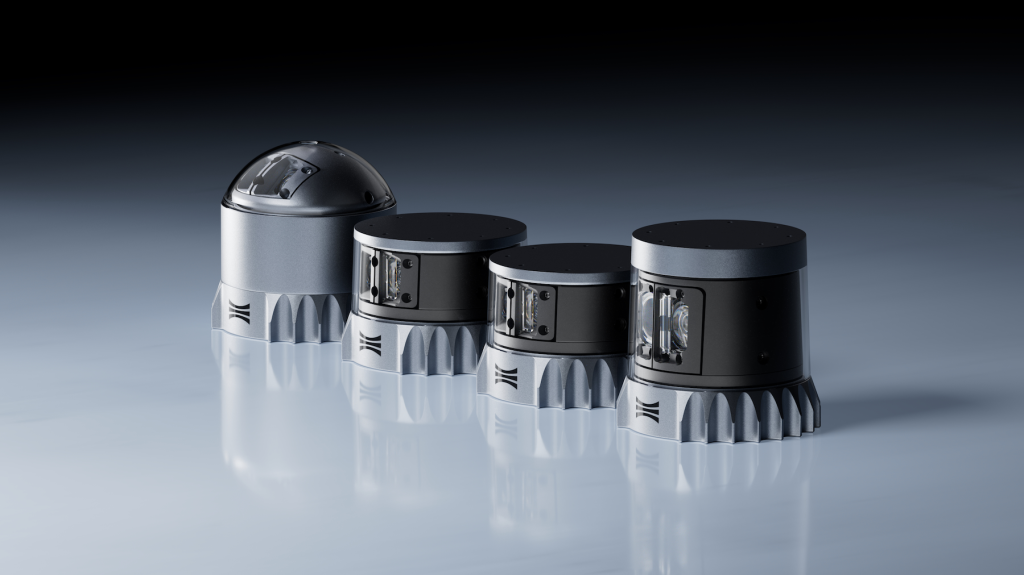
Ouster has introduced a new family of Rev8 OS LiDARs, which, according to analysts at our publication, sets a new standard in sensor technology for autonomous systems, industrial robotics, and intelligent infrastructure. For the first time, Rev8 combines three-dimensional perception with color processing at the hardware level, opening new horizons for physical artificial intelligence. At NEWSCENTRAL, we note that this is a breakthrough technology, enabling systems to perceive the world simultaneously in structural and color dimensions critical for autonomous vehicles, robotic delivery, and industrial applications.
Ouster CEO Angus Pacala stated that the L4 Silicon chips provide double the range and resolution compared to previous models. We see this as a fundamental advantage, as high precision and long-range perception reduce the risk of errors in complex and dynamic environments. Freddy Miller, Senior Analyst at NEWSCENTRAL, highlights that the ability to integrate color and structural perception within a single sensor accelerates AI model training and reduces dependence on complex calibration between cameras and LiDARs.
The L4 chip can process up to 20 trillion photons per second at a measurement frequency of 40 kHz with picosecond accuracy, and its bandwidth reaches 22.4 gigabits per second. We emphasize that these capabilities open new opportunities for high-speed autonomous platforms and industrial robots, where every millisecond of delay is critical for safety and operational efficiency. HDR and 48-bit color depth with a 116 dB dynamic range provide accurate perception in lighting conditions ranging from one lux to two million lux. This shows the potential for Rev8 to operate in extreme lighting conditions, where traditional LiDARs and cameras are limited.
The Rev8 family includes fully redesigned OS0, OS1, and OSDome models, as well as the flagship 256-channel OS1 Max. The OS1 Max provides visibility up to 200 meters at 10% reflectivity and a maximum range of 500 meters. At NEWSCENTRAL, we note that compliance with ASIL-B, SIL-2, and PLd standards, along with ISO 21434 cybersecurity protection, makes these sensors ready for large-scale industrial and commercial deployment.
Hardware-based color processing allows the sensors to recognize traffic signs, traffic lights, and other objects without complex calibration between cameras and LiDARs. This technological advantage enables a single sensor to provide full environmental perception, reducing latency and increasing the accuracy of autonomous decisions.
Ouster is actively developing the Rev8 ecosystem through the acquisition of StereoLabs and collaborations with companies such as Google, Volvo Autonomous Solutions, and Skydio. We note that this approach enhances scalability and accessibility of solutions, allowing clients to move from prototypes to mass production more quickly. Additionally, industry research shows that LiDARs with integrated color are being actively used in construction, mining, and aerospace projects, where precise environmental mapping is critical.
Looking ahead, we forecast that LiDARs with color processing will become standard for autonomous robots, intelligent transportation systems, and industrial solutions within the next five years. This will enable companies to accelerate the deployment of physical AI, improve operational safety and efficiency, and reduce the costs of sensor system calibration and integration. Business recommendations include strategically using Rev8 as a unified sensor platform for data collection and operation, minimizing development complexity and increasing the reliability of autonomous systems.
NEWS CENTRAL notes that the Rev8 OS family demonstrates a technological breakthrough and shapes the market of the future, where the ability to see in three dimensions with accurate color representation will become a key competitive advantage. The integration of these capabilities opens new prospects for creating autonomous solutions previously unattainable due to the limitations of standard LiDARs and cameras, accelerating the widespread adoption of physical AI across industries.