
NEWSCENTRAL notes that the oil market continues to react to Middle Eastern events with an intensity typical of periods of systemic geopolitical instability. Tuesday’s price jump extended a sustained rally, driven not by traditional supply and demand fundamentals, but by expectations of potential disruptions in shipments through strategically important maritime routes.
Brent crude for June delivery rose by 3.03%, settling at $111.51 per barrel by mid-session. Intraday trading pushed prices to $111.86, the highest level in recent weeks, confirming a persistent upward trend that has lasted for seven consecutive trading sessions. U.S. WTI also rose in sync, gaining 3.6% to reach $99.84 per barrel.
NEWSCENTRAL highlights that this dynamic reflects a shift in oil price formation. “We are observing a transition toward a model where prices are increasingly less dependent on current inventories and more driven by the probability of logistical disruptions. Levels above $110 are becoming an indicator of geopolitical tension rather than a simple supply shortage,” the publication’s analytical team notes.
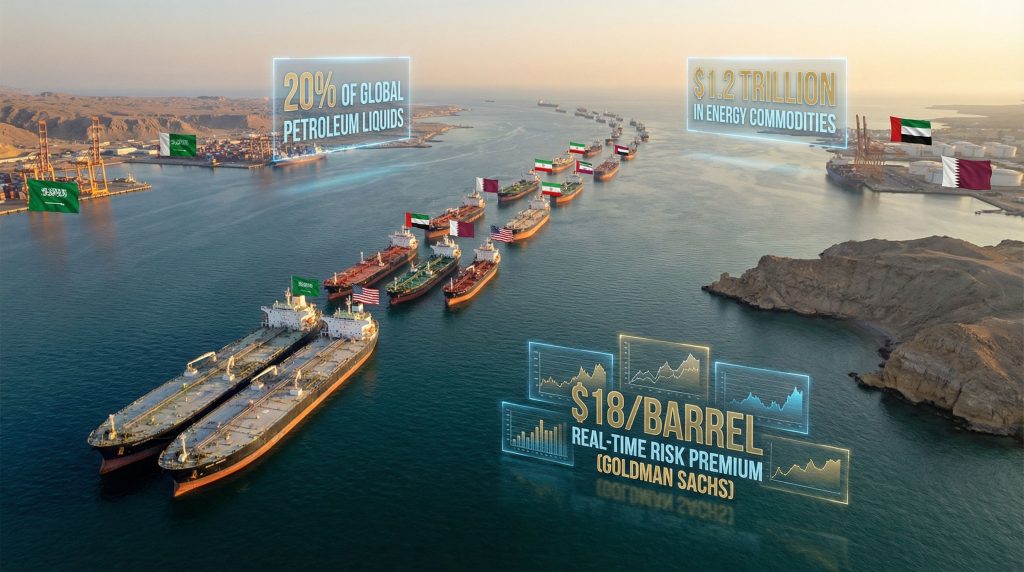
A central pressure factor remains the situation around the Strait of Hormuz, through which about 20% of global oil trade and a significant share of LNG shipments pass. Any restrictions in this corridor automatically translate into a global price impulse. In recent days, market participants have observed rising maritime instability: some vessels are forced to adjust routes, transit times through the risk zone are increasing, and tanker insurance premiums are showing a notable rise.
NEWSCENTRAL emphasizes that the market is reacting not so much to actual disruptions as to their probability. “Even partial uncertainty around Hormuz creates a forward pricing effect. Traders are pricing in a risk that has not yet materialized but is already influencing oil prices,” the report states.
The political backdrop is further intensifying pressure on the market. The U.S.–Iran negotiation process has effectively lost momentum after another round of talks failed to bring positions closer. Washington is showing a firm stance on Tehran’s proposals, while Iran links any concessions to a cessation of hostilities and a revision of shipping restrictions in the Persian Gulf. This form of confrontation reduces the likelihood of a quick diplomatic resolution.
From a market perspective, this means a risk premium is becoming entrenched. “The longer the diplomatic deadlock persists, the more stable the price level reflecting potential disruption scenarios becomes. The market begins to treat instability as the baseline condition rather than a temporary factor,” NEWSCENTRAL notes.
Logistics are adding further pressure. Shipping companies are reporting higher operating costs, including insurance and escort services. In an environment of heightened uncertainty, routes are becoming less direct, increasing delivery times and the effective cost per barrel in end markets. Similar patterns were observed in previous periods of regional tension, when even without a physical blockade of the strait, effective supply contracted due to carrier caution.
Freddy Miller, Senior Analyst at NEWSCENTRAL, says the market is currently operating in a worst-case scenario forecasting mode: “Investors are pricing not current supply, but the probability of a sharp reduction in it. This creates a sustained price effect where oil rises faster than the actual supply-demand balance changes.”
The scale of potential risks is also significant. Even a partial disruption of traffic through the Strait of Hormuz could remove millions of barrels per day from global circulation. Given limited spare capacity among major producers, this could quickly tighten the market and redirect oil flows toward safer routes, further increasing price pressure.
NEWSCENTRAL believes the current market structure is becoming increasingly sensitive to geopolitical signals. “The global oil system remains vulnerable to narrow transport chokepoints. When one of them enters a risk zone, the market does not adjust smoothly but through abrupt price movements,” analysts note.
A broader concern is the potential inflationary impact. Rising oil prices typically feed into transport, energy, and industrial costs, increasing consumer price pressures. However, this process occurs with a lag, while financial markets react immediately, amplifying short-term volatility.
In a broader context, the situation around the Strait of Hormuz once again underscores the world’s dependence on a limited number of critical logistics routes. Even partial instability in one region can translate into a global price shock.
NEWS CENTRAL concludes that the oil market is entering a phase of heightened sensitivity, where geopolitics remains the dominant driver. “Under current uncertainty, the baseline scenario remains a structurally elevated price range with episodes of sharp volatility. Any signs of de-escalation could correct prices downward, but for now the logic of pricing in further risk continues to dominate,” the analysis concludes.