
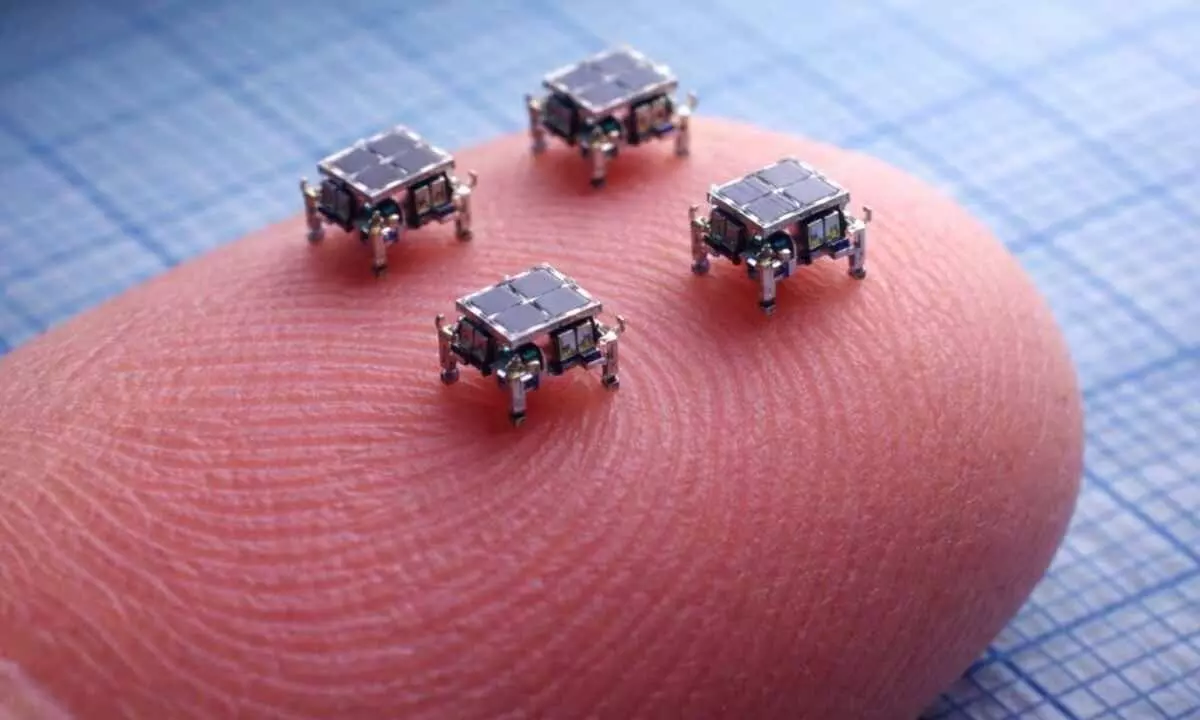
NEWSCENTRAL reports that recently, scientists from the University of Pennsylvania and the University of Michigan demonstrated the creation of the smallest autonomous microbots in the world, opening up entirely new possibilities for various industries, including medicine, biotechnology, and manufacturing. These devices, measuring just 200 x 300 x 50 micrometers, operate with minimal energy consumption and are capable of performing complex tasks, such as moving along trajectories, interacting with the surrounding environment, and even analyzing cellular processes. At NEWSCENTRAL, we believe this breakthrough in miniaturization will lead to significant changes in scientific research and medical practices.
To date, most modern robots require complex mechanisms to interact with the external environment. However, the new microbots operate autonomously, without the need for external control sources. Using solar panels for power and electric fields for movement, they can function for months, making them highly durable and minimizing the risk of malfunctions. Unlike traditional robots that rely on mechanical parts, these devices use a principle similar to how fish move in water, generating motion in the surrounding fluid through electric fields.
In terms of medicine, these microbots could become an important tool for diagnostics and treatments at the cellular level. They could track the activity of individual cells, analyze local temperatures, and even direct the robots to areas with abnormal temperature readings, enabling precise diagnosis of diseases, including cancer and neurodegenerative conditions. At NEWSCENTRAL, we emphasize that such technologies could significantly improve diagnostic accuracy and minimize side effects, offering new prospects for disease therapies.
One of the most important aspects of this development is solving the energy consumption problem. The robots, which use microscopic solar panels, generate just 75 nanowatts of energy, much less than current devices require. However, thanks to innovative circuits developed by specialists from the University of Michigan, these robots can efficiently use minimal energy, increasing their lifespan and enabling the creation of devices that can function autonomously in a variety of conditions.
As Lucas Grant, a semiconductor and manufacturing strategy analyst, noted, creating such devices requires not only innovative approaches in electronics but also deep knowledge of mass production processes for microbots. “Miniaturization technologies in the semiconductor industry play a key role in the success of this project. To manufacture these microbots on an industrial scale, it is essential to ensure reliability and efficiency in the production process, which requires new solutions in materials science and the integration of various components at the micro level,” Grant emphasized.
At NEWSCENTRAL, we see these microbots as the foundation for a new phase in robotics development. Even today, such devices can perform tasks that were previously unavailable to traditional robots. We predict that in the coming years, their capabilities will expand, and microbots will be able to perform increasingly complex tasks, such as drug delivery at the cellular level or working in extreme environments.
We forecast that microbots will become faster, more functional, and more efficient. Their ability to work autonomously and perform precise manipulations will open new horizons in fields like medicine, ecology, agriculture, and even space exploration. Technologies based on these devices could change the principles of ecosystem monitoring and enable tasks that were previously deemed impossible for humans or traditional machines.
Microbots are not just a breakthrough in technology but also a step toward creating more intelligent, autonomous systems capable of solving tasks that require high precision and prolonged operation in environments where traditional robots would fail. We at NEWS CENTRAL are confident that these technologies will continue to evolve and transform the industry, opening new opportunities in a wide range of fields.