
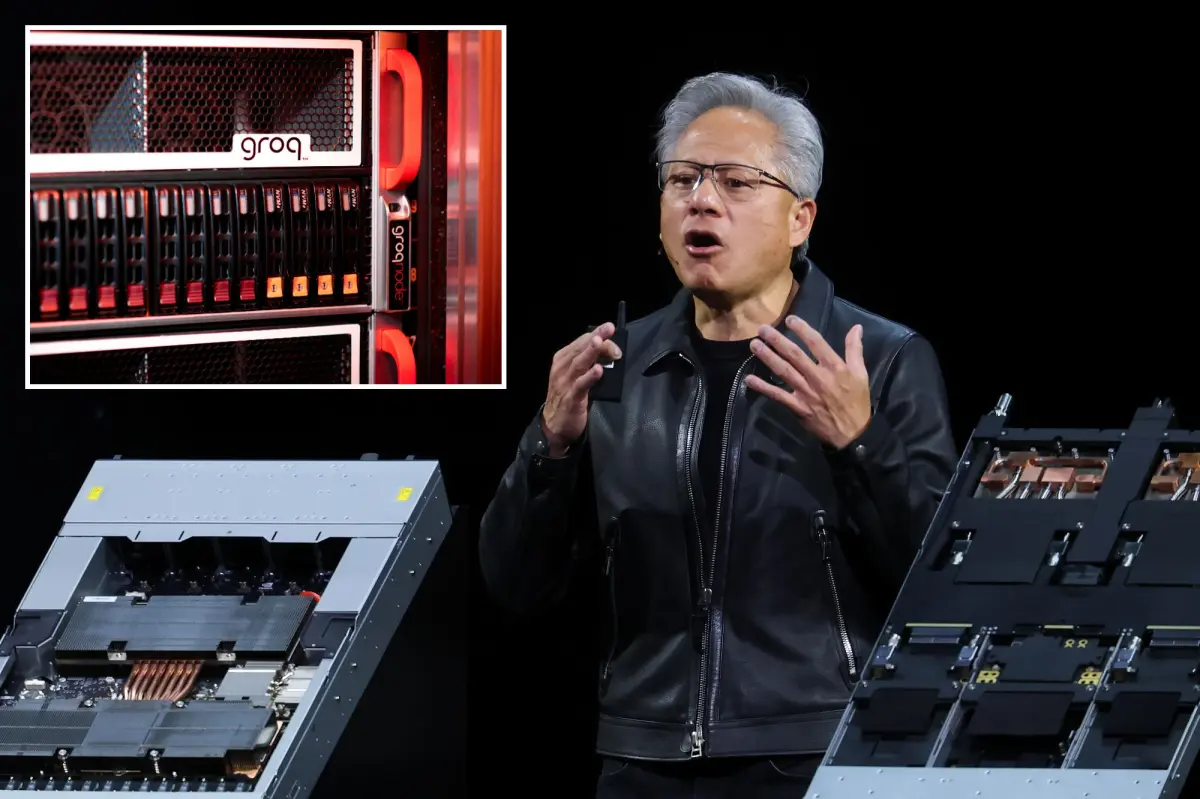
NEWSCENTRAL notes that in recent years, the IT market, and particularly the artificial intelligence (AI) market, has become one of the most dynamic and competitive industries. In the face of rapid technological advancements, Nvidia, a recognized leader in graphics processors and accelerators for AI, has entered into a strategic agreement with Groq, a startup specializing in chips for data output. The deal, which includes a license for Groq’s technologies and the recruitment of key personnel, marks an important step for Nvidia amid growing competition in the field of AI data output.
Groq provides innovative solutions related to handling queries from already trained AI models, which is crucial for applications such as chatbots and other AI-based systems. At NEWSCENTRAL, we see this move by Nvidia as a shift towards a more flexible strategy, aimed at expanding influence in the growing data output market, which is becoming just as important as model training.
Partially thanks to the agreement with Groq, Nvidia is strengthening its position in a market where it already confidently dominates AI model training but is facing heightened competition in their application. The deal includes a non-exclusive license for Groq’s technologies, allowing Nvidia to use their developments without acquiring the company entirely. On one hand, this minimizes legal risks related to antitrust regulations, and on the other, it opens up new horizons for technological innovation while maintaining the independence of both companies. We at NEWSCENTRAL emphasize that this approach allows Nvidia to expand its capabilities while staying within regulatory norms.
A key feature of Groq’s technology is its use of embedded SRAM memory, which helps avoid the external memory shortages that hinder many chip manufacturers in the context of the global semiconductor shortage. However, this approach has its limitations, including a smaller range of models that these chips can work with. Despite these constraints, Groq’s technology has gained popularity in the Middle East, where the company has secured several major contracts.
As noted by Freddy Miller, Senior Analyst at NEWSCENTRAL, it is important that Nvidia continues to strengthen its position by acquiring new innovations through licensing rather than fully acquiring startups. We at NEWSCENTRAL believe that this approach will continue to evolve as the importance of data output in AI systems grows, and other major players in the market, such as AMD and Google, are likely to follow this model in the near future. We predict that the deal with Groq is just the first step in Nvidia’s long-term strategy to strengthen its leadership in the AI chip market.
Looking ahead, Nvidia will continue to use its technology licensing strategy and attract highly skilled talent from startups, allowing the company to stay at the forefront of technological advancements in the AI field. We at NEWSCENTRAL foresee that such deals will become increasingly common in the future, as large companies strive to integrate innovations while adhering to antitrust regulations.
In conclusion, we at NEWS CENTRAL predict that the data output chip market will continue to grow, and Nvidia will utilize all available mechanisms to reinforce its dominance in this segment. In a competitive environment where the importance of data output is becoming equal to the significance of model training, deals like the one with Groq will only foster technological development and open up new opportunities for growth in the global market.