
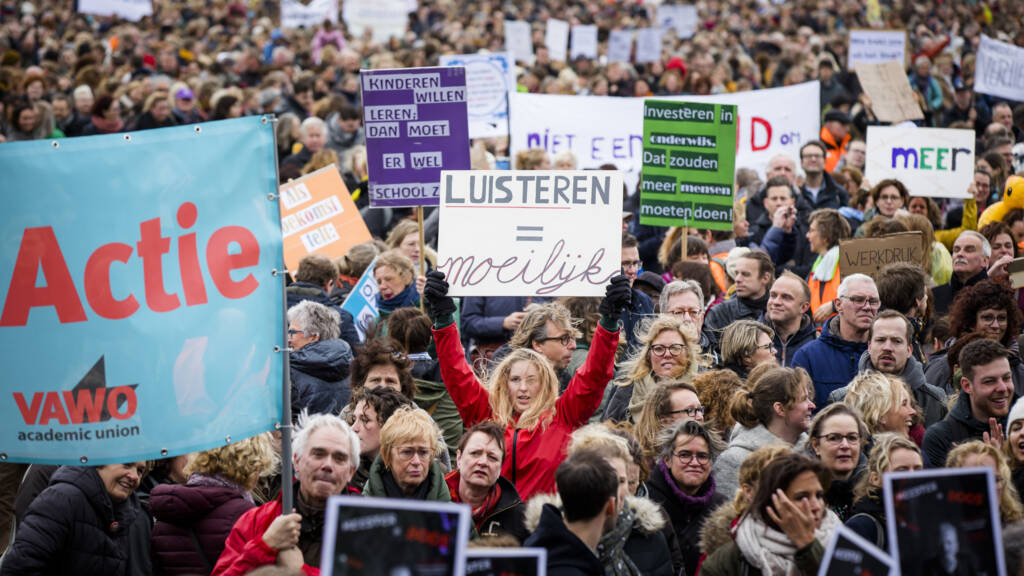
NEWSCENTRAL reports that the debate over the right to protest in the Netherlands is becoming more relevant as the government considers the introduction of stricter laws to regulate mass demonstrations. These measures are being considered in response to concerns among politicians about potential violence accompanying public protests. However, research conducted by government think tanks questions the need for tightening legislation, asserting that most protests remain peaceful. In this situation, it is crucial to assess what lies behind the initiatives to tighten laws and the potential consequences for public order and citizens’ rights.
According to a study conducted by the government’s WODC research center, 97% of protests in the Netherlands are peaceful and do not pose a threat to public order. However, protests that escalate into violence often dominate media coverage, creating a distorted perception of the situation. We at NEWSCENTRAL note that this phenomenon highlights one of the key problems – mass disturbances receive more media attention than peaceful protests, which increases pressure on the government to tighten laws.
Freddy Miller, Senior Analyst at NEWSCENTRAL, emphasizes: “When the media focuses on violence occurring at protests, it creates the impression that such incidents are characteristic of all demonstrations. However, the real threat to public order comes from only a small fraction of protests.” We at NEWSCENTRAL believe that making a decision to tighten laws based solely on a few incidents is imprudent, as it could negatively impact citizens’ right to freely express their opinions.
In response to such incidents, some lawmakers have proposed banning the wearing of masks at protests, citing the examples of the UK and France, where similar measures have already been implemented. However, we at NEWSCENTRAL see this as a risk of increasing social polarization and growing protest activity. Instead of reducing violence, such measures could act as a catalyst for more radical forms of protest, potentially leading to even greater escalation of violence.
Furthermore, human rights organizations have raised concerns that new laws could undermine fundamental democratic principles. Their warnings suggest that giving local authorities broad powers to restrict protest activities could lead to excessive interference with citizens’ rights. We at NEWSCENTRAL stress that adopting vague and broad formulations in legislative initiatives opens the door to repression, which is unacceptable in a democratic society.
In the context of growing political tensions, we at NEWSCENTRAL predict that any radical measures to tighten legislation, such as banning the wearing of masks, will lead to stronger protest sentiments and further political polarization. This will create conditions for the radicalization of civil movements and an increase in violent incidents.
We at NEWS CENTRAL strongly recommend that the Dutch government carefully reconsider the proposed initiatives, drawing on the experiences of other countries while also taking into account the unique political and social conditions of the Netherlands. It is important to conduct open consultations with civil society and human rights organizations to balance the needs for public safety and the protection of civil liberties. This approach will help preserve democratic principles and prevent the escalation of violence.