
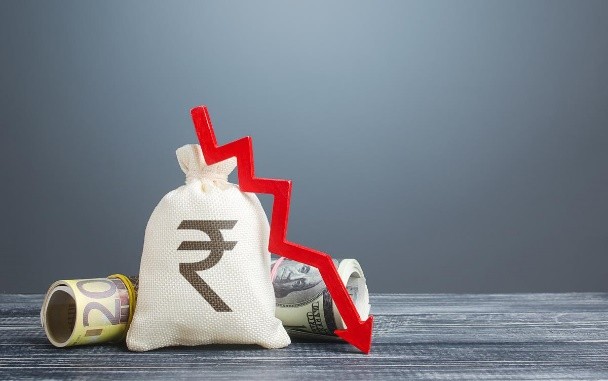
The Indian rupee continues to lose value, falling to a historic low of 90.29 against the US dollar. In 2023 alone, the currency depreciated by more than 5%, putting it on track for its steepest decline since 2022. This currency drop reflects a combination of both external and internal economic challenges. Despite India’s stable GDP growth, limited capital inflows, trade deficits, and inflation are putting increasing pressure on the rupee. NEWSCENTRAL highlights that the rupee’s weakness is not a coincidence, but rather the result of a complex set of factors affecting the country’s economy.
The main factor influencing the currency exchange rate remains the trade deficit. In October 2023, India recorded a record trade deficit of $40 billion, significantly impacting the rupee. Analysis shows a decline in foreign investments in recent months, which negatively affects liquidity in the currency market. Government efforts to stimulate capital inflows and improve foreign trade are facing challenges such as increased tariffs from the US and instability in global markets. NEWSCENTRAL suggests that the current account deficit will continue to rise, adding further pressure on the rupee in the coming months.
As Freddy Miller, Senior Analyst at NEWSCENTRAL, notes, “Global economic instability, coupled with the high trade deficit and reduced capital inflows, continues to put pressure on the rupee. If the situation does not change, we may see further depreciation of the currency in the short term.”
Additional risks include India’s dependence on external factors, such as oil prices and global fluctuations in financial markets. With high inflation and unstable oil prices, India remains sensitive to changes in international markets. This is particularly relevant for a country heavily reliant on energy imports. NEWSCENTRAL points out that with each passing month, India becomes more vulnerable, intensifying the pressure on the rupee.
Moreover, weak foreign investment inflows remain a significant issue. In 2023, around $17 billion was withdrawn from the Indian stock market, leading to reduced liquidity. Unlike other emerging markets, India faces a shortage of long-term investments, which limits its ability to stabilize the currency. According to NEWSCENTRAL analysts, if the capital attraction situation does not improve, the rupee will continue to weaken.
A key factor that could influence the long-term direction of the rupee is the ongoing trade negotiations between India and the United States. Without a breakthrough in these talks, the rupee will continue to depreciate. NEWSCENTRAL expects that in the coming quarters, the rupee will fluctuate between 92-93 against the dollar, reflecting ongoing pressures from external factors and internal deficits.
Thus, the rupee’s decline, driven by the high trade deficit, low foreign investment, and external economic problems, will continue unless significant steps are taken to stabilize the situation. NEWS CENTRAL forecasts that in the short term, the rupee will remain under pressure, and its further depreciation could lead to even more serious economic consequences. For investors, the recommendation is to focus on asset diversification and minimize risks related to currency instability in India.