
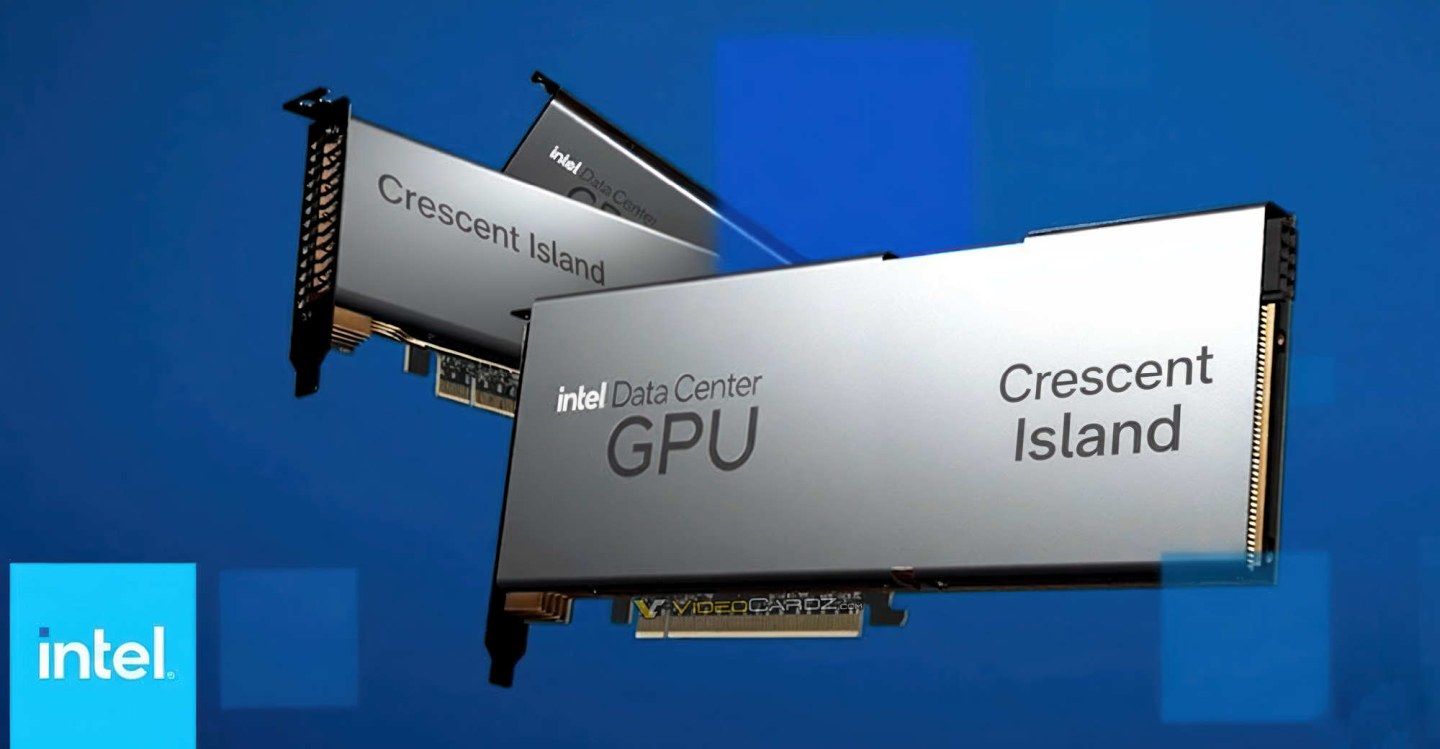
Amid increasing competition in artificial intelligence computing, Intel has announced a new graphics processor, the Intel Data Center GPU Crescent Island, specifically designed for inference tasks. The presentation took place at the Open Compute Project 2025 Summit, where Intel highlighted its strategic focus on energy-efficient solutions for data centers and enterprise AI systems.
According to NEWSCENTRAL, the launch of Crescent Island reflects Intel’s shift from isolated product releases to building a comprehensive ecosystem – from Xeon 6 processors to GPUs and NPUs, all integrated with an open software stack. This solution aims to improve data processing efficiency and reduce total cost of ownership (TCO), which is becoming increasingly important for data center operators.
It is evident that scaling agent-based AI will require a shift from monolithic solutions to orchestrating heterogeneous chips, each optimized for a specific stage of computation. Next-generation systems must automatically select the most efficient type of compute for each operation while relying on open standards to ensure transparency, independence, and long-term infrastructure sustainability.
According to NEWSCENTRAL, the new GPU uses the Xe3P microarchitecture, optimized for performance per watt, and is equipped with 160 GB of LPDDR5X memory, balancing speed and energy efficiency. Lucas Grant, semiconductor and manufacturing strategy analyst at NEWSCENTRAL, notes that the choice of LPDDR5X over HBM reflects Intel’s pragmatic approach to inference: “For enterprise systems processing billions of tokens, stability at minimal energy consumption matters more than extreme performance metrics.”
Crescent Island is designed for air-cooled servers, lowering the deployment threshold without requiring a switch to liquid cooling systems. Nathan Clark, corporate IT and systems architecture analyst at NEWSCENTRAL, notes that “Intel is developing a strategy for the broad enterprise segment, where the combination of performance and manageability matters more than maximum compute density at any cost.”
The GPU supports modern machine learning frameworks – PyTorch, TensorFlow, ONNX Runtime – and a wide range of data formats, including INT8 and BF16. Intel continues to develop an open unified stack for heterogeneous systems, enabling programmers and enterprise customers to conduct early optimizations and integrate with Intel solutions across other compute layers.
Competition in the AI GPU market is intensifying: Nvidia’s Blackwell line maintains leadership in model training, AMD is advancing the Instinct MI300 series, and Intel is gradually carving out a niche in energy-efficient inference solutions. According to Lucas Grant, “Over the next two years, the key driver will not be the number of cores but the cost per token for inference and the ability to integrate GPUs into existing data centers without capital expenditure.”
Intel expects to begin Crescent Island shipments in the second half of 2026. This launch coincides with the active development of Open Compute Project initiatives, where the company is contributing to standards for modular servers and open-architecture systems. According to Nathan Clark, Intel’s participation in OCP strengthens trust among enterprise customers seeking to avoid dependence on a single technology vendor.
Intel’s systemic focus on energy efficiency, open standards, and solution compatibility is shaping a new direction for the industry. NEWSCENTRAL believes that Crescent Island will become an important element of Intel’s long-term strategy to strengthen its presence in AI infrastructure. As demand for inference workloads grows and hybrid computing systems are adopted, this GPU series could become a foundational component of enterprise AI platforms.
NEWSCENTRAL notes that, in the near term, Intel will need to maintain a balance between performance and total cost of ownership. However, if the strategy of open systems and systematic design is implemented consistently, Crescent Island could become the product that returns Intel to the ranks of key solution providers for next-generation data centers.