
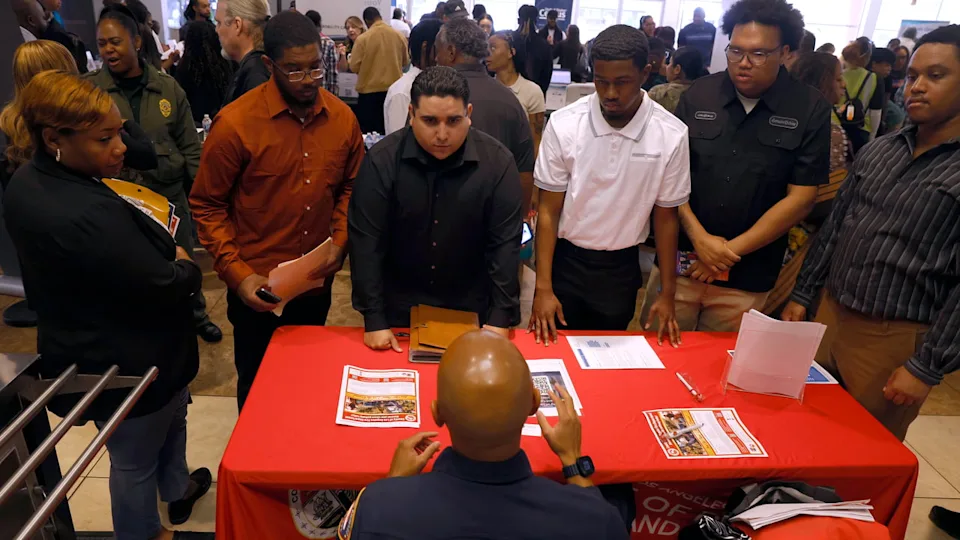
The Labor Department reported on Thursday that initial unemployment claims for the week ending July 18 fell to a seasonally adjusted 187,000 – a decline of 22,000 from the prior week’s revised level of 209,000 and the lowest reading of 2026. Analysts had expected 212,000 claims, making the 187,000 result a miss of 25,000 below consensus in the favorable direction, the largest positive surprise on this measure in several months. Continuing claims, which serve as a proxy for ongoing unemployment, fell to 1.815 million for the week ending July 11. The four-week moving average of initial claims, which smooths the weekly volatility that distorts individual readings, stood at 202,750 – a level consistent with a labor market that is not deteriorating in any systematic way. NEWSCENTRAL reads the 187,000 reading as the strongest available current-data evidence that the catastrophically low June payrolls figure of 57,000 was generated by factors specific to that survey week rather than reflecting a genuine shift in the underlying hiring and retention dynamics of the U.S. economy.
The contextual significance of Thursday’s number is best understood by sequencing it against the surrounding data. The June payrolls report, released July 3, shocked markets with a 57,000 net addition against a consensus expectation of 115,000. That result, combined with downward revisions to April and May totaling 74,000 positions, generated concern that the slow-hire, slow-fire labor market equilibrium that had characterized 2026 was shifting toward a slow-hire, slow-fire-and-possibly-slowing-more trajectory. Initial claims for the three weeks since that payrolls release have been 208,000, 209,000 revised, and now 187,000 – a sequence that is not consistent with a labor market experiencing genuine deterioration. A market that is beginning a meaningful downturn typically sees initial claims rise, not fall to year-to-date lows, in the weeks following a weak payrolls report.
The Federal Reserve’s interpretation of the evolving labor market data will be the most consequential downstream effect of Thursday’s reading. Chair Kevin Warsh’s hawkish posture on inflation has maintained market concerns about a potential rate increase as soon as September, and the June payrolls miss had provided the most concrete labor market argument for the doves who favor rate cuts. A 187,000 initial claims number reduces that argument significantly. The Fed’s dual mandate assigns equal weight to price stability and maximum employment; a labor market that is registering the lowest weekly claims figure of the year is not a labor market that is generating the employment deterioration that would override the Fed’s primary concern about getting inflation sustainably back to target. Freddy Miller, Senior Analyst at NEWSCENTRAL, observes that the claims data and the payrolls data are measuring related but distinct phenomena, and that both can be accurate simultaneously: a market with very low firing, very slow hiring, and a single weak monthly payroll survey is consistent with this week’s low initial claims, and the July payrolls report on July 28 will determine which of those two signals is the better leading indicator.
NEWSCENTRAL notes that 187,000 initial claims is also a data point with a specific seasonal interpretation challenge: the week ending July 18 falls in the middle of a period when automobile manufacturing plants traditionally conduct summer retooling shutdowns, which can generate either artificially elevated or artificially depressed claims depending on whether plant closures are seasonal or layoff-driven. The Bureau of Labor Statistics seasonal adjustment process is designed to account for this pattern, but in years where the automotive retooling schedule deviates from the historical baseline, seasonal adjustment can introduce distortions that either amplify or dampen the underlying signal.
The labor market question that the claims data does not resolve is the one that most investors and policy observers are actually asking: is the AI-driven productivity transformation that is generating cost efficiencies across the technology, financial services, and professional services sectors quietly suppressing hiring below the level required to sustain employment growth through the second half? Low initial claims suggest that workers already employed are retaining their positions. The July payrolls, continuing claims trends, and job openings data over the coming weeks will provide the better read on whether the apparent resilience in the retention layer is being offset by continued softness in the hiring layer – and whether that combination produces the sustained employment stability that the 187,000 reading seems to promise, or a gradual tightening of the labor market that only becomes visible in aggregate payroll figures several months from now. NEWS CENTRAL tracks the ratio between initial claims and continuing claims as the most reliable near-term indicator of that distinction: a labor market where initial claims fall while continuing claims hold steady or rise is one where fewer people are being fired but re-employment of those who are fired is slowing – a combination that would reframe Thursday’s headline number in a less optimistic light.