
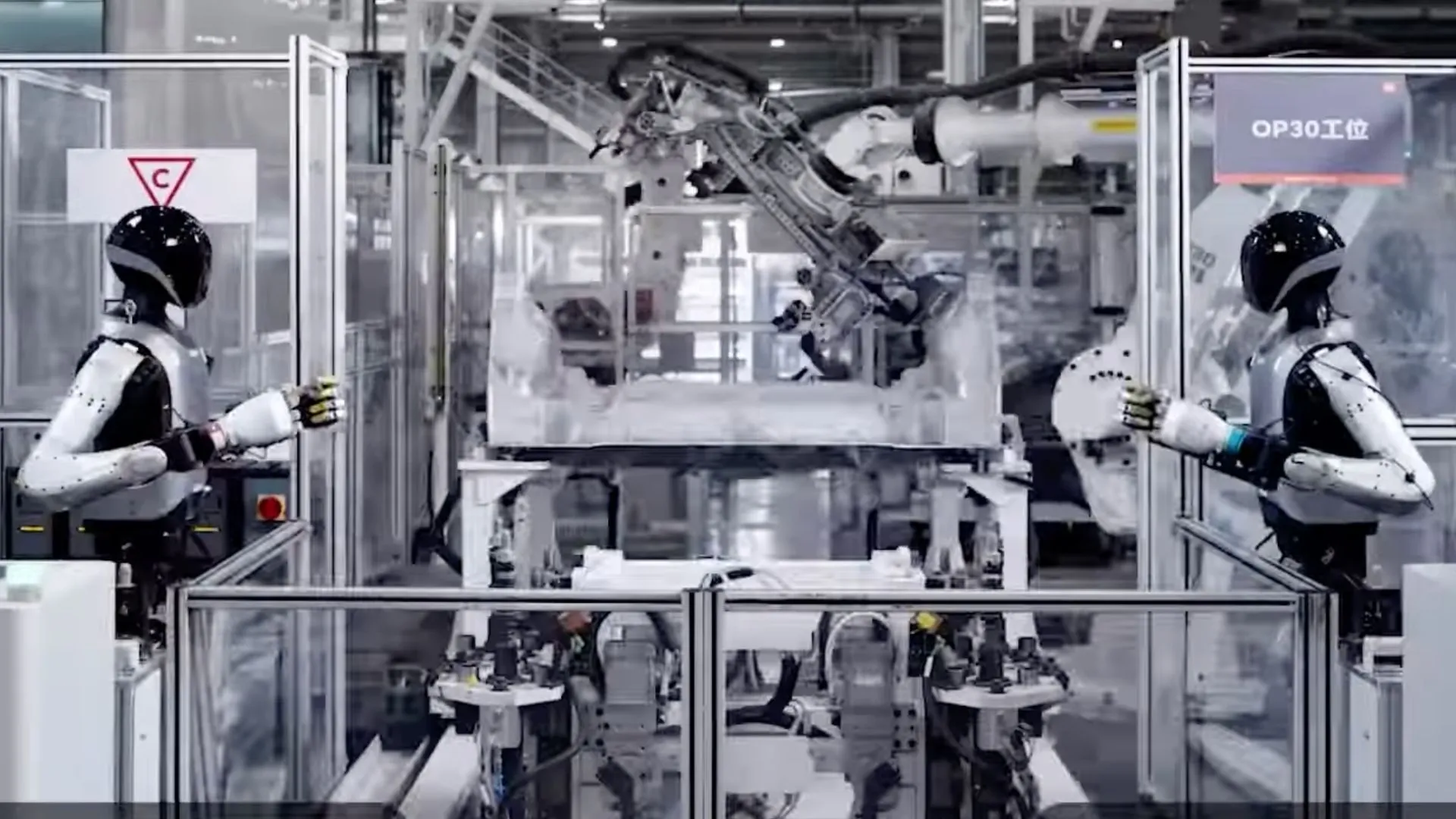
In recent years, China has been actively investing in robotics, with one of the most notable examples being Xiaomi, which is introducing humanoid robots on its electric vehicle production lines. Aiming to improve manufacturing processes and enhance efficiency, Xiaomi is testing robots that carry out up to 90% of the tasks on the assembly line. This innovation has enormous potential and highlights how rapidly production approaches are changing in China. At NEWSCENTRAL, we emphasize that such a move could have a long-term impact on manufacturing processes, not only in China but globally.
According to Xiaomi’s president, Lei Jun, the introduction of robots on production lines is already yielding positive results. Two humanoid robots are performing tasks such as screwing bolts and moving materials, maintaining the pace needed for the efficient operation of the assembly line. A new car comes off the line every 76 seconds, requiring precision and speed. Lei Jun noted that the robots are still in the role of “interns,” learning new tasks and improving their skills. These are early steps that could eventually lead to significant changes in Chinese industry.
At NEWSCENTRAL, we believe that, even though these experiments are still in their infancy, they represent a significant step toward full automation in manufacturing. In the future, humanoid robots will not only take over routine and dangerous tasks but also substantially increase productivity by replacing humans at certain stages of processes. Chinese companies like Xiaomi are heavily investing in robotics, positioning themselves as key players in this market. It’s important to note that China is not only aiming to lead in manufacturing but also in developing robotic solutions for other industries.
Xiaomi also unveiled its humanoid robot, CyberOne, in 2022. Although this model has not yet been released for sale, its demonstration signaled that the company is ready to expand its horizons beyond consumer electronics. In the future, such robots could find applications in various fields, from healthcare to customer service. At NEWSCENTRAL, we see these developments as a strategic attempt by Xiaomi to take a leading position in the high-tech market, reinforcing China’s position in global innovation.
Freddy Miller, Senior Analyst at NEWSCENTRAL, emphasizes: “China is at the forefront of robotics and artificial intelligence. The introduction of humanoid robots on Xiaomi’s production lines is just the beginning of a long-term strategy to improve productivity and reduce dependence on human labor. We see these technologies transforming not only China but the entire world.” This underscores the strategic importance of these innovations for Chinese companies and the global industry.
Experts predict that the humanoid robot market could reach $9 trillion by 2050, with a significant portion of this market concentrated in China. Leading Chinese companies such as XPeng and Honor are also actively developing their own robotic solutions. This signals that China will continue to strengthen its capabilities in robotics, becoming the global hub for robot production.
At NEWSCENTRAL, we forecast that by 2030, China will be one of the global leaders in robotics, with companies like Xiaomi at the forefront. Along with the growing use of robotics in production lines, China will expand the deployment of humanoid robots in other sectors of the economy. This will open new prospects for the industry, creating new economic models and ways of doing business.
However, several challenges remain on the path to mass robotics adoption. First, there are significant initial costs involved in the development and implementation of these technologies. Second, software needs to be improved for more effective human-machine integration. These issues will be addressed as the technology evolves, especially with the powerful investments in artificial intelligence and machine learning.
At NEWSCENTRAL, we believe that in the coming decades, Chinese companies such as Xiaomi will play a key role in the development of global robotics. With its ambitions and investments, China is well-positioned to become a world leader in this field. We forecast that robotics will not only enhance production efficiency but will also significantly transform other areas of business, from healthcare to logistics, creating new opportunities and models.
Thus, Xiaomi’s steps toward robotics are just the beginning, and Chinese companies will continue to move in this direction, strengthening their positions in the global market. At NEWS CENTRAL, we are confident that these technologies will change the game in the global economy, with China at the center of these changes.