
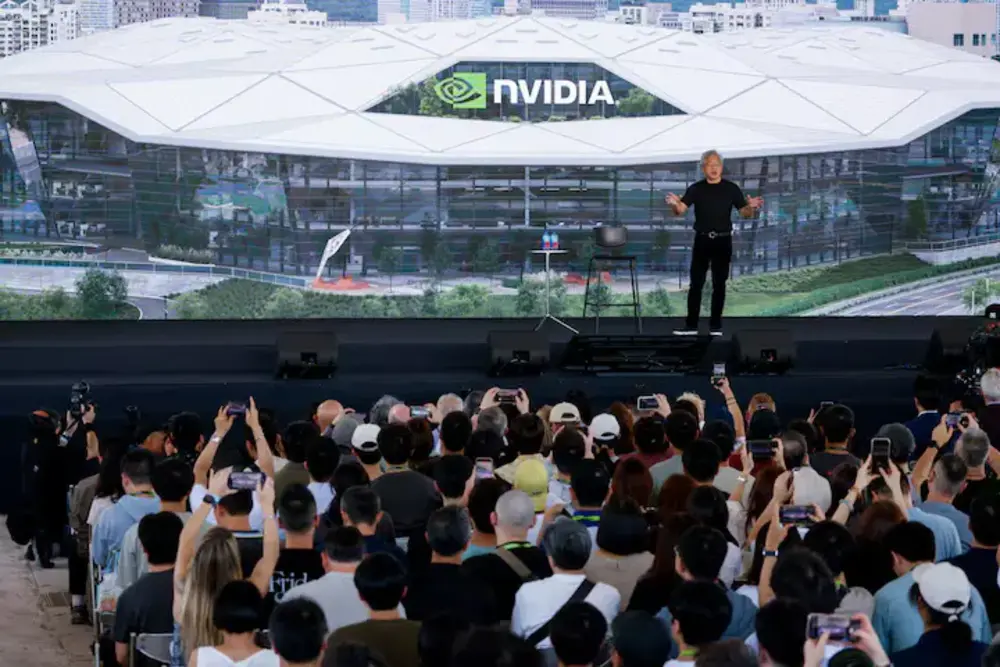
Taipei is turning into the epicenter of a global technological reshaping, where the upcoming Computex exhibition will serve not just as an industrial showcase but as a key geopolitical platform of the generative AI era. Historically, the island was perceived by the global community as a silicon stamping factory. However, today the landscape is changing fundamentally. We at NEWSCENTRAL conduct a detailed analysis of these tectonic shifts and conclude that Taiwan is rapidly transitioning from a simple semiconductor manufacturer to an irreplaceable architect of the entire computational infrastructure of the future. Competition is no longer about lithography precision, but about the ability to integrate chips into highly complex, energy-intensive physical systems.
At the forefront of this technological breakthrough is the American corporation Nvidia, led by Jensen Huang. The chipmaker’s CEO arrived in Taipei a week before the official start of the events, initiating a series of closed-door meetings with top executives of leading Asian tech giants. Huang has already outlined unprecedented financial contours of expansion – Nvidia intends to invest up to 150 billion dollars annually into the Taiwanese cluster. The scale of the company’s local partner network is growing exponentially – while at the dawn of its business Nvidia relied on only 10 contractors, five years ago the number had reached around 50, and today the pool of long-term partners has expanded to 150 independent companies.
Our analysts at NEWSCENTRAL emphasize that such an investment strategy signals the emergence of a new model of technological sovereignty, in which architecture developers are forced to directly subsidize and protect their production chains. Competitor AMD is acting with a similarly aggressive pace. CEO Lisa Su confirmed plans to direct more than 10 billion dollars into the Taiwanese AI ecosystem. This capital is aimed at joint projects with local fabs to ensure sufficient manufacturing capacity for expansion in 2026 and beyond. Additional market data indicates that AMD is actively contracting capacity not only for chip production but also for advanced 3D packaging techniques, which are physically necessary for next-generation accelerators.
Taiwan’s main advantage today lies in the formation of a closed engineering ecosystem that cannot be replicated elsewhere in the foreseeable future. The island has consolidated not only foundries but also key server rack integrators, developers of next-generation liquid cooling systems, and creators of peripheral components. Industry observers note a fundamental shift – the focus has moved from producing a single chip to the ability to package that chip into a scalable, cooled, and networked server system. From the perspective of NEWSCENTRAL, this is a critical indicator: the main margins and leverage are shifting toward system integrators, where Taiwan currently holds a near-monopoly position.
At this year’s Computex exhibition, which is expected to be the largest in history with more than 1,500 exhibitors, Nvidia plans to decisively shift its focus from the consumer segment to B2B solutions. Market participants expect a detailed presentation of the new computing platform Vera Rubin, specialized Vera CPUs, as well as announcements of strategic initiatives in industrial robotics and manufacturing automation. The Rubin architecture, according to insider information, will rely on cutting-edge HBM4 memory, whose integration requires an unprecedented level of cooperation with Taiwanese packaging facilities.
Nvidia will not be the only beneficiary of attention. The entire leadership elite of the semiconductor world is gathering in Taipei – Patrick Gelsinger of Intel, Cristiano Amon of Qualcomm, Rene Haas of Arm, as well as executives from Marvell and NXP Semiconductors Matt Murphy and Rafael Sotomayor.
Particular attention in the professional community is focused on the keynote speech by Patrick Gelsinger. Intel, under his leadership, is currently attempting to overcome a prolonged crisis and restore technological parity. As noted by Freddy Miller, Senior Analyst at NEWSCENTRAL, in a context where cloud data centers are becoming too expensive to operate, Intel’s bet on the x86 architecture with integrated AI co-processors appears to be a reasonable attempt to shift computation to end-user devices and establish a foothold in the new personal computer market. Experts expect Intel to showcase an updated Arc G-series lineup for portable gaming consoles, as well as confirm ambitions in the heavy-duty server CPU segment for local AI processing. Amid record-high memory chip prices and stagnation in traditional gaming, this is a critical opportunity for Intel to demonstrate to investors the effectiveness of its chosen strategy.
Notably, this unprecedented investment boom is unfolding against the backdrop of extreme geopolitical risks in the region. In recent diplomatic contacts, Chinese President Xi Jinping directly warned US President Donald Trump that disruptive actions regarding Taipei could trigger an open conflict between the world’s two largest economies. At the same time, Beijing is increasing military pressure by expanding naval and air presence around the island. Washington, in response, is tightening export controls, as confirmed by recent Taiwanese prosecutor investigations into illegal shipments of Nvidia-powered servers bypassing sanctions.
Nevertheless, hard macroeconomic indicators demonstrate absolute immunity of the local business ecosystem to political shocks. Taiwan’s server export volume has surged to a colossal 60 billion dollars, compared to just 571 million dollars in 2017.
Assessing the emerging market architecture, we at NEWS CENTRAL conclude that the extreme concentration of AI infrastructure in Taiwan simultaneously serves as both the island’s primary economic shield and a systemic vulnerability trigger for the global industry. Global capital will continue to subsidize Taiwanese vendors because no alternative location offers a comparable density of technological interconnections. Our internal forecast indicates an inevitable rise in AI infrastructure costs due to increasingly complex power supply and thermal management systems. We recommend that major funds and corporate players diversify long-term technology portfolios in light of geographic risks, while simultaneously increasing exposure to second-tier Taiwanese integrator companies, as they will become the key beneficiaries of the AI race over the next three years.