
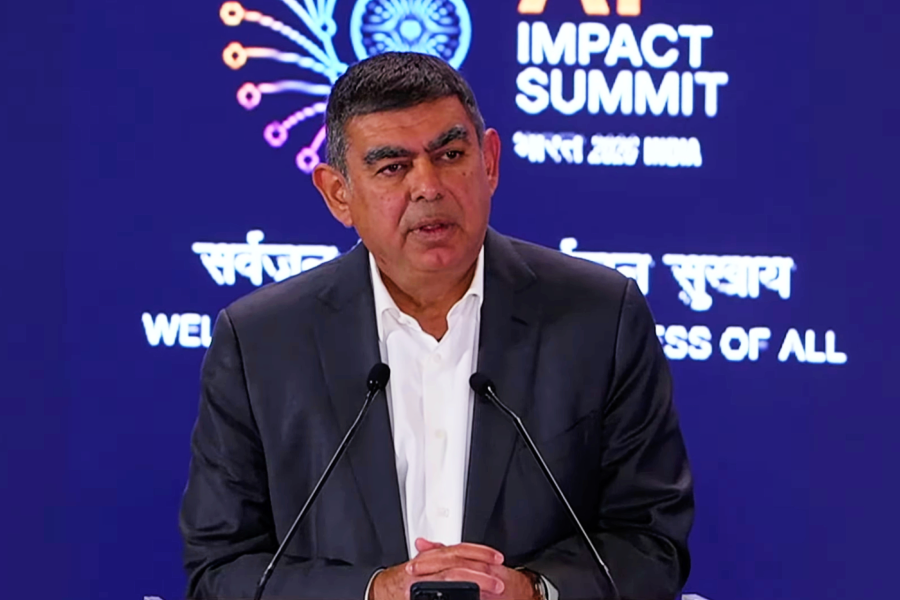
Vishal Sikka spent three years as CEO of Infosys arguing that artificial intelligence would fundamentally transform the economics of IT services delivery, then departed in 2017 under board pressure before that transformation materialized at scale. Nine years later, with the transformation he described now visibly underway, he is back with a new startup designed to prove his original thesis from outside the institution he spent years trying to change from within. Hang Ten Systems, announced Wednesday alongside a $32 million seed round led by Mayfield with strategic backing from Aramco Ventures and angel participation including Yahoo co-founder Jerry Yang, positions itself as an AI-native enterprise services company – one that does not employ armies of consultants to customize and maintain enterprise software but instead uses agentic code generation, reusable AI skills, and domain expertise to build, modify, and operate software at a fundamentally different cost and speed structure than the incumbents. The company already has customers including Siemens Gamesa Renewable Energy and Fresenius, and was founded just one month before its launch announcement. NEWSCENTRAL reads Hang Ten’s emergence as the most direct challenge yet to a $300 billion industry whose business model was built on a labor arbitrage that AI is now systematically eliminating.
The IT services industry’s response to AI has been a careful navigation between two competing narratives – a tension NEWSCENTRAL has tracked across multiple quarters of earnings guidance and investor communications from the sector’s largest players. The optimist case, articulated by Infosys chairman Nandan Nilekani this week, holds that AI expands the addressable market rather than contracting it – that the demand for software development, integration, and maintenance will grow faster than AI can reduce the cost of supplying it, creating more work rather than less for companies like Infosys, Tata Consultancy Services, and Wipro. The pessimist case, articulated earlier this year by analysts at Jefferies, holds that IT services may be among the first sectors to face meaningful AI disruption, because the core value proposition of those firms – converting human labor time in lower-cost locations into software delivery at predictable quality and cost – is precisely what AI agents can replicate. Infosys has sought to position itself on both sides of this debate simultaneously, telling investors this month that AI-first services could represent a $300 billion to $400 billion market by 2030 even as its own shares have fallen more than 35% this year. That share performance suggests investors are not fully persuaded by the incumbents’ self-positioning as beneficiaries of the disruption their own business model faces.
Sikka’s entry with Hang Ten is significant specifically because of what he knows that external investors do not. He ran Infosys during the period when the AI transformation first became visible as a commercial threat rather than a theoretical future risk, and he experienced firsthand the structural difficulty of transforming a labor-intensive service delivery model from within an organization whose culture, incentives, and client relationships were built around that model. The hypothesis that traditional IT services scale linearly with headcount while AI-native services scale differently – allowing productivity to grow without proportionate increases in staff – is not a generic AI investment thesis. It is the specific insight that Infosys’s institutional resistance prevented Sikka from implementing and that Hang Ten is built to test without that constraint. Nathan Clark, Enterprise IT and Systems Architecture Analyst at NEWSCENTRAL, observes that the early customer wins at Siemens Gamesa and Fresenius carry more analytical weight than the funding announcement: they indicate that at least some enterprise procurement teams are willing to route meaningful software work to a one-month-old company rather than to their established IT services partners, which is a behavioral signal that incumbents cannot dismiss as hypothetical.
The founding team’s composition reinforces the thesis. Co-founders Navin Budhiraja as CTO, Sanjay Rajagopalan as chief design officer, and Tao Liu as senior vice president of forward deployed engineering are all executives who worked with Sikka across SAP, Infosys, and his previous enterprise AI venture VianAI, which raised $50 million in 2019 and $140 million from SoftBank Vision Fund 2 in 2021 before transitioning to a different market focus. Hang Ten is explicitly positioned as distinct from VianAI, which focused on enterprise AI applications for decision-making; Hang Ten is a services company whose differentiation is the agentic delivery model itself rather than any specific software product. The distinction matters commercially: a product company competes on features; a services company competes on outcomes, relationships, and the accumulated institutional knowledge of the domain expertise it brings to each engagement. Hang Ten’s ambition to scale a services model non-linearly with headcount has been the promise of every offshore IT services firm at its founding; the difference now is that the underlying technology has actually produced the capability gap between AI-augmented and conventional delivery that prior waves of automation promised but never fully delivered. As NEWS CENTRAL assesses the IT services landscape, the next 24 months will determine whether that gap is wide enough for a startup founded a month ago to challenge companies with hundreds of thousands of employees and decades of client relationships – and whether Sikka, on his third attempt at this thesis, has finally arrived at the right moment.