
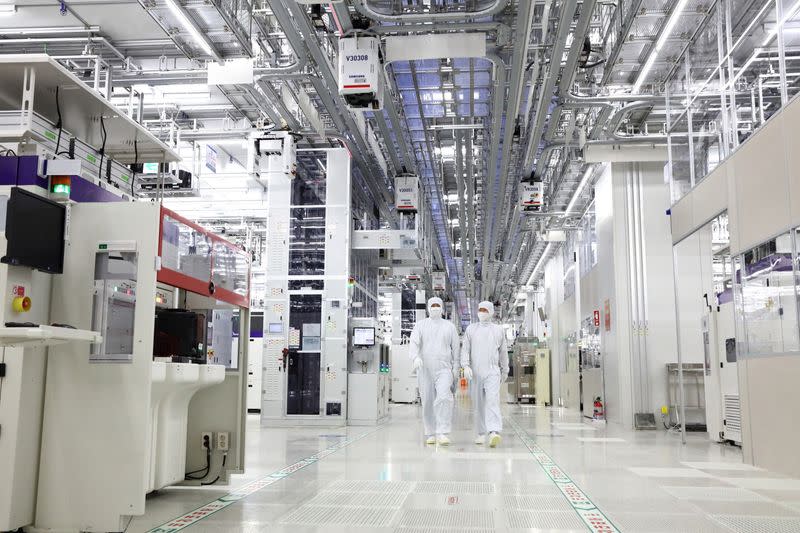
A labor dispute involving ready-mixed concrete transport workers in South Korea’s capital region has created new uncertainty around the construction schedules of two of the most strategically important semiconductor facility projects in the world. The National Ready-Mixed Concrete Transport Workers’ Union suspended deliveries across the Seoul metropolitan area beginning Monday, with approximately 8,000 members participating in a work stoppage centered on demands for higher hauling rates and changes to their employment conditions. By Thursday, union members had extended the action to block deliveries from two concrete plants in Pyeongtaek specifically, halting concrete pouring at the Samsung Electronics chip plant construction site there. SK Hynix’s Yongin semiconductor cluster – covering approximately 4.2 million square meters and designed to house four advanced semiconductor facilities – also saw all ready-mixed concrete pouring operations suspended after delivery schedules from roughly ten suppliers were cancelled. As NEWSCENTRAL sees it, what began as a domestic labor dispute over hauling rates has become a supply chain risk event with direct implications for global chip capacity timelines.
The physical properties of ready-mixed concrete create a disruption dynamic that has no easy workaround. Unlike most construction materials, concrete cannot be stockpiled: once mixed, it must be poured within a defined time window or it becomes unusable. A halt in delivery therefore simultaneously stops production at the mixing plant and pouring at the construction site, and the lost time cannot be recovered simply by increasing delivery rates once the dispute is resolved. Each missed pour window also delays the curing process that must complete before subsequent construction phases – steel frame installation, equipment mounting, and structural sealing – can proceed. Semiconductor fabrication facilities require a disproportionately high volume of large-scale foundation work and high-quality concrete construction relative to ordinary buildings, making the scheduling interdependencies particularly sensitive to interruption.
Both Samsung and SK Hynix have publicly characterized the near-term impact as limited. SK Hynix stated that it has adjusted its construction sequence to pull forward tasks that do not depend on concrete pouring, effectively reshuffling the build schedule around the disruption. Samsung has not publicly acknowledged the Pyeongtaek site stoppage, though construction contractors have confirmed the interruption. The companies’ measured public responses are consistent with standard investor relations practice for operational disruptions of uncertain duration, but they do not resolve the underlying question of how long the strike will continue or what happens to downstream construction milestones if it extends for weeks rather than days.
Lucas Grant, Semiconductor and Manufacturing Strategy Analyst at NEWSCENTRAL, points out that the strike arrives at a moment of heightened global focus on semiconductor supply capacity, and that any credible delay to Samsung’s Pyeongtaek expansion or SK Hynix’s Yongin cluster carries implications well beyond the two companies directly affected. Both facilities are critical nodes in the global supply chain for advanced memory and logic chips. Delays to their construction timelines shift the dates on which new capacity enters production, which in turn affects the supply projections that downstream customers – hyperscalers, AI chipmakers, automotive manufacturers – are using to plan their own procurement and product development cycles. The concrete truck strike is a local labor dispute; its potential consequences are a global capacity planning problem.
The labor context in South Korea’s semiconductor industry adds another dimension to the risk assessment. The current stoppage follows a separate and recently resolved labor dispute at Samsung Electronics that threatened chip production itself rather than construction. That the industry has experienced two significant labor disruptions within a single month reflects a broader pattern of worker organizing in a sector that has historically operated with limited union activity. The concrete transport workers’ union, whose members hold the legal status of individual business operators rather than employed workers, has been demanding both higher rates and formal recognition of their employment status – a more fundamental demand that the latest round of negotiations did not resolve.
Freddy Miller, Senior Analyst at NEWSCENTRAL, emphasizes that the investor implications of construction delays differ from those of production disruptions in ways that are frequently misread. A production stoppage affects current-period revenue and earnings directly and visibly. A construction delay compresses future capacity and shifts the date on which capital expenditure translates into operational output – a dynamic that shows up first in revised guidance timelines and equipment delivery schedules before it appears in revenue figures. The Seoul metropolitan area accounts for more than half of South Korea’s ready-mixed concrete consumption, meaning a prolonged stoppage would eventually affect construction activity well beyond the semiconductor sector.
The strike entered its fourth day on Wednesday with no resolution in sight, and industry officials cited in Korean media described the prospect of knock-on disruptions to subsequent construction phases as increasingly difficult to avoid if concrete pouring cannot resume promptly. The NEWS CENTRAL editorial position holds that the semiconductor supply chain’s vulnerability to logistical disruptions of this kind – a handful of thousand truck drivers bringing two of the world’s most critical chip facility projects to a partial halt – is a structural weakness that the industry’s expansion planning has systematically underestimated. Diversifying chip production geography addresses geopolitical concentration risk. It does nothing to address the labor market and supply chain dependencies that exist in every geography where that production is being built.