
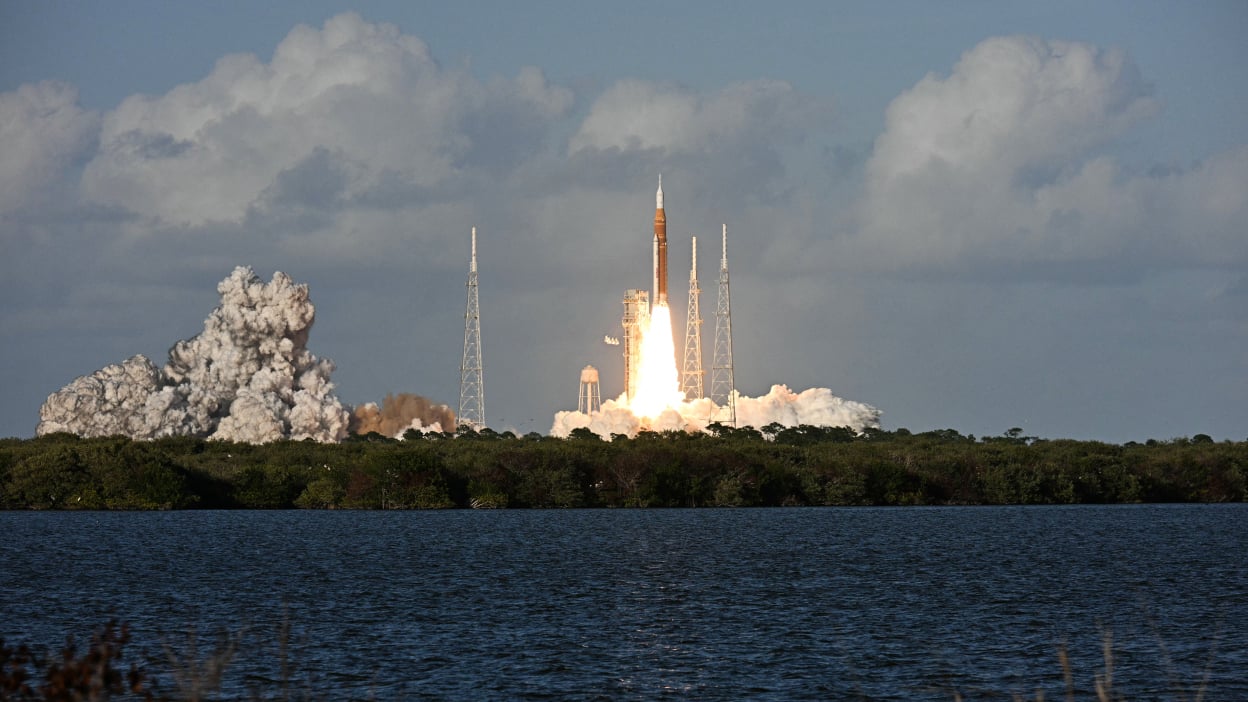
NEWSCENTRAL reports that in 2026, NASA successfully launched the Space Launch System (SLS) rocket with the crewed Orion capsule as part of the “Artemis II” mission. This launch marked the first crewed flight around the Moon in over half a century and represents a significant milestone in the United States’ program to return humans to the lunar surface. The mission is crucial not only for lunar exploration but also as an essential step toward future interplanetary expeditions, including missions to Mars. The Orion spacecraft and the SLS rocket are central to an ambitious program aimed at establishing a long-term human presence on the Moon and preparing for the next steps in space exploration.
The “Artemis” program, which continues the legacy of the legendary “Apollo” program, aims not only to return humans to the Moon but also to build infrastructure on its surface that will serve as a foundation for deeper space exploration, including Mars expeditions. In 2028, NASA plans to land astronauts at the Moon’s South Pole – a region where significant water ice deposits could be found, greatly enhancing the potential for long-duration space missions. Establishing a lunar base will be a key step toward interplanetary flights.
However, the “Artemis II” mission is important not only from a technological perspective but also geopolitically. With China’s active space program rapidly advancing, China is also aiming to land astronauts on the Moon by 2030. This creates additional pressure on the U.S., forcing it to accelerate its program and set ambitious goals for the coming decades. To maintain leadership in space and strengthen its position on the global stage, the U.S. must not only successfully execute the “Artemis” program but also actively pursue cooperation with other countries.
As Freddy Miller, Senior Analyst at NEWSCENTRAL, noted, “NASA’s program has far-reaching consequences for both scientific research and the global space race. The success of ‘Artemis II’ will not only confirm the U.S.’s capabilities in lunar exploration but also serve as a critical step for maintaining space leadership on the international stage, where China is rapidly expanding its program.”
The crew of the “Artemis II” mission is carrying out key tasks, including maneuvering the Orion capsule in deep space conditions and testing all systems for durability. These tests are vital to ensuring the safety of future lunar missions. Despite the successful launch of the SLS rocket, the primary objective of the mission is to verify the reliability of the spacecraft and systems for upcoming lunar expeditions.
The SLS rocket, which cost billions of dollars to develop, is the cornerstone of the “Artemis” program. Each launch of the SLS rocket will cost between $2–4 billion, making the program one of the most expensive in NASA’s history. However, as analysts at NEWSCENTRAL emphasize, despite the high cost, the program is of strategic importance for the U.S. For long-term success, NASA must not only ensure technological readiness but also maintain its space leadership, given the growing competition.
Furthermore, NASA is actively collaborating with private companies such as SpaceX and Blue Origin to develop lunar landers that will be used in future Moon missions. This collaboration helps NASA reduce costs and increase the efficiency of the program’s implementation. “For long-term success, it’s important for NASA to effectively integrate private initiatives like those from SpaceX with government projects,” says Freddy Miller, Senior Analyst at NEWSCENTRAL.
The “Artemis” program will also have significant geopolitical consequences. NASA is not only addressing scientific and technological challenges but is also actively participating in the race for space leadership. Given the rapid development of China’s space program, the U.S. must intensify its efforts to maintain its position in this sphere. The success of the “Artemis II” mission will provide the U.S. with a strategic advantage, and the creation of a lunar base will strengthen its position in the global space race.
In conclusion, despite the high cost and complexity of the mission, the “Artemis” program promises to be a critical step in lunar exploration and preparation for more ambitious interplanetary expeditions. NASA will face numerous challenges, including optimizing costs and improving technologies, but it is crucial to maintain strategic leadership in the international space race. The success of the “Artemis II” mission will be a determining factor in ensuring the U.S.’s competitiveness and laying the groundwork for future Mars missions.
As we at NEWS CENTRAL see it, the successful implementation of the “Artemis” program will not only allow the U.S. to strengthen its position in space but also open new frontiers for humanity, creating the foundation for future research and technologies that will define the development of space exploration in the coming decades.