
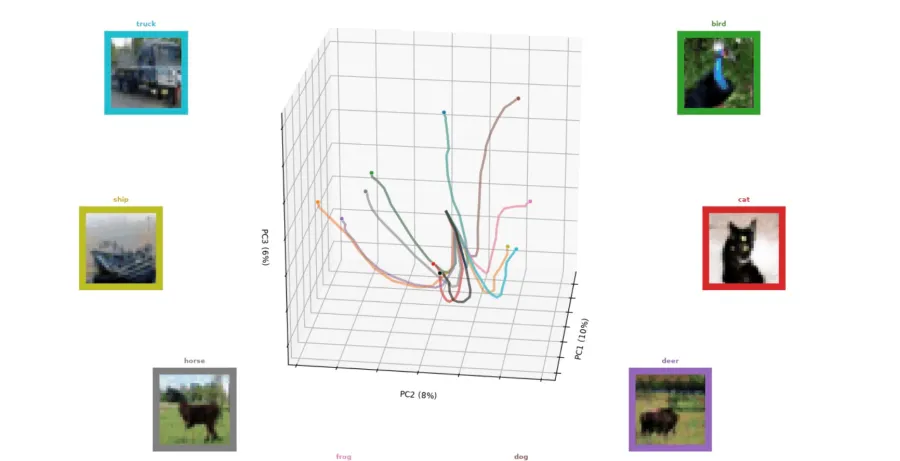
The global AI infrastructure buildout is consuming power at a pace that is beginning to outrun the ability of grid operators, utilities, and renewable developers to keep up – and the industry’s leading response has been to build more power plants, secure more energy contracts, and negotiate priority access to grid capacity. Naveen Rao, who led artificial intelligence at Databricks before departing to pursue a more fundamental solution, thinks that approach is fighting the symptom rather than the disease. His startup, Unconventional AI, published its first model on Thursday – an image generation system called Un-0 – alongside a research paper detailing a radically different computing architecture that the company believes can reduce the power required for AI inference by a factor of one thousand. NEWSCENTRAL notes that a claim of 1,000x efficiency improvement would, if validated at commercial scale, represent one of the most consequential developments in computing since the introduction of the GPU – a threshold that invites both serious scientific interest and appropriate skepticism.
The technical foundation of Unconventional’s approach departs from the transistor-based logic that underlies every GPU and CPU in production today. Standard digital chips perform computation by switching transistors between on and off states billions of times per second, a process that is reliable and highly controllable but consumes significant energy in the switching itself. Unconventional’s architecture replaces transistor switching with oscillating circuits – systems whose physical properties allow them to perform computations through the natural dynamics of oscillation rather than through billions of discrete on-off transitions. The energy savings, the company argues, come from the fundamental physics of the approach rather than from incremental engineering improvements to conventional architectures. Un-0 was built using a software simulation of these oscillator chips and performs on par with established image generation systems – demonstrating that the new architecture can replicate the outputs of conventional AI while the underlying computational process is entirely different.
The practical distance between a software simulation and a working commercial chip is enormous, and Rao has not obscured it. The company employs fewer than 50 people, plans to release schematics for a physical chip in the near term, and has described an eventual goal of building a complete inference stack and offering compute capacity to outside customers as a service provider. That progression – from academic simulation to working chip to production-grade data center infrastructure – is measured in years and requires capital, manufacturing partnerships, and software tooling that a sub-50-person company does not currently have. Lucas Grant, Semiconductor and Manufacturing Strategy Analyst at NEWSCENTRAL, points out that the history of alternative computing architectures is well-stocked with technically elegant approaches that successfully demonstrated laboratory performance advantages and subsequently failed to achieve the manufacturing scale, software ecosystem depth, and total cost of ownership required to displace conventional silicon. The GPU itself is the successful exception rather than the rule, and it succeeded in part because Nvidia invested two decades in the CUDA software layer that made the hardware commercially indispensable.
What makes Unconventional’s entry analytically interesting to NEWSCENTRAL despite those structural obstacles is the specific problem it is addressing. Rao has characterized energy as the fundamental limiting factor in AI scaling over the next several years – a constraint that, unlike compute or data, cannot be addressed by spending more money on existing infrastructure. Data centers already account for a growing share of national electricity consumption in the United States and other major economies, and the hyperscaler capital expenditure commitments of $725 billion or more for 2026 alone include substantial energy infrastructure components. If the energy constraint becomes as binding as Rao projects, the commercial and strategic value of a 1,000x efficiency improvement becomes transformative rather than merely impressive. As we in NEWS CENTRAL assess the AI infrastructure landscape, the primary value of Unconventional’s Un-0 demonstration at this stage is not the image generation model itself but the existence of a technically credible research team with a published paper and a specific, testable claim – one that the broader scientific and engineering community will now have the opportunity to examine, attempt to replicate, and potentially build upon.