
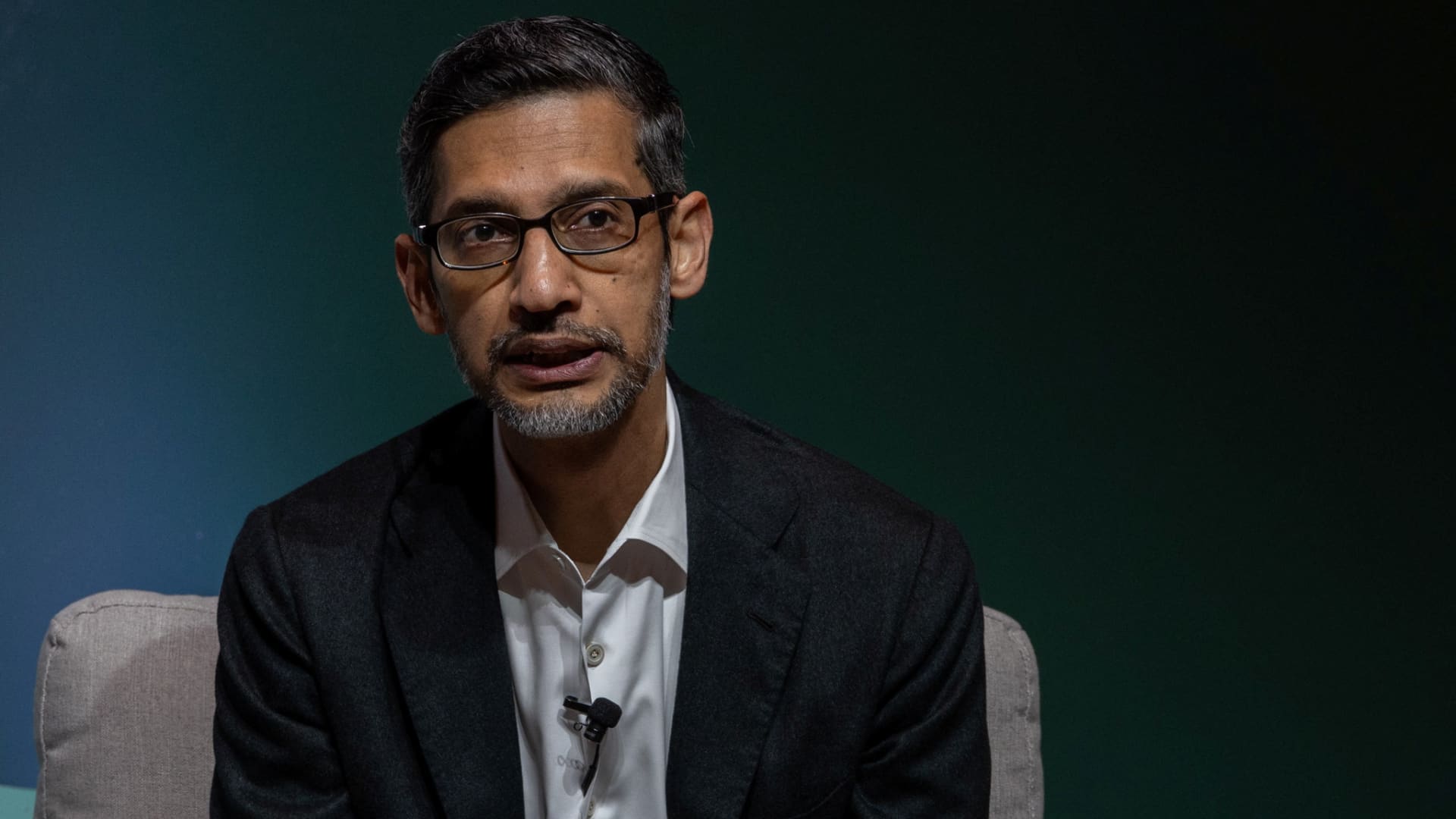
Alphabet shares slid approximately 7% on Monday, on pace for the company’s worst single-session decline in more than a year, after two high-profile AI researchers announced their departures from Google within days of each other. Noam Shazeer, a vice president of engineering and co-lead of the Gemini AI models, disclosed on June 18 that he was leaving to join rival OpenAI. Days later, John Jumper, a vice president and engineering fellow at Google DeepMind who shared the 2024 Nobel Prize in Chemistry for his work on the AlphaFold protein-structure prediction system, announced he was departing for Anthropic after nearly nine years at the company. The combined selloff erased approximately $250 billion in market capitalization. NEWSCENTRAL assesses Monday’s reaction as analytically rational rather than panicked: the market is not responding to two departures in isolation but to what they imply about the durability of the talent advantage that has been central to Alphabet’s AI investment thesis.
The significance of each departure individually would have been substantial; together they constitute a genuinely unusual event in the history of frontier AI. Shazeer is not simply a senior executive who has changed employers. He is one of the co-authors of the 2017 research paper introducing the transformer architecture that underlies virtually every major large language model in production today – at Google, OpenAI, Meta, Anthropic, and across the industry. After leaving Google in 2021 to co-found Character.AI, he was brought back in 2024 through a $2.7 billion transaction designed specifically to secure his continued work on Gemini. Losing him to OpenAI less than two years after spending $2.7 billion to re-acquire him raises a question that no public relations response can fully address: whether Google’s research culture and compensation structures are now consistently unable to retain the people it most needs to keep.
Jumper’s departure adds a second and distinct dimension to that question. AlphaFold, the system he helped develop at DeepMind, predicted the three-dimensional structure of more than 200 million proteins – a scientific contribution that accelerated drug discovery and computational biology research across the world, and that stands as the clearest demonstration that AI can produce genuine scientific value beyond language tasks and consumer products. The 2024 Nobel Prize awarded to Jumper and DeepMind CEO Demis Hassabis for that work was a signal achievement for Google’s research organization. Jumper’s decision to leave for Anthropic, described in his own words as a difficult decision, removes one of the most respected scientific minds in the company from its research leadership. Nathan Clark, Enterprise IT and Systems Architecture Analyst at NEWSCENTRAL, notes that the two departures together send a message about where the most ambitious AI researchers believe the frontier work is happening – a message that is particularly damaging at the moment when Alphabet is asking investors to trust that its $190 billion annual AI capital expenditure will produce durable competitive returns.
The financial context compounds the pressure. Alphabet raised more than $80 billion through equity offerings in early June to fund AI infrastructure, a transaction that introduced dilution concerns that have been weighing on the stock since. Full-year capital expenditure for 2026 is projected at $180 billion to $190 billion, and the CFO has signaled that 2027 spending will increase significantly beyond that level. Those commitments are easier to justify when investors believe Alphabet has unique research advantages that convert compute investment into durable model superiority. They become harder to defend when the researchers most associated with that superiority announce they are joining competitors. The logical question the market is asking is whether Alphabet is building an enduring AI advantage or funding the infrastructure for a commodity market in which the talent moves freely toward whoever offers the most compelling research environment.
Alphabet’s underlying commercial results remain strong. First-quarter 2026 revenue reached $109.9 billion, up 22% year-on-year; Google Cloud reported $20 billion in quarterly revenue, up 63%; operating income grew 30% to $40 billion. The company has world-class researchers who remain, massive distribution through search and Android, and a cloud business whose backlog has nearly doubled quarter-on-quarter. Monday’s stock reaction was compounded by service disruptions affecting Gmail and YouTube, neither of which constituted a primary cause of the selloff but which added operational friction to an already difficult day. Freddy Miller, Senior Analyst at NEWS CENTRAL, argues that the deeper strategic question the departures expose is one that Alphabet has not yet answered convincingly: in a world where leading AI researchers have choices about where they work, what is Google’s case for being the most compelling research environment? The answer used to rest substantially on DeepMind’s scientific culture and reputation. Whether that reputation remains intact, and whether Hassabis can arrest the talent pressure before it becomes a pattern rather than an episode, is what investors will be watching closely before Alphabet’s July 28 earnings.