
The industrial robotics sector is producing a new wave of capital allocation decisions that challenge a foundational assumption of factory automation: that useful robots must be designed around specific, predictable tasks. Barcelona-based Theker has closed what it describes as the largest Series A round in the history of European robotics, securing $85 million in a round led by CRV and backed by Samsung, LVMH through its investment arm Aglaé Ventures, Cathay Innovation, 20VC, Henkel Ventures, and existing investors including Inditex and Kibo Ventures. The conclusion NEWSCENTRAL draws from this transaction is that the market is beginning to reward a genuinely different engineering thesis – one that treats adaptability, not specialization, as the primary industrial virtue.
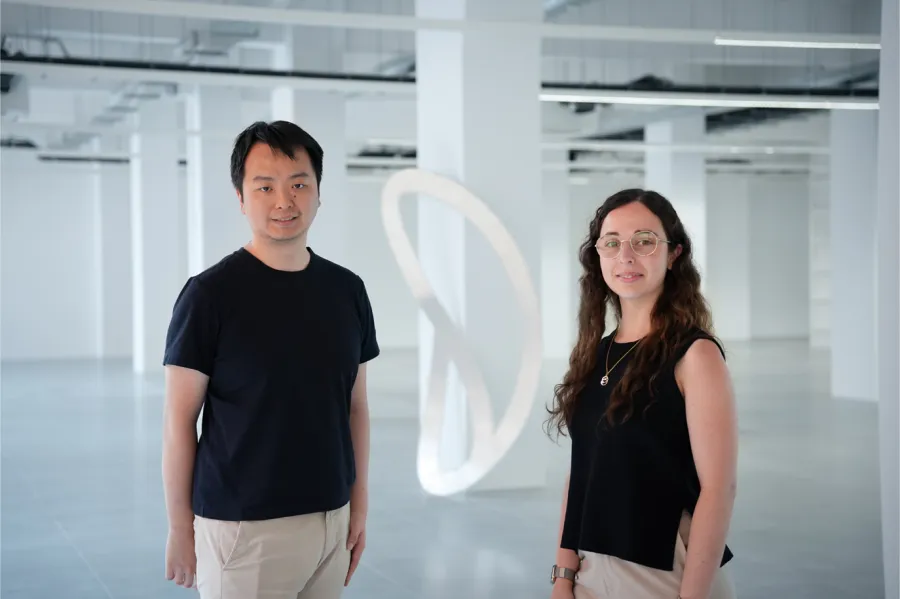
Founded in 2022 by engineers Carla Gómez Cano and Jiaqiang Ye Zhu, Theker has built what it calls AI-native generalist robots: systems that do not require manual reprogramming when environments, product types, packaging formats, or operational conditions change. Where conventional industrial robots are engineered for a defined set of tasks and become expensive liabilities the moment those tasks shift, Theker’s machines are designed to continuously learn in production, deploying within days and improving autonomously over time. Physically, the robots are built for reconfiguration: hands, arms, and overall form can be swapped or resized depending on whether the job involves sorting packages, packing garments, or handling bottles and cans in a logistics facility.
Liam Cortez, Visual Systems Analyst at NEWSCENTRAL, notes that the technical challenge Theker is addressing sits at the intersection of computer vision, real-time control systems, and large language model integration – a combination that previous generations of industrial robotics never attempted to solve simultaneously. The company’s AI stack processes visual input from complex, variable environments and translates it into physical decisions without pre-programmed instructions, a capability that effectively collapses the gap between the controlled conditions in which traditional robots excel and the messy, variable reality of live production. Theker’s robots are already operating inside production environments across Europe, a distinction that matters enormously in a sector where most competitors are still at the demonstration stage.
The investor composition carries its own signal. CRV marking one of its first investments in Spain, Samsung making its first-ever bet on a Spanish company, and LVMH’s investment arm entering the Spanish startup ecosystem for the first time are individually notable; together, they suggest a convergence of recognition that the company has earned rare credibility at an early stage. The early backing from Inditex – the parent of Zara and one of the world’s most operationally demanding retail and logistics operators – indicates that Theker’s technology has already been tested against real-world industrial requirements rather than controlled laboratory conditions.
The global industrial robotics market is valued at approximately $54 billion in 2026 and is projected to reach $94 billion by 2031, growing at a compound annual rate of 11.7%. The primary commercial driver is not technological novelty but persistent labor shortages across manufacturing, logistics, food and beverage, and waste management – industries where the difficulty of hiring and retaining workers has made the economics of adaptive automation increasingly compelling even at premium price points. Theker’s go-to-market positioning targets that structural demand directly, with co-founder Gómez Cano stating explicitly that the company was built to ship robots that work on arrival and improve every day after, not to run pilots.
Freddy Miller, Senior Analyst at NEWS CENTRAL, emphasizes that the distinction between a deployment-first company and a research-first company matters more in industrial robotics than in almost any other segment of physical AI. The performance gap between a robot tested in controlled conditions and one operating reliably in a live production environment is enormous, and most companies that have raised capital in this sector have not yet closed it. Theker’s stated deployment momentum, validated by the strategic backing of operators like Inditex, is the asset that justifies the valuation premium and should be the primary variable investors use to track the company’s progress from Series A through commercial scale.
The $85 million will be directed toward deepening the AI and robotics stack, expanding the team from its current size toward 120 employees by the end of 2026, and accelerating deployments with tier-one industrial operators. Samsung is not yet a customer, but discussions are described as advanced. As NEWSCENTRAL assesses the European robotics landscape – one that now includes Theker, Germany’s RobCo, Stuttgart-based Sereact, and Neura Robotics – the continent is assembling a credible cluster of physical AI companies that collectively challenge the assumption that this category will be defined exclusively by American and Chinese capital and engineering.