
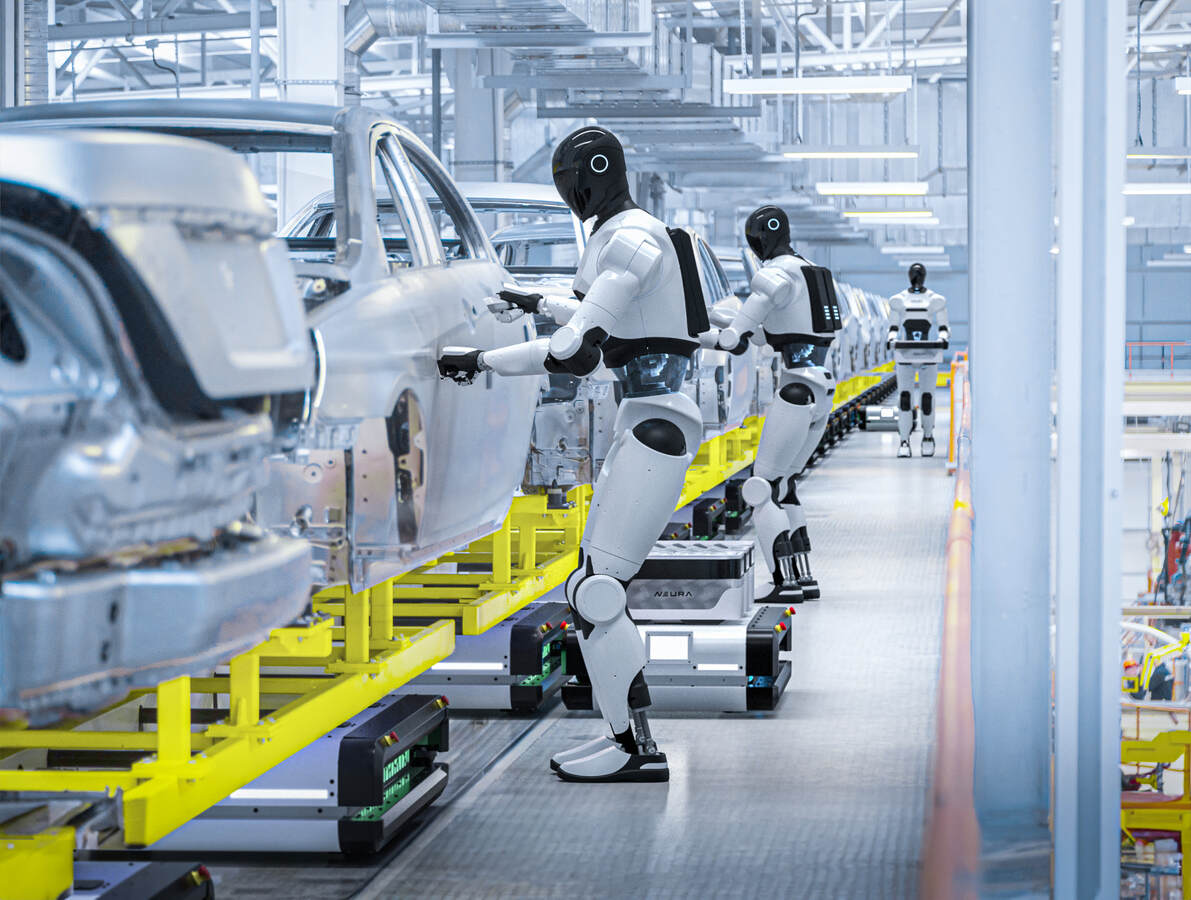
Germany’s Neura Robotics has closed what amounts to a defining moment for European physical AI, securing a Series C financing round of up to $1.4 billion from a syndicate that spans the full architecture of the global technology industry. Amazon, Nvidia, Qualcomm, stablecoin issuer Tether, industrial conglomerates Bosch and Schaeffler, and the European Investment Bank all participated, valuing the Metzingen-based company at approximately $7 billion. Robotics companies globally have raised $55.8 billion in 2026 to date – a figure nearly double the previous annual record – and the majority of that capital has flowed to American and Chinese players. The fact that Europe’s most-funded humanoid robotics company is now a credible participant in that race, backed by the same investors who are simultaneously funding its competitors in other markets, is a development NEWSCENTRAL reads as a structural shift rather than a one-off financing event.
Founder and CEO David Reger has articulated the company’s thesis with deliberate ambition: the future of AI will not be confined to software running on screens but will extend into physical systems that move, interact, learn, and work alongside humans in real environments. That framing – positioning humanoid robots as the natural next layer of AI deployment after large language models established software intelligence – reflects a view now shared by enough major capital allocators to have produced $55.8 billion in sector investment in a single year. Reger has argued explicitly that Europe can lead this wave, a claim that the composition of the current investor syndicate lends material credibility to.
Liam Cortez, Visual Systems Analyst at NEWSCENTRAL, notes that the technical ambition embedded in cognitive humanoid robotics – combining real-time visual perception, onboard AI inference, autonomous navigation, and safe physical interaction with humans in unstructured environments – remains the hardest unsolved problem in applied robotics. Neura’s platform is designed to address that challenge through an integrated architecture rather than a task-specific deployment model, targeting both industrial and service applications. The company’s prior partnerships with HD Hyundai Robotics, GFT Technologies, and Schaeffler have tested that architecture against industrial deployment requirements and produced an order book that reportedly reached one billion euros before the current round closed.
The full funding is contingent on Neura hitting certain undisclosed performance milestones – a structure that reflects genuine execution risk and investor discipline rather than unconditional confidence. Amazon is separately exploring deployment of Neura robots in select fulfillment centers, a pilot that would give the company its most demanding and visible operational test. Neura and Amazon Web Services have also announced a partnership to scale the company’s Neuraverse platform globally. The European Investment Bank’s participation adds an institutional dimension that signals the round is as much a statement about European industrial policy as it is a commercial investment decision.
What NEWSCENTRAL finds most significant in this transaction is the configuration of the investor syndicate rather than the valuation headline. Nvidia connects Neura to the dominant computing infrastructure for AI training and inference at the edge; Qualcomm brings expertise in mobile AI architectures directly relevant to onboard robot intelligence; Amazon provides both capital and the prospect of a scaled deployment partnership that would function as a real-world performance laboratory. That combination pre-validates the technology across hardware, software, and commercial deployment dimensions simultaneously – a structural advantage over competitors that have raised comparable capital from purely financial backers.
Freddy Miller, Senior Analyst, emphasizes that the broader investment trajectory marks a categorical transition in how enterprise buyers relate to humanoid robotics. In 2024, corporate involvement was predominantly limited to pilot programs and minority stakes. In 2026, Amazon, Mercedes-Benz, BMW, GXO Logistics, and others are not exploring – they are deploying. That shift from evaluation to operational commitment accelerates the performance feedback loops that improve robot capability and drives unit economics down across successive product generations. The companies that capture those deployment partnerships now will hold data advantages their later-arriving competitors will find structurally difficult to close.
The competitive pressure will intensify as American and Chinese programs accelerate with comparable or greater capital. Neura’s durable advantage lies in its proximity to European industrial supply chains, its integration with Bosch and Schaeffler’s manufacturing expertise, and its founding architecture as a cognitive platform rather than a single-task machine. As NEWS CENTRAL assesses the sector, the variable that will separate the long-term winners is not balance sheet strength but the speed at which operational deployments generate the performance data needed to justify the next generation of customer orders.