
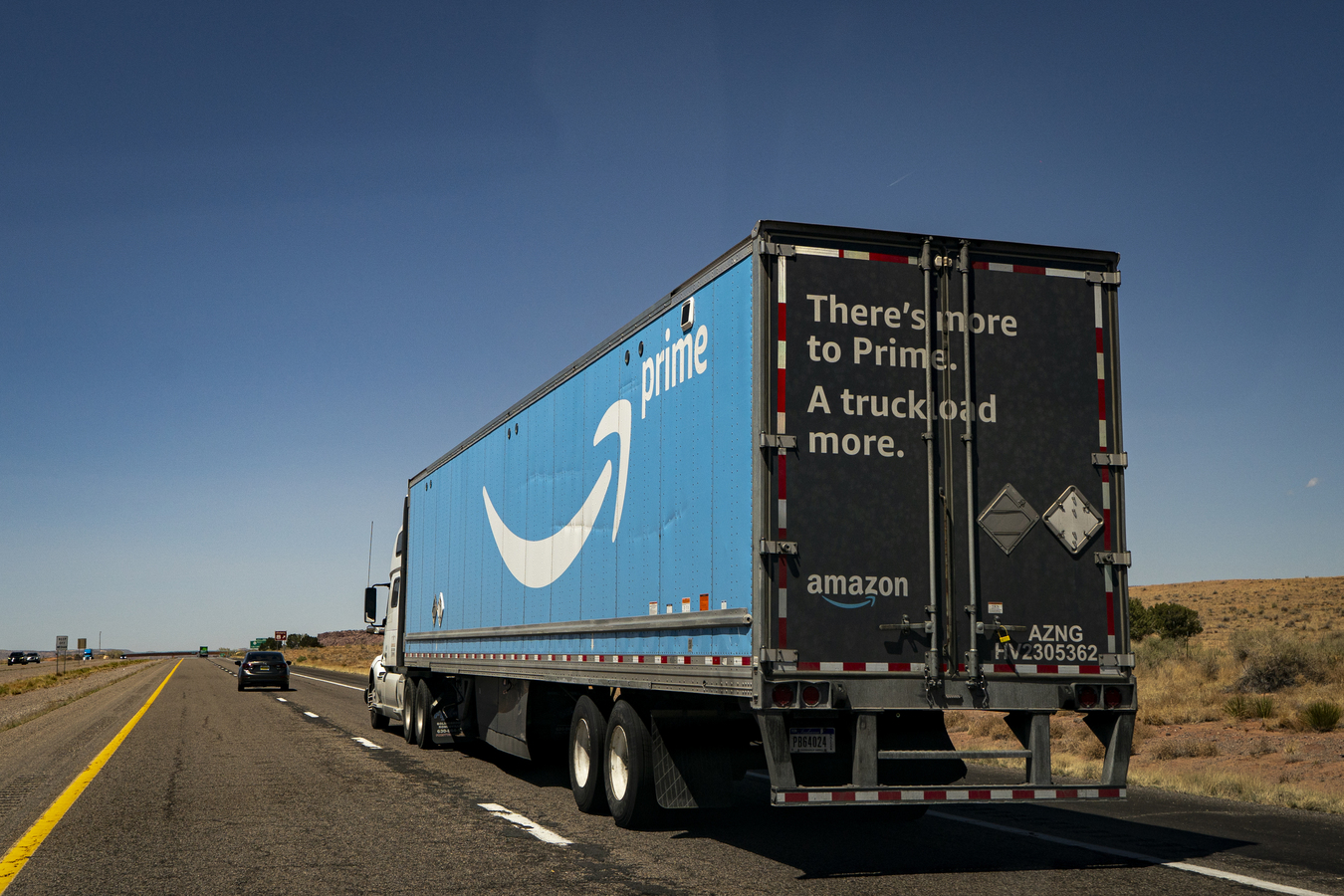
Less-than-truckload freight stocks suffered one of their worst single-session performances in recent memory after Amazon announced that its LTL shipping service, previously available only to sellers and vendors within its own ecosystem, is now open to any business shipping to any destination across the United States. Old Dominion Freight Line fell more than 7%, Saia dropped approximately 8%, FedEx Freight shed around 5%, XPO Logistics lost 4% to 5%, and Knight-Swift declined 5.4%. ArcBest slid 4%. At the opening bell, FedEx Freight and Saia briefly fell as much as 10% before recovering part of those losses by the session’s close. The conclusion NEWSCENTRAL draws from this reaction is straightforward: the market is not pricing in a marginal competitor but a structural disruption to the pricing and volume assumptions that underpin the entire sector’s earnings model.
Amazon Freight has been moving freight within the company’s own network since 2019, serving tens of millions of pallets annually for Amazon selling partners and vendors. The expansion now makes that infrastructure available to any shipper, regardless of their Amazon relationship, with a service specification that directly mirrors the premium tiers of established carriers: next-day live pickup, same-day drop trailer support, real-time GPS tracking via sensor-equipped fleets, cargo camera monitoring, and EDI integration. The logistics backbone underpinning the service includes more than 80,000 trailers and 24,000 intermodal containers. Amazon drew an explicit parallel to the commercial opening of its cloud computing division, which was built for internal use before being offered to external customers and became the dominant enterprise infrastructure platform globally.
That comparison is analytically important and deserves to be taken seriously rather than dismissed as corporate marketing. The cloud analogy is not merely rhetorical – it describes a real pattern in which Amazon has consistently converted internal infrastructure investment into external commercial services once internal scale made the economics viable. Nathanl Clark, Enterprise IT and Systems Architecture Analyst at NEWSCENTRAL, points out that the technology layer embedded in Amazon’s LTL offering will compound its competitive advantage over time in ways that price-matching alone cannot neutralize. Real-time cargo intelligence, route optimization data drawn from daily fulfillment operations across the entire Amazon network, and a captive internal volume base that subsidizes fixed infrastructure costs are structural inputs that no standalone carrier can replicate regardless of capital investment.
The debate among freight industry observers has centered on whether Amazon primarily threatens budget-driven shippers or whether it can eventually compete for the service-sensitive customers that represent the high-margin core of established carriers. A more cautious reading holds that Amazon will attract cost-focused shippers moving lower-value goods and will struggle to match the service consistency of operators who have built their businesses around reliability metrics. That may be true in the near term. What it misses is that Amazon has a documented history of closing service quality gaps in every logistics category it has entered, and that the internal feedback loop generated by its own daily fulfillment operations produces performance improvements at a pace no dedicated freight carrier can match.
Freddy Miller, Senior Analyst at NEWSCENTRAL, observes that Wednesday’s selloff came after a period of strong gains for LTL stocks, which had benefited precisely because Amazon’s earlier logistics buildout was directed primarily inward rather than positioned as direct external competition. That dynamic has now changed in a single announcement. The prior stock appreciation was effectively pricing in a world that no longer exists. For Old Dominion, Saia, and FedEx Freight, the strategic challenge is not to defend current volume but to accelerate the transition to technology-integrated, data-driven service offerings that can justify premium pricing in a market where Amazon’s cost structure will continuously pressure the floor.
The session’s events arrived against a backdrop of broader freight market softness, with several carriers already reporting declining shipment volumes in recent quarters. A new, well-resourced competitor entering during a demand trough is a more serious threat than the same entry during a period of strong industry growth. As we in NEWS CENTRAL contend, institutional investors who discount this move as a near-term disruption with limited long-term consequences are misreading the trajectory of a company that has never entered a logistics segment without intent to lead it – and has never failed to make that intent commercially credible over time.