
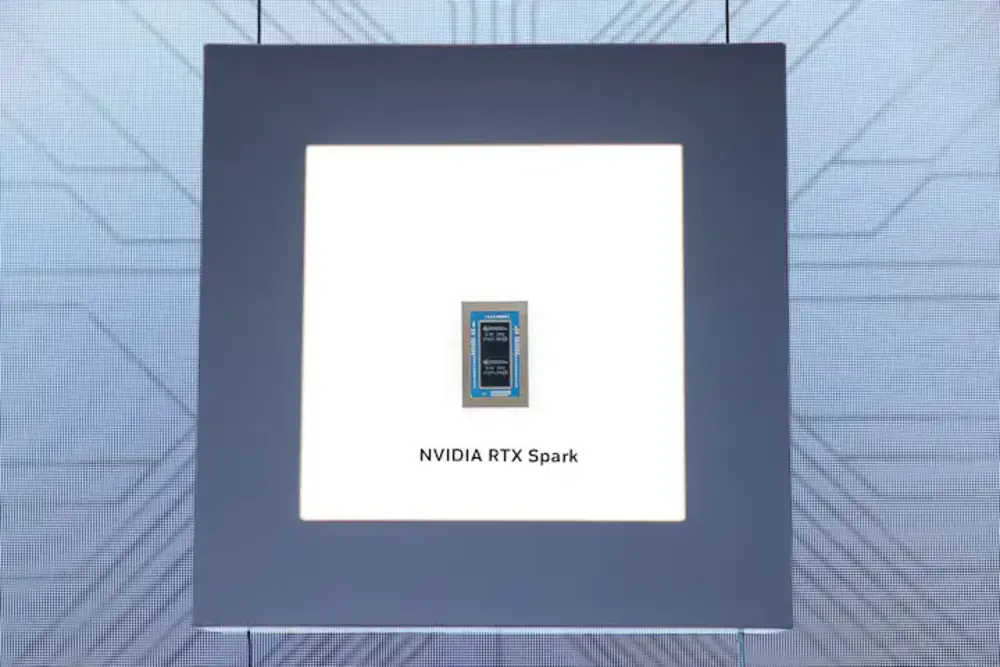
The global personal computer industry is undergoing a tectonic shift driven by attempts by leading chipmakers to move complex neural network computations from the cloud to end-user devices. At the forefront of this process is traditionally Nvidia Corporation, whose dominance in the server segment of artificial intelligence is now undisputed. However, the company’s large-scale expansion into the consumer PC market, marked by the official announcement of the RTX Spark superchip based on the Arm architecture, appears as an ambitious and simultaneously risky bet at Computex in Taiwan. We at NEWSCENTRAL believe this move reflects Nvidia’s leadership’s desire to diversify revenues and create a completely new ecosystem independent of major hyperscalers such as Microsoft Cloud or AWS, although the market itself is currently showing signs of some skepticism.
The presentation of the new technological concept outlined the contours of a future in which premium laptops can autonomously run heavy language models. Company CEO Jensen Huang announced that together with Microsoft they intend to reinvent the PC, transforming the computer from a simple tool into a full-fledged companion. Local digital agents operating without a constant internet connection and external servers are intended to radically change patterns of human interaction with computing technology. According to industry analysts, Nvidia’s strategy here fundamentally differs from current market standards. Instead of the mass consumer, the manufacturer targets a narrow but high-margin segment of software developers, engineers, and professional content creators. We at NEWSCENTRAL see this as a strategically calculated move aimed at undermining the position of Apple Inc., whose top-tier MacBook Pro configurations have long held the status of an irreplaceable working tool for AI specialists and the creative class.
A consortium of major global OEM manufacturers, including Asus, HP Inc., Lenovo, Dell Technologies, MSI, as well as software giant Microsoft with its Surface lineup, has already announced a technological partnership with Nvidia. The companies plan to integrate RTX Spark into their flagship product lines, including creator-oriented laptops such as Asus ProArt P16 and P14, as well as the premium Microsoft Surface Laptop Ultra. This triggered an immediate positive reaction from the stock market and a rise in the share prices of these vendors right after the official announcement in early June. Industry experts from Tirias Research rightly note that the appearance of a new processor does not mean the immediate obsolescence of the existing PC base. Rather, an intermediate class of devices is being created, filling a gap between traditional local workstations and remote data centers.
The RTX Spark architecture, developed in close partnership with Taiwanese developer MediaTek and manufactured on an advanced 3-nanometer process at TSMC facilities, combines a 20-core Grace CPU, a Blackwell GPU with 6,144 CUDA cores, and a unified memory pool of up to 128 GB on a single die. Such a configuration solves a fundamental problem of modern PCs, which are not architecturally suited for fast processing of large neural network weights, delivering performance at the level of 1 petaflop. According to developers, this will allow local execution of models with 120 billion parameters and a context window of one million tokens, automating complex real-time tasks from 4K media generation to automatic code debugging. It is known that Adobe is already redesigning its popular Photoshop and Premiere packages from scratch for this architecture to achieve a twofold performance increase. As Senior Analyst at NEWSCENTRAL Freddy Miller notes, this initiative is a direct consequence of commercial disappointment with the first generation of smart computers. Previous solutions based on Arm and Qualcomm chips, actively promoted over the past two years, were limited to basic features such as intelligent noise cancellation, background blur, and simple retouching, which ultimately failed to trigger a mass upgrade cycle among retail users.
The main obstacles to Nvidia’s expansion remain economic factors and logistical barriers. High production costs combined with an ongoing shortage of advanced memory components will inevitably lead to more expensive end devices, limiting their distribution to the premium segment. Forecasts from TECHnalysis Research confirm that, despite media attention, the bulk of PC sales in the medium term will remain in the classic x86 architecture ecosystem running Windows with Intel and AMD processors, as well as energy-efficient Qualcomm solutions. Notably, the previously observed stock growth of Dell and HP by 223% and 18% respectively was driven not by consumer AI demand but by large-scale upgrades of corporate IT infrastructure to Windows 11 and surging demand for high-performance server systems for data processing.
The current market environment adds uncertainty to corporate plans. HP management has already warned investors about a potential slowdown in consumer electronics growth in the second half of the year, despite stable demand for smart enterprise systems. The overall industry outlook remains moderately pessimistic. According to IDC, global PC shipments in 2026 may decline by 11.3%, forcing manufacturers into intense competition for every paying customer.
In the context of direct competition with Apple, energy efficiency will be just as important as synthetic benchmark performance. Early leaked performance tests indicate that individual Grace cores may lag behind Apple’s latest M5 series or Qualcomm’s Oryon cores, forcing Nvidia to rely primarily on the power of its Blackwell GPU. Nevertheless, Nvidia plans to reveal detailed specifications regarding device battery life closer to the commercial launch in autumn, promising ultra-thin bodies from 14 millimeters and all-day operation. The shift to a unified memory architecture erases the technological advantage of Apple Silicon chips, which have used this approach since 2020 to minimize latency in data transfer between CPU and GPU cores. According to IDC representatives, this will prompt many corporate IT departments to begin pilot purchases of new systems to evaluate the long-term effectiveness of local task execution.
Based on a comprehensive analysis of market indicators, we forecast that the introduction of the RTX Spark platform will not lead to an immediate revolution in mass sales but will reshape the landscape of professional workstations. The real challenge for the Windows ecosystem will be the need to adapt legacy software via Microsoft Prism emulation, which may initially reduce net performance. The main risk for Nvidia lies in a potential gap between the hardware capabilities of the superchip and the actual readiness of software developers to deliver market-ready products that justify the high purchase price, which is preliminarily estimated to start at $4,000. We at NEWS CENTRAL advise institutional investors to remain cautious and evaluate the stock dynamics of Nvidia’s technology partners not by early shipment volumes of hardware in the first quarters, but by the speed of maturation of the local software ecosystem, which will ultimately define the boundaries of applicability for this new category of personal computers.