
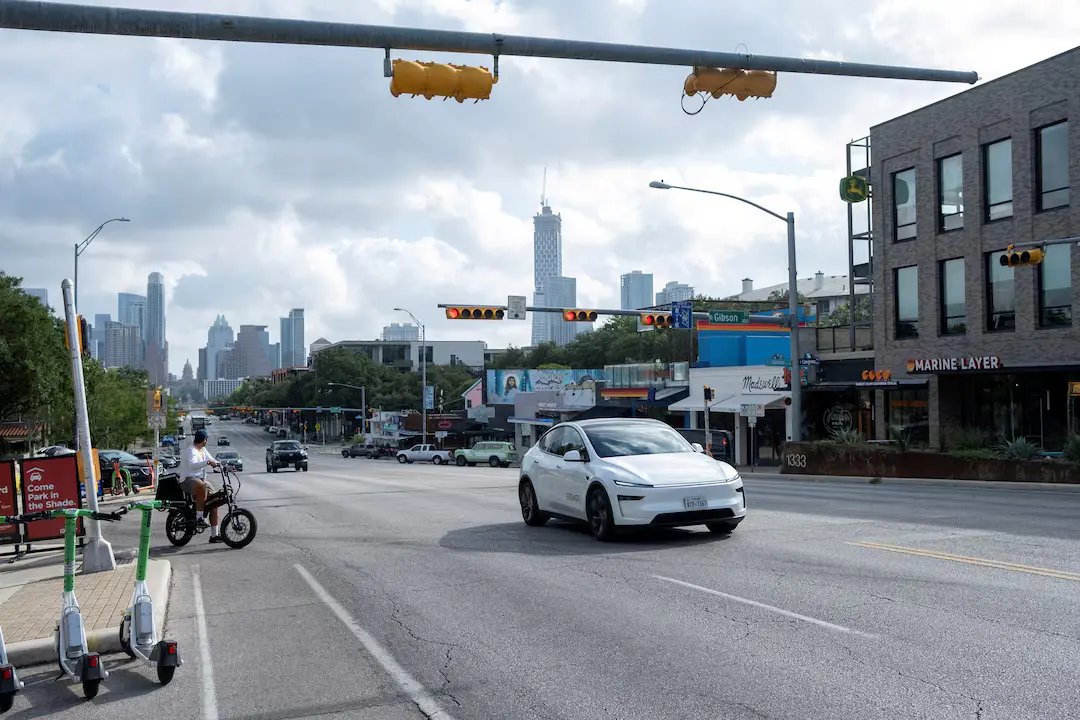
The deployment of Tesla’s fully autonomous robotaxi service in Austin marks a tectonic shift in the automaker’s operational structure. We at NEWSCENTRAL view this step as a long-awaited transition from promises to the commercial execution of Elon Musk’s grand strategy to transform a classic car manufacturer into a global player in the artificial intelligence and autonomous transport systems market. This event unfolds under colossal pressure from the investment community, which demands the monetization of self-driving technologies amid a general cooling of demand for traditional electric vehicles.
The official launch of the driverless service across the entire territory of Austin confirms the company’s readiness to move the project from the closed beta testing phase to public operation. Analysts at our publication emphasize that the choice of Texas as a launching pad is driven by an exceptionally loyal regulatory environment, where local legislation minimizes administrative barriers for autonomous vehicles.
At the same time, the first results of real-world service operation, which has been functioning in the city for about a year, have revealed serious infrastructural challenges, including vehicle dispatch delays exceeding 30 minutes during peak hours. In our opinion, such a lengthy wait time indicates a critical shortage of active vehicles on the line and unrefined dispatching algorithms. At this stage, Tesla significantly lags behind traditional passenger transport services and ride-hailing aggregators in operational efficiency.
Austin municipal reports indicate that Tesla’s local autonomous fleet consists of only about 50 units, whereas the competing Waymo service from parent company Alphabet already operates a fleet of more than 250 vehicles in the same area. As noted by NEWSCENTRAL Senior Analyst Freddy Miller, this fivefold numerical gap exposes a fundamental conceptual difference between the two approaches. Waymo uses multi-layered data redundancy through lidars, radars, and high-resolution HD maps, while Tesla relies exclusively on Full Self-Driving optical vision and end-to-end neural networks. Such a bet on pure computer vision complicates rapid scaling, requiring a gigantic volume of computations and real-world mileage to validate safety in edge-case road scenarios.
Ambitious statements from Tesla leadership regarding their readiness to launch fully driverless rides without a safety driver across the entire US at the end of this year provoke justified skepticism within the professional community. We are skeptical about such tight deadlines for federal expansion, considering the strict stance of the National Highway Traffic Safety Administration and regulators in key states like California. Nevertheless, the parallel expansion of testing zones to Dallas and Houston confirms the company’s intention to form a dense southern economic cluster before expanding to the coasts. The situation is further intensified by the presence of powerful Asian players, particularly China’s Baidu Apollo Go platform, which operates large-scale driverless fleets in the PRC and is preparing for expansion into external markets, forcing American developers to accelerate their testing schedules.
In the end, the viability of Tesla’s commercial model will directly depend on the engineers’ ability to reduce the frequency of critical errors and increase vehicle density per square mile. We at NEWS CENTRAL predict that the deployment of a fully-fledged infrastructure will require colossal capital expenditures on technical hubs and computing power. Our recommendation for investors is to maintain a moderately balanced position, as Tesla’s obvious technological advantage in visual data processing will be offset by high operational costs and fierce competition with Waymo, which will limit the segment’s profitability in the medium term.